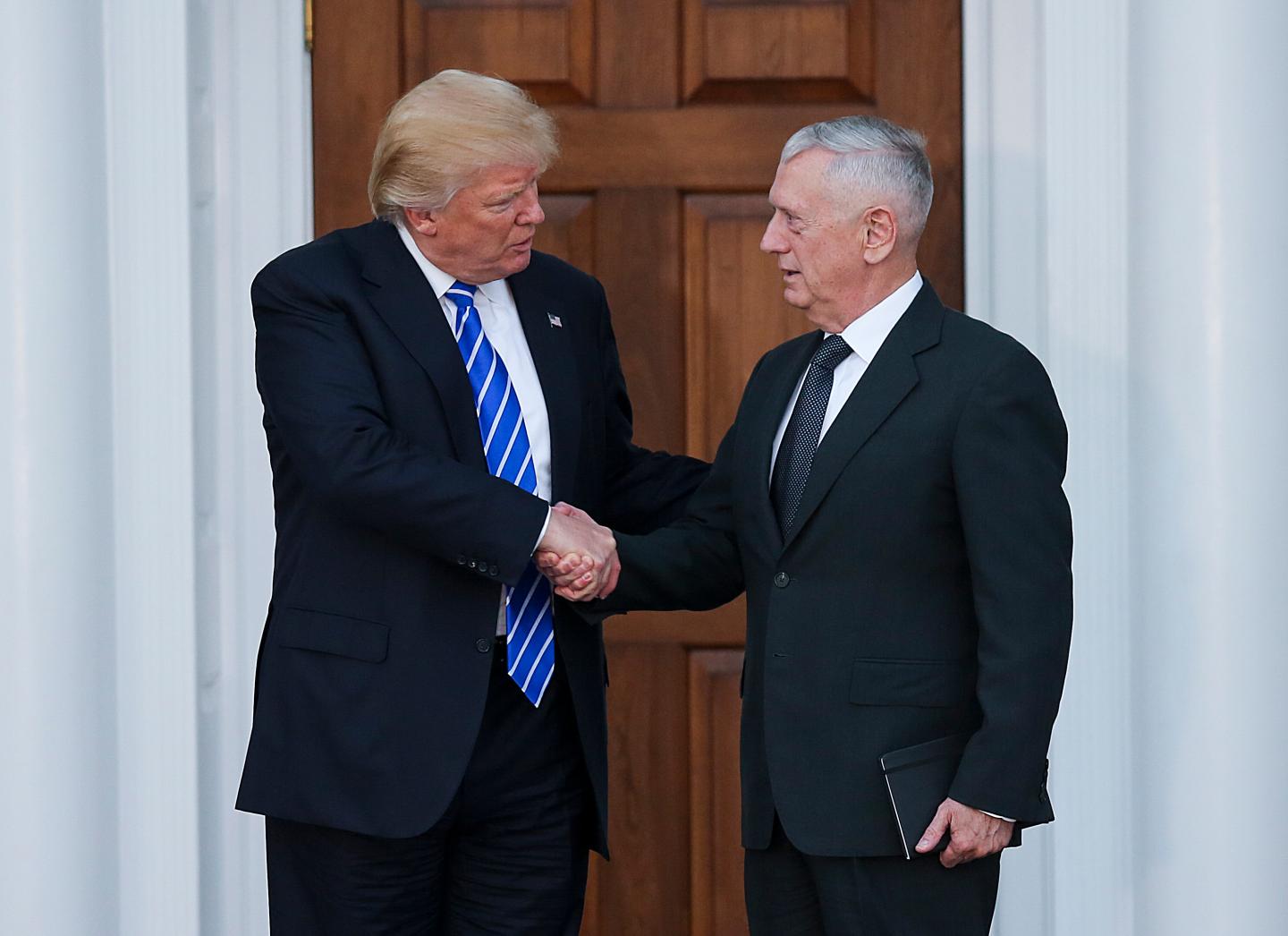
Last April, retired Gen. James Mattis stood in front of an august audience at the Center for Security and International Studies in Washington and declared, “The Iranian regime, in my mind, is the single most enduring threat to stability and peace in the Middle East.” This was quite a statement, given the challenges posed by ISIS, Al Qaeda, the Syrian civil war, and Russia’s first military intervention in the Middle East in 30 years. But for Mattis, the priority was crystal clear: Iran.
Fast forward six months, and President-elect Donald Trump has nominated Mattis to be the next U.S. secretary of defense. Ironically enough, the man who places such a high priority on countering Iran’s bad behavior may turn out to be one of the new administration’s biggest supporters of the Iran Nuclear deal that aims to curb the country’s nuclear programs, which Trump criticized throughout his presidential campaign.
To understand why, it’s worth taking a closer look at his military background. Mattis’s focus on Iran is shaped by the U.S. military’s experiences over the past 35 years. The 1983 Marine Barracks attack by Iranian-sponsored Hezbollah bombers killed 241 service members, leaving an indelible mark, especially for Marines such as Mattis. The 1996 Khobar Towers bombing in Saudi Arabia, sponsored by Iran, killed 19 Americans. And most recently, Iranian-armed Shia proxy groups in Iraq were responsible for roughly 1,000 American fatalities during the eight years of the Iraq War.
While many American diplomats have their own searing experiences with Iran from the days of the hostage crisis in the late ‘70s and early ‘80s, they have, over the years, been exposed to the softer side of the regime through urbane, western-educated Iranian diplomats, such as those who negotiated the nuclear agreement. But for Mattis and his military colleagues, their interactions with Iran since 1979 are almost exclusively violent episodes with the darker elements of the regime, leading to extreme skepticism inside the Pentagon about Iranian intentions.
Mattis’s views on Iran were likely reinforced during his time as the head of the United States Central Command from 2011 to 2013, as he was responsible for all American military forces in the Middle East. Much of Mattis’s time focused on building relations with Gulf Cooperation Council partners, who host an American military presence critical for U.S. operations in Afghanistan, Iraq, and across the Middle East. And while the leaders in these countries each have their unique perspectives, almost all perceive Iran as the greatest threat to their security.
Mattis’s critiques of the Obama administration are not about how it addressed the nuclear file, but about how it did not address the threats posed by Iran’s regional behavior. At his April talk, he did not support dismantling the nuclear agreement, instead stating that short of a major violation by Iran, a new president will not be able to walk back the deal without isolating the United States and strengthening Iran.
Instead of killing the deal, Mattis is likely to advocate for a harder line on other Iran-related issues. First, he will push for a firmer stance on Iran’s provocations in the crowded waters of the Persian Gulf. In recent months, there have been a number of dangerous incidents due to problematic behavior from the Islamic Revolutionary Guard Corps Navy, including an Iranian patrol boat pointing its guns at an American helicopter.
This doesn’t mean he’ll recommend shooting Iranian ships out of the water, but rather to draw firm lines for Iran about the consequences for such actions, and to follow through if Iran crosses those lines. In early 2012, when Iran stopped and boarded a number of international ships going through the Strait of Hormuz, and Secretary of Defense Leon Panetta publicly stated this was a redline that could lead to an American military response, the IRGC-Navy quickly pulled back. Mattis’s reputation and Trump’s unpredictability will make such an approach even more effective going forward. The Iranians don’t want a direct conventional fight with the United States in the Gulf, and will thus think twice before testing Mattis.
More difficult will be responding to Iran’s training and arming of surrogates and proxy forces, including Shia militias in Iraq, Hezbollah in Lebanon, the Assad regime in Syria, and the Houthis in Yemen. This activity, which is spearheaded by Iran’s elite paramilitary units—the IRGC Quds Force—is the biggest concern for America’s Arab partners. The challenge in developing an effective response is how to send a resolute signal to Tehran that the United States will contest Iranian meddling in the affairs of other states, but to ensure that the American response is proportional and avoids escalation to a major military conflict.
During my time at the Department of Defense, very few current or former senior American officials have spent as much time thinking about these types of responses as Mattis, who made this question one of his primary focuses as commander of the United States Central Command. Some examples include more aggressively interdicting illegal arms shipments around the region and exposing those shipments in a high-profile fashion that embarrasses Iran. For example, my guess is that it wouldn’t be surprising to see Mattis standing beside an array of Iranian weaponry that was being illegally smuggled to Syria or Yemen in contravention of UN Security Council resolutions.
The United States could up the pace and scale of military exercises in the region and advertise them publicly, not as routine military maneuvers, but as steps specifically designed to counter Iran. And the Trump administration could find discrete ways to expose, arrest, or even eliminate some Iranian Quds Force members who are supporting particularly nefarious activities.
Taken together, these steps could have a useful deterrent effect on an Iranian leadership that tests the boundaries of American patience, but has no interest in a major direct military confrontation with the United States that it would certainly lose.
And these policies can all be executed while continuing to adhere to the commitments in the nuclear agreement—a proposition that President-elect Trump may find appealing. Trump has put a high priority on improving ties with Russia, which would oppose tearing up the JCPOA and vehemently object to major U.S. military action against Iran’s nuclear program that may follow.
Having billed himself as a job creator, Trump will not want to walk away from the multi-billion deal Boeing (BA) just inked for civilian commercial aircraft with Iran. And he has prioritized quickly defeating ISIS, a difficult proposition in a world in which we are heading toward a major new conflict with Iran over its nuclear program.
Mattis’s ability to think in subtle shades of gray but express himself in colorful black and white language may be a tremendous asset in communicating this new strategy to the president-elect, as when he recently convinced Trump to reconsider his approach toward torture by explaining: “Give me a pack of cigarettes and a couple of beers and I do better with that than I do with torture.” Mattis can probably convince him that pushing back on Iran’s other regional behavior will allow him to fulfill two campaign promises: getting tougher on Iran while avoiding a major new quagmire in the Middle East.
Still, it is also quite possible that Mattis’s more nuanced approach loses out and a Trump administration walks away from the deal. And even if Trump chooses not to actively sabotage the JCPOA, the tough talk from the president-elect and his advisors could sew Iranian distrust and bad blood that ultimately kills the agreement. In these scenarios, Mattis’s role would become even more important, as the Defense Department quickly shifts to deterring Iran from moving to a nuclear weapon, and offering the president military options should Iran begin taking aggressive steps toward a bomb.
Either way, Mattis is primed to play a major role in U.S. policy toward Iran. The only question is whether it will be to guide the Trump administration toward a hard-nosed but pragmatic policy, or instead pick up the pieces after the collapse of the Iran agreement and start preparing for war. Let’s hope it’s the former.
Ilan Goldenberg is the Director of the Middle East Security Program at the Center for a New American Security. He previously served as Iran Team Chief in the Office of the Secretary of Defense.