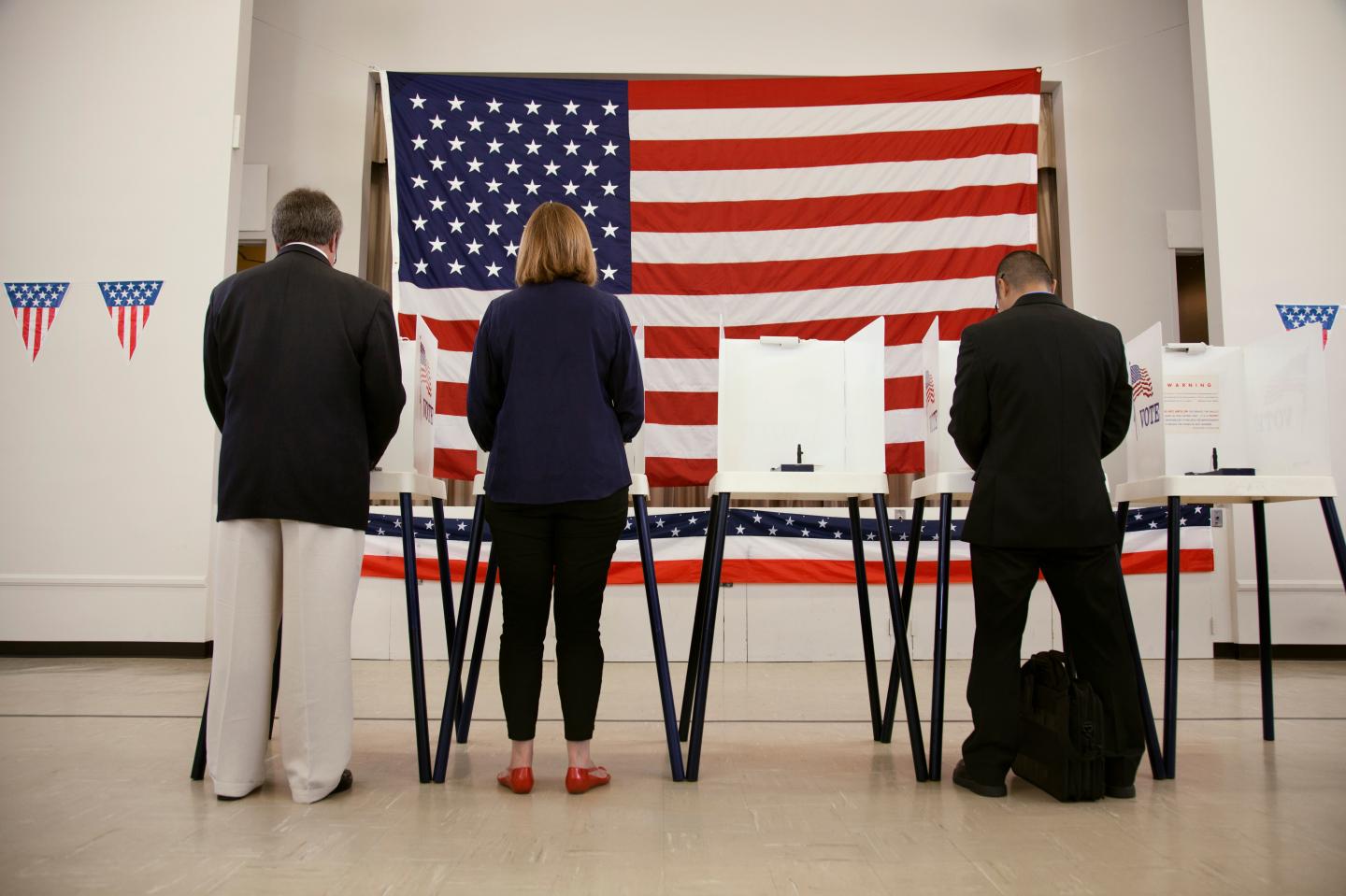
Just when the right to vote, so cherished and so disputed, seem entrenched around the country, a new chapter in the long-running battle to secure it has opened. That chapter is unfolding in North Carolina, which holds its presidential primaries on March 15.
In a matter of weeks, a federal judge in the state will decide whether to uphold or repeal new state requirements for photo identification from citizens who want to vote. The requirements are controversial, as some see them as an effort to curb African-American and Hispanic voting participation just as these groups are becoming a larger portion of the overall voter population.
No matter the outcome, the case is likely to be regarded as a harbinger of whether enfranchisement applies to every eligible citizen, or whether it can be circumscribed as it has often been in the country’s past. In recent years, more than a dozen states, including Kansas, Texas, and Wisconsin, have adopted new voter identification laws. And Florida and Ohio have curbed early voting.
This shift, Ari Berman writes in his new book, Give Us the Ballot, The Modern Struggle for Voting Rights in America, gathered steam at the state level after the U.S. Supreme Court upheld Indiana’s new voter identification law in 2008.
Like-minded state legislatures began adopting such restrictions at a greater pace after President Barack Obama’s first election. In North Carolina, a high turnout among African-American and young voters helped him win the state’s 15 electoral votes and become the first Democrat to carry the state in 32 years. Four years ago, black voter turnout exceeded that of white voters for the first time, according to the U.S. Census Bureau.
In adopting the changes, Berman says states often used a legislative template provided by the national conservative group, the American Legislative Exchange Council. And this occurred despite a lack of evidence of substantial voter fraud, he argues in his book, published last year.
According to Berman, a writer for the liberal magazine The Nation, there has been a “concerted effort” to redirect the voting population away from the young and diverse to an electorate that is “older, white and more conservative.”
The push to place stricter requirements on voters comes on the heels of a nearly unanimous vote, less than a decade ago, to renew the landmark Voting Rights Act of 1965, which was aimed at eliminating voting obstacles like literacy tests and poll taxes.
Only seven years later, in 2013, the Supreme Court invalidated parts of the Voting Rights Act, thereby clearing the path for state legislatures to seek ways to curb access to the ballot. With the Supreme Court’s decision, political jurisdictions with histories of racial discrimination, largely in the South (and including more than one-third of North Carolina’s counties), were no longer required to gain federal approval before changes to their voting procedures.
In altering access to its voting booths, North Carolina’s majority Republican legislature cited a need for safeguards against voter fraud. Prospective voters must now show one of six types of credentials or file a provisional ballot, which is less certain to be counted as valid. Lawmakers also scaled back early voting, halted same-day registration during the early voting period, and stopped preregistering teenagers who would be 18 by election day.
Defending the changes when he signed them into law, the state’s Republican governor Pat McCrory noted that “common practices like boarding an airplane or purchasing Sudafed require photo ID, and we should expect nothing less for the protection of our right to vote.”
When the changes were challenged, the case went to trial in Winston-Salem last month. There, Michael A. Glick, a lawyer for North Carolina’s chapter of the NAACP, told the judge that the state “has engaged in a game of whack-a-mole with one of our most basic constitutional rights.”
In addition, the Justice Department maintains that such restrictions are out of bounds because the Voting Rights Act has another provision—which was not negated by the Supreme Court—that bars any “standard, practice or procedure” that has the effect of denying or abridging “the right of any citizen of the United States to vote on account of race or color.”
State lawyers have insisted that lawmakers had no sweeping goal of disenfranchising voters, but a report they provided showed that as many as 224,800 of the state’s 6.4 million registered voters lacked the required identification. The report also found that black voters were more than twice as likely as their white counterparts not to have the necessary identification because of economic and other barriers to obtaining it.
Lawyers for the state also highlighted the subsequent amendment to the law—passed as the trial was looming—that allows voters to cast a provisional ballot along with a declaration of why they lack the requisite identification, such as a disability or lack of transportation. The state’s motor vehicle division is charged with providing free identification cards for those who need them to vote, the state maintained.
Witnesses told presiding Judge Thomas D. Schroeder that short staffing at the state’s motor vehicle division and glitches such as typographical errors on birth certificates impeded the ability of many to obtain the necessary identification and, in effect, hampered their right to cast a ballot.
Schroeder, an appointee of former president George W. Bush, has thus far refused to grant the challengers’ request for an injunction to temporarily stop the voter requirements from taking effect. He said they had “failed to clearly demonstrate they are likely to succeed on the merits.”
Even so, he noted that “the right to vote is fundamental” and needs to “be freely available.”
Barring a speedy ruling, the new requirement is likely to be in effect when early in-person voting for the upcoming presidential primary begin on March 3.