• Home
  • Latest
  • Fortune 500
  • Finance
  • Tech
  • Leadership
  • Lifestyle
  • Rankings
  • Multimedia

Trendingnow

1

As Big Tech showers employees with perks to win the talent war, Nvidia built a nearly $5 trillion company by making people pay for their own lunch

2

Mark Zuckerberg feeds his cows macadamia nuts and beer to create the 'highest-quality beef in the world' on his $300 million estate in Hawaii

3

Today, Emily Blunt is worth $80 million thanks to her Hollywood career—but she actually wanted to be a UN Spanish translator on $80K

1

As Big Tech showers employees with perks to win the talent war, Nvidia built a nearly $5 trillion company by making people pay for their own lunch

2

Mark Zuckerberg feeds his cows macadamia nuts and beer to create the 'highest-quality beef in the world' on his $300 million estate in Hawaii

3

Today, Emily Blunt is worth $80 million thanks to her Hollywood career—but she actually wanted to be a UN Spanish translator on $80K
CommentaryChina

Why China’s economic slowdown is good news for the middle class

By
Peter Hilsenrath
Peter Hilsenrath
Down Arrow Button Icon
By
Peter Hilsenrath
Peter Hilsenrath
Down Arrow Button Icon
October 15, 2015, 9:15 AM ET
CHINA--STOCKS-NOON
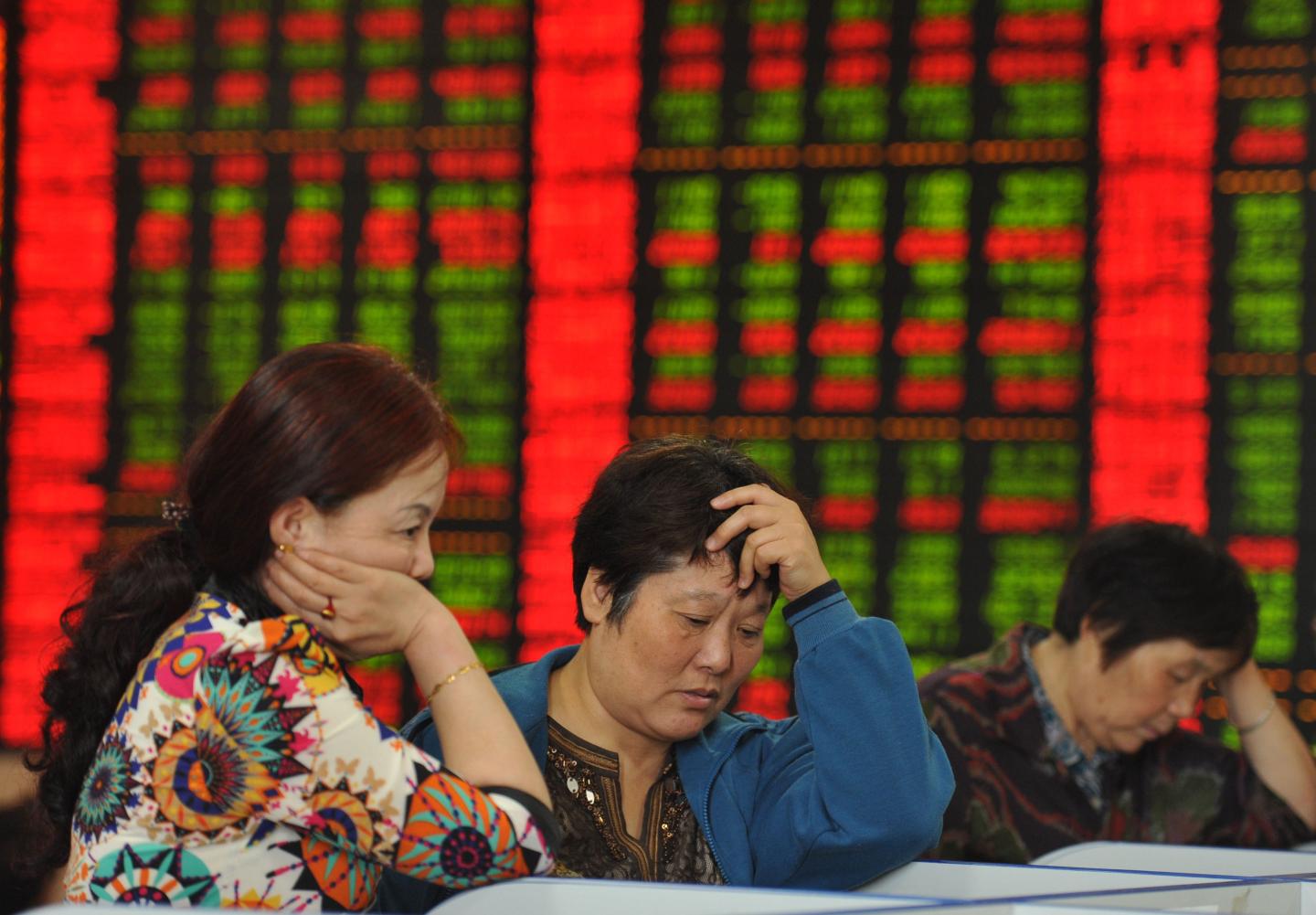
Investors check share prices in a stock firm in Fuyang, east China's Anhui province on June 29, 2015. Chinese shares plunged in morning trading on June 29, extending losses from the past two weeks despite a surprise interest rate cut at the weekend. AFP PHOTO CHINA OUT (Photo credit should read STR/AFP/Getty Images)Photograph by AFP/Getty Images
Add Fortune on Google for similar content.

It’s too easy to think China’s economy is in a downward spiral, given recent headlines in the U.S. press, from “China’s Middle-Class Dreams in Peril” to “Is China Really Collapsing?” The world has been awash with such pessimism. And fumbled reactions by China’s leaders to disasters, excessive financial speculation and other problems raise concerns about governance. It may even raise questions of long-term stability.

A transition away from a reliance on exports toward consumption and services is under way, as well as the rapid creation of a middle class. It is not an easy or smooth transition, and financial markets around the world have been disturbed, most recently when China’s stock exchange boomed and then crashed, and indexes like the Dow Jones seesawed by thousands of points in a matter of days.

Economic growth in China has long been premised on high levels of savings and investment, growth of manufacturing and exports, migration of low-productivity rural workers to higher-productivity urban jobs and integration of new technologies. These trends could not be sustained, and as a result growth is slowing. But that’s not a bad thing and not so unlike the economic history of developed economies of the U.S., Europe and Japan. It’s also a long path that will require more effective leadership and greater openness than we’ve seen thus far. The question is, how well can Chinese leaders manage in this new environment, and will they be able to find a better way forward?

The focus of my research is in the health care industry, but I also explore broader economic themes and history. During a recent half-year sabbatical in China, I had the opportunity to search for answers to these questions, with the management of its health care industry as a prism.

In search of the Chinese dream
The Chinese have been through a lot. After devastating famine in the late 1950s followed by social upheavals of the Cultural Revolution in the ’60s and ’70s, China turned to a more pragmatic approach to economic development when Deng Xiaoping ascended to power at the end of that period. The market approaches he ushered in have delivered remarkable gains, and never have so many people become so prosperous so fast. Half the country is now urban and half of them are middle-class, a stark change from even 37 years ago, when 82% was rural. Today China’s economy is already larger than the U.S. in terms of purchasing power parity.

Continuing that process of transformation from a state-run economy to consumer-driven capitalism presents challenges for both future growth and the Communist Party. Rapid gains in productivity are easier to achieve in manufacturing than services. But the fast-paced and often double-digit growth that propelled such prosperity can’t be maintained as services become a larger share of the economy.

Chinese leadership, perennially concerned about stability, has acknowledged the necessity of economic deceleration and is orienting its companies and citizens for slower growth. The shift to services is part of a planned process. The reward for slower income growth is better for environmental quality and an improved social safety net. This shift also underpins a more vibrant middle class that is an increasing source of strength. But this growing segment of the population has aspirations not dissimilar to the “American Dream,” with a nice home, car and college education for their children.

And now there are concerns that growth will decelerate into stagnation and China will fall into a middle-income trap, with weak manufacturing, exports and construction. Increasing services provides a substitute for these sectors. But over the long run, services must also improve productivity to drive the economy. This underscores the need for governance and institutions capable of generating more efficient services over the long haul. Can China reinvent these sectors in ways that have eluded developed countries?

Health care’s transition
The health sector is an interesting case in point. It was all but abandoned by the state when China liberalized in the ‘80s and ’90s. Hospitals and other health care organizations were largely left to cover their own costs. The safety net for health services, especially in rural areas, fell apart. The threat of medically related financial ruin loomed large over Chinese families, and the World Health Organization ranked Communist China 188 out of 191 countries in terms of fairness in financial contribution.

Chinese leadership, after realizing mistakes had been make, in the early 2000s set a new course, which included schemes to provide health insurance for all. I have spent much of 2015 in Shandong Province researching China’s shift toward a consumption-based economy. In particular, I looked at the effect of improved health insurance on precautionary savings and household consumption. Urban and rural Chinese now have health insurance entitlement programs, and the government is opening the sector up more toward private providers, more skilled health care managers are being trained and public health infrastructure is improving.

Yet insurance remains limited largely to hospitals that cap payouts with high copayments. Much more needs to be done to improve the system over the long run to encourage both efficient production and consumption. The sector remains over reliant on hospitals and has relied on overprescribing drugs to generate revenues. There are parallel systems of Western and traditional medicine and problems of coordination throughout.

The macroeconomic potential of health insurance is to reduce savings, increase consumption and stimulate growth as part of the shift to a service economy. This is not yet happening in an unambiguous way, perhaps in part because health care prices are rising to offset the benefits of health insurance. The health care sector, with some promising green shoots, is emblematic of China’s economy as a whole as it slogs toward one based on consumption and services.

Challenges and opportunities
Improving productivity will be difficult given institutionally entrenched interests and culture. The ability of the Communist Party to navigate such waters is uncertain. A rising middle class will expect results but can also be a source of stability as a buffer absorbing and facilitating necessary reform. China’s neighbor and rival Japan experienced rapid economic growth both before and after World War II. It built a prosperous high-consumption society that hit a wall of stagnation around 1990. The world survived this downshift and so has Japanese democracy. China still has much room for catch-up, and such dramatic and sustained deceleration is not expected. But it illustrates the dynamic nature of economic development.

China’s Communist leadership discovered how to generate economic growth by the 1980s. It has delivered remarkable gains since then. But the old formula relying on manufacturing and exports is giving way to a more mature economy driven by consumption and services. Current planning and policy facilitates this transition, but the longer-run challenges of boosting productivity in services has not really been addressed. The welfare of China and beyond depends on this.

China, a country deeply rooted in Confucian tradition with emphasis on family and social order, values meritocracy and the ability to get things done. Implementation of this approach within the Communist Party leaves much to be desired. But it is a worthy objective that can carry on in one form or another. Perhaps we should have a little more confidence in China’s ability to navigate the shift from manufacturing to services, accept slower growth rates and focus a bit more on pragmatic governance at home.

Peter Hilsenrath is the chair in healthcare management at University of the Pacific. This article originally appeared on The Conversation.
The Conversation

About the Author
By Peter Hilsenrath
See full bioRight Arrow Button Icon
Add Fortune on Google for similar content.

Latest in Commentary

Finance
Lorem ipsum dolor sit amet, consectetur adipiscing elit, sed do eiusmod tempor incididunt ut labore et dolore magna aliqua. Ut enim ad minim veniam
By Fortune Editors
October 20, 2025
Finance
Lorem ipsum dolor sit amet, consectetur adipiscing elit, sed do eiusmod tempor incididunt ut labore et dolore magna aliqua. Ut enim ad minim veniam
By Fortune Editors
October 20, 2025
Finance
Lorem ipsum dolor sit amet, consectetur adipiscing elit, sed do eiusmod tempor incididunt ut labore et dolore magna aliqua. Ut enim ad minim veniam
By Fortune Editors
October 20, 2025
Finance
Lorem ipsum dolor sit amet, consectetur adipiscing elit, sed do eiusmod tempor incididunt ut labore et dolore magna aliqua. Ut enim ad minim veniam
By Fortune Editors
October 20, 2025
Finance
Lorem ipsum dolor sit amet, consectetur adipiscing elit, sed do eiusmod tempor incididunt ut labore et dolore magna aliqua. Ut enim ad minim veniam
By Fortune Editors
October 20, 2025
Finance
Lorem ipsum dolor sit amet, consectetur adipiscing elit, sed do eiusmod tempor incididunt ut labore et dolore magna aliqua. Ut enim ad minim veniam
By Fortune Editors
October 20, 2025

Most Popular

Finance
Lorem ipsum dolor sit amet, consectetur adipiscing elit, sed do eiusmod tempor incididunt ut labore et dolore magna aliqua. Ut enim ad minim veniam
By Fortune Editors
October 20, 2025
Finance
Lorem ipsum dolor sit amet, consectetur adipiscing elit, sed do eiusmod tempor incididunt ut labore et dolore magna aliqua. Ut enim ad minim veniam
By Fortune Editors
October 20, 2025
Finance
Lorem ipsum dolor sit amet, consectetur adipiscing elit, sed do eiusmod tempor incididunt ut labore et dolore magna aliqua. Ut enim ad minim veniam
By Fortune Editors
October 20, 2025
Finance
Lorem ipsum dolor sit amet, consectetur adipiscing elit, sed do eiusmod tempor incididunt ut labore et dolore magna aliqua. Ut enim ad minim veniam
By Fortune Editors
October 20, 2025
Finance
Lorem ipsum dolor sit amet, consectetur adipiscing elit, sed do eiusmod tempor incididunt ut labore et dolore magna aliqua. Ut enim ad minim veniam
By Fortune Editors
October 20, 2025
Finance
Lorem ipsum dolor sit amet, consectetur adipiscing elit, sed do eiusmod tempor incididunt ut labore et dolore magna aliqua. Ut enim ad minim veniam
By Fortune Editors
October 20, 2025
Fortune Secondary Logo
Rankings
  • 100 Best Companies
  • Fortune 500
  • Global 500
  • Fortune 500 Europe
  • Most Powerful Women
  • World's Most Admired Companies
  • See All Rankings
  • Lists Calendar
Sections
  • Finance
  • Fortune Crypto
  • Features
  • Leadership
  • Health
  • Commentary
  • Success
  • Retail
  • Mpw
  • Tech
  • Lifestyle
  • CEO Initiative
  • Asia
  • Politics
  • Conferences
  • Europe
  • Newsletters
  • Personal Finance
  • Environment
  • Magazine
  • Education
Customer Support
  • Frequently Asked Questions
  • Customer Service Portal
  • Privacy Policy
  • Terms Of Use
  • Single Issues For Purchase
  • International Print
Commercial Services
  • Advertising
  • Fortune Brand Studio
  • Fortune Analytics
  • Fortune Conferences
  • Business Development
  • Group Subscriptions
About Us
  • About Us
  • Press Center
  • Work At Fortune
  • Terms And Conditions
  • Site Map
  • About Us
  • Press Center
  • Work At Fortune
  • Terms And Conditions
  • Site Map
  • Facebook icon
  • Twitter icon
  • LinkedIn icon
  • Instagram icon
  • Pinterest icon

Latest in Commentary

rn
CommentaryCryptocurrency
Former Iran director at NSC: Crypto legislation is a ticket to sanctions evasion
By Richard NephewJuly 2, 2026
17 hours ago
m
Commentary250 Years of Innovation
McKinsey chairs: Building a more resilient industrial base may require $2 trillion in investment
By Eric Kutcher and Shubham SinghalJuly 2, 2026
18 hours ago
em
Commentary250 Years of Innovation
America’s 250th birthday has Elon Musk and a record IPO. Its 15th had Alexander Hamilton — and a stock market bubble
By Owen LamontJuly 2, 2026
21 hours ago
paramount
CommentaryAntitrust
How Paramount’s theater commitments could boost local economies across the nation
By Ike BrannonJuly 2, 2026
21 hours ago
elon
CommentaryChina
China has 400 private space companies. The West is barely paying attention
By Rainer ZitelmannJuly 2, 2026
23 hours ago
senate
CommentaryCongress
One rare bipartisan AI bill is moving through Congress. Here’s why it deserves to pass
By Neil Björkman and Betsy BrewerJuly 1, 2026
2 days ago

Most Popular

As Big Tech showers employees with perks to win the talent war, Nvidia built a nearly $5 trillion company by making people pay for their own lunch
Big Tech
As Big Tech showers employees with perks to win the talent war, Nvidia built a nearly $5 trillion company by making people pay for their own lunch
By Marco Quiroz-GutierrezJuly 1, 2026
2 days ago
Mark Zuckerberg feeds his cows macadamia nuts and beer to create the 'highest-quality beef in the world' on his $300 million estate in Hawaii
Success
Mark Zuckerberg feeds his cows macadamia nuts and beer to create the 'highest-quality beef in the world' on his $300 million estate in Hawaii
By Sasha RogelbergJuly 2, 2026
15 hours ago
Today, Emily Blunt is worth $80 million thanks to her Hollywood career—but she actually wanted to be a UN Spanish translator on $80K
Success
Today, Emily Blunt is worth $80 million thanks to her Hollywood career—but she actually wanted to be a UN Spanish translator on $80K
By Orianna Rosa RoyleJuly 2, 2026
1 day ago
Americans are escaping the U.S. for New Zealand where house prices have hit a new low—but only wealthy Americans with $3 million spare can invest
Success
Americans are escaping the U.S. for New Zealand where house prices have hit a new low—but only wealthy Americans with $3 million spare can invest
By Emma BurleighJuly 2, 2026
17 hours ago
Current price of oil as of July 2, 2026
Personal Finance
Current price of oil as of July 2, 2026
By Joseph HostetlerJuly 2, 2026
18 hours ago
MacKenzie Scott alone accounted for one-third of America's $19.2 billion in megagifts last year
Success
MacKenzie Scott alone accounted for one-third of America's $19.2 billion in megagifts last year
By Sydney LakeJune 25, 2026
8 days ago

© 2026 Fortune Media IP Limited. All Rights Reserved. Use of this site constitutes acceptance of our Terms of Use and Privacy Policy | CA Notice at Collection and Privacy Notice | Do Not Sell/Share My Personal Information
FORTUNE is a trademark of Fortune Media IP Limited, registered in the U.S. and other countries. FORTUNE may receive compensation for some links to products and services on this website. Offers may be subject to change without notice.