• Home
  • Latest
  • Fortune 500
  • Finance
  • Tech
  • Leadership
  • Lifestyle
  • Rankings
  • Multimedia

Trendingnow

1

Mark Cuban says he has the solution to growing income inequality, and it's to reward every employee—from CEO to janitor—with company stock

2

‘I want to die broke’: Billionaire philanthropist Denny Sanford dies after giving away $4 billion

3

OpenAI says its AI models secretly broke out of a secure test environment and hacked into AI company Hugging Face in order to cheat on an evaluation

1

Mark Cuban says he has the solution to growing income inequality, and it's to reward every employee—from CEO to janitor—with company stock

2

‘I want to die broke’: Billionaire philanthropist Denny Sanford dies after giving away $4 billion

3

OpenAI says its AI models secretly broke out of a secure test environment and hacked into AI company Hugging Face in order to cheat on an evaluation
Ebola

The psychology behind our collective Ebola freak-out

By
TIME
TIME
Down Arrow Button Icon
By
TIME
TIME
Down Arrow Button Icon
October 21, 2014, 7:55 AM ET
NIGERIA-SAUDI-RELIGION-ISLAM
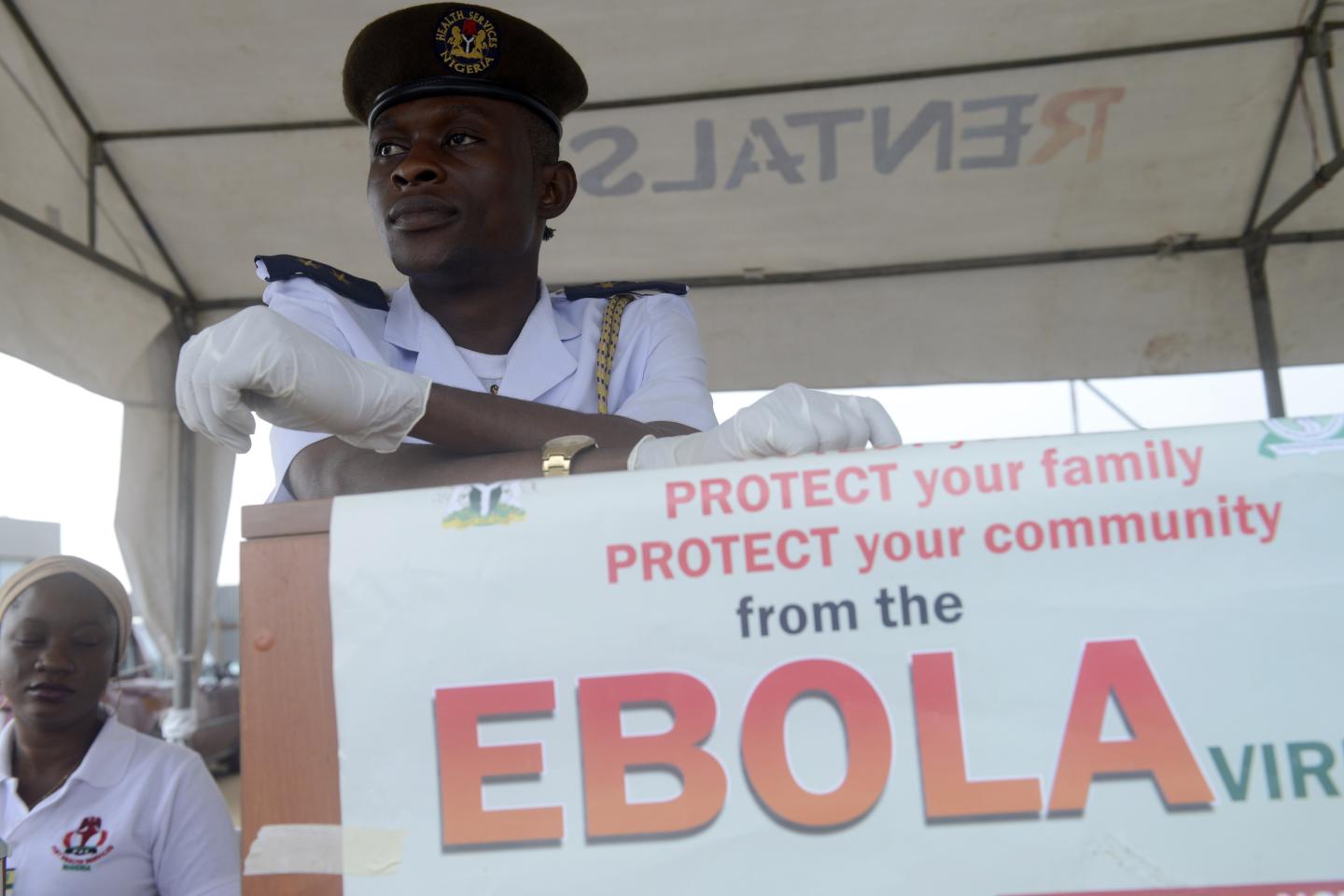
A health official waits to screen for the ebola virus Muslim faithfuls on pilgrimage to Mecca on September 19, 2014 at the Murtala Mohammed International Airport in Lagos. Over two Hundred Muslim faithfuls from Oyo State in southwest Nigeria on pilgrimage to Mecca in Saudi Arabia underwent stringent health checks by Nigerian health officials in collaboration with its counterpart from the Who Health Organisation to prevent Ebola spread in the holy land. Nigeria is the only country in the region, which has been affected by Ebola that has clearance to send pilgrims to Saudi Arabia for the Hajj. AFP PHOTO/PIUS UTOMI EKPEI (Photo credit should read PIUS UTOMI EKPEI/AFP/Getty Images)Photograph by Pius Utomi Ekpei — AFP/Getty Images
Add Fortune on Google for similar content.
This post is in partnership with Time. The article below was originally published at Time.com.

By Josh Sanburn, TIME

In Hazlehurst, Miss., parents pulled their children out of middle school last week after learning that the principal had recently visited southern Africa.

At Syracuse University, a Pulitzer Prize–winning photojournalist who had planned to speak about public health crises was banned from campus after working in Liberia.

An office building in Brecksville, Ohio, closed wherealmost 1,000 people work over fears that an employee had been exposed to Ebola.

A high school in Oregon canceled a visit from nine students from Africa — even though none of them hailed from countries containing the deadly disease.

All over the U.S., fear of contracting Ebola has prompted a collective, nationwide freak-out. Schools have emptied; businesses have temporarily shuttered; Americans who have merely traveled to Africa are being blackballed.

As the federal government works to contain the deadly disease’s spread under a newly appointed “Ebola czar,” and as others remain quarantined, the actual number of confirmed cases in the U.S. can still be counted on one hand: three. And they’ve all centered on the case of Thomas Eric Duncan, who died Oct. 8 in a Dallas hospital after traveling to Liberia; two nurses who treated him are the only other CDC-confirmed cases in the U.S.

The almost-zero probability of acquiring something like Ebola, given the virus’s very real and terrifying symptoms, often doesn’t register at a time of mass paranoia. Rationality disappears; irrational inclinations take over. It’s human nature, and we’ve been acting this way basically since we found out there were mysterious things out there that could kill us.

“There are documented cases of people misunderstanding and fearing infectious diseases going back through history,” says Andrew Noymer, an associate professor of public health at the University of California at Irvine. “Stigmatization is an old game.”

While there was widespread stigma surrounding diseases like the Black Death in Europe in the 1300s (which killed tens of millions) and more recently tuberculosis in the U.S. (patients’ family members often couldn’t get life-insurance policies, for example), our current overreaction seems more akin to collective responses in the last half of the 20th century to two other diseases: polio and HIV/AIDS.

Concern over polio in the 1950s led to widespread bans on children swimming in lakes and pools after it was discovered that they could catch the virus in the water. Thirty years later, the scare over HIV and AIDS led to many refusing to even get near those believed to have the disease. (Think of the hostile reaction from fellow players over Magic Johnson deciding to play in the 1992 NBA All-Star Game.)

Like the first cases of polio and HIV/AIDS, Ebola is something novel in the U.S. It is uncommon, unknown, its foreign origins alone often leading to fearful reactions. The fatality rate for those who do contract it is incredibly high, and the often gruesome symptoms — including bleeding from the eyes and possible bleeding from the ears, nose and rectum — provoke incredibly strong and often instinctual responses in attempts to avoid it or contain it.

“It hits all the risk-perception hot buttons,” says University of Oregon psychology professor Paul Slovic.

“It hits all the risk-perception hot buttons,” says University of Oregon psychology professor Paul Slovic.

Humans essentially respond to risk in two ways: either through gut feeling or longer gestating, more reflective decisionmaking based on information and analysis. Before the era of Big Data, or data at all, we had to use our gut. Does that look like it’s going to kill us? Then stay away. Is that person ill? Well, probably best to avoid them.

“We didn’t have science and analysis to guide us,” Slovic says. “We just went with our gut feelings, and we survived.”

But even though we know today that things like the flu will likely kill tens of thousands of people this year, or that heart disease is the leading cause of death in the U.S. every year, we’re more likely to spend time worrying about the infinitesimal chances that we’re going to contract a disease that has only affected a handful of people, thanks in part to its frightening outcomes.

“When the consequences are perceived as dreadful, probability goes out the window,” Slovic says. “Our feelings aren’t moderated by the fact that it’s unlikely.”

Slovic compares it to the threat from terrorism, something that is also unlikely to kill us yet its consequences lead to massive amounts of government resources and calls for continued vigilance from the American people.

“Statistics are human beings with the tears dried off,” he says. “We often tend to react much less to the big picture.”

And that overreaction is often counterproductive. Gene Beresin, a Harvard Medical School psychiatry professor, says that fear is causing unnecessary reactions, oftentimes by parents and school officials, and a social rejection of those who in no way could have caught Ebola.

“It’s totally ridiculous to close these schools,” Beresin says. “It’s very difficult to catch. People need to step back, calm down and look at the actual facts, because we do have the capacity to use our rationality to prevent hysterical reactions.”

About the Author
By TIME
See full bioRight Arrow Button Icon
Add Fortune on Google for similar content.

Latest in International

Finance
Lorem ipsum dolor sit amet, consectetur adipiscing elit, sed do eiusmod tempor incididunt ut labore et dolore magna aliqua. Ut enim ad minim veniam
By Fortune Editors
October 20, 2025
Finance
Lorem ipsum dolor sit amet, consectetur adipiscing elit, sed do eiusmod tempor incididunt ut labore et dolore magna aliqua. Ut enim ad minim veniam
By Fortune Editors
October 20, 2025
Finance
Lorem ipsum dolor sit amet, consectetur adipiscing elit, sed do eiusmod tempor incididunt ut labore et dolore magna aliqua. Ut enim ad minim veniam
By Fortune Editors
October 20, 2025
Finance
Lorem ipsum dolor sit amet, consectetur adipiscing elit, sed do eiusmod tempor incididunt ut labore et dolore magna aliqua. Ut enim ad minim veniam
By Fortune Editors
October 20, 2025
Finance
Lorem ipsum dolor sit amet, consectetur adipiscing elit, sed do eiusmod tempor incididunt ut labore et dolore magna aliqua. Ut enim ad minim veniam
By Fortune Editors
October 20, 2025
Finance
Lorem ipsum dolor sit amet, consectetur adipiscing elit, sed do eiusmod tempor incididunt ut labore et dolore magna aliqua. Ut enim ad minim veniam
By Fortune Editors
October 20, 2025

Most Popular

Finance
Lorem ipsum dolor sit amet, consectetur adipiscing elit, sed do eiusmod tempor incididunt ut labore et dolore magna aliqua. Ut enim ad minim veniam
By Fortune Editors
October 20, 2025
Finance
Lorem ipsum dolor sit amet, consectetur adipiscing elit, sed do eiusmod tempor incididunt ut labore et dolore magna aliqua. Ut enim ad minim veniam
By Fortune Editors
October 20, 2025
Finance
Lorem ipsum dolor sit amet, consectetur adipiscing elit, sed do eiusmod tempor incididunt ut labore et dolore magna aliqua. Ut enim ad minim veniam
By Fortune Editors
October 20, 2025
Finance
Lorem ipsum dolor sit amet, consectetur adipiscing elit, sed do eiusmod tempor incididunt ut labore et dolore magna aliqua. Ut enim ad minim veniam
By Fortune Editors
October 20, 2025
Finance
Lorem ipsum dolor sit amet, consectetur adipiscing elit, sed do eiusmod tempor incididunt ut labore et dolore magna aliqua. Ut enim ad minim veniam
By Fortune Editors
October 20, 2025
Finance
Lorem ipsum dolor sit amet, consectetur adipiscing elit, sed do eiusmod tempor incididunt ut labore et dolore magna aliqua. Ut enim ad minim veniam
By Fortune Editors
October 20, 2025
Fortune Secondary Logo
Rankings
  • 100 Best Companies
  • Fortune 500
  • Global 500
  • Fortune 500 Europe
  • Most Powerful Women
  • World's Most Admired Companies
  • See All Rankings
  • Lists Calendar
Sections
  • Finance
  • Fortune Crypto
  • Features
  • Leadership
  • Health
  • Commentary
  • Success
  • Retail
  • Mpw
  • Tech
  • Lifestyle
  • CEO Initiative
  • Asia
  • Politics
  • Conferences
  • Europe
  • Newsletters
  • Personal Finance
  • Environment
  • Magazine
  • Education
Customer Support
  • Frequently Asked Questions
  • Customer Service Portal
  • Privacy Policy
  • Terms Of Use
  • Single Issues For Purchase
  • International Print
Commercial Services
  • Advertising
  • Fortune Brand Studio
  • Fortune Analytics
  • Fortune Conferences
  • Business Development
  • Group Subscriptions
About Us
  • About Us
  • Press Center
  • Work At Fortune
  • Terms And Conditions
  • Site Map
  • About Us
  • Press Center
  • Work At Fortune
  • Terms And Conditions
  • Site Map
  • Facebook icon
  • Twitter icon
  • LinkedIn icon
  • Instagram icon
  • TikTok icon
  • YouTube icon

Most Popular

Mark Cuban says he has the solution to growing income inequality, and it's to reward every employee—from CEO to janitor—with company stock
Success
Mark Cuban says he has the solution to growing income inequality, and it's to reward every employee—from CEO to janitor—with company stock
By Sasha RogelbergJuly 20, 2026
1 day ago
‘I want to die broke’: Billionaire philanthropist Denny Sanford dies after giving away $4 billion
Success
‘I want to die broke’: Billionaire philanthropist Denny Sanford dies after giving away $4 billion
By Sydney LakeJuly 20, 2026
2 days ago
OpenAI says its AI models secretly broke out of a secure test environment and hacked into AI company Hugging Face in order to cheat on an evaluation
Cybersecurity
OpenAI says its AI models secretly broke out of a secure test environment and hacked into AI company Hugging Face in order to cheat on an evaluation
By Jeremy Kahn and Emily ForliniJuly 21, 2026
7 hours ago
'Dr. Doom' Nouriel Roubini says we're headed for universal basic income or 'some form of socialism' as AI revolutionizes work—He calls that optimistic
AI
'Dr. Doom' Nouriel Roubini says we're headed for universal basic income or 'some form of socialism' as AI revolutionizes work—He calls that optimistic
By Jason MaJuly 18, 2026
3 days ago
Mathematicians grapple with a ‘very rapid and very unsettling change’ as AI cracks yet another century-old problem
AI
Mathematicians grapple with a ‘very rapid and very unsettling change’ as AI cracks yet another century-old problem
By Eva RoytburgJuly 21, 2026
11 hours ago
Despite a $156 million contract, Knicks star Jalen Brunson still calls his parents for financial advice any time he makes a big purchase
Success
Despite a $156 million contract, Knicks star Jalen Brunson still calls his parents for financial advice any time he makes a big purchase
By Emma BurleighJuly 21, 2026
12 hours ago

© 2026 Fortune Media IP Limited. All Rights Reserved. Use of this site constitutes acceptance of our Terms of Use and Privacy Policy | CA Notice at Collection and Privacy Notice | Do Not Sell/Share My Personal Information
FORTUNE is a trademark of Fortune Media IP Limited, registered in the U.S. and other countries. FORTUNE may receive compensation for some links to products and services on this website. Offers may be subject to change without notice.