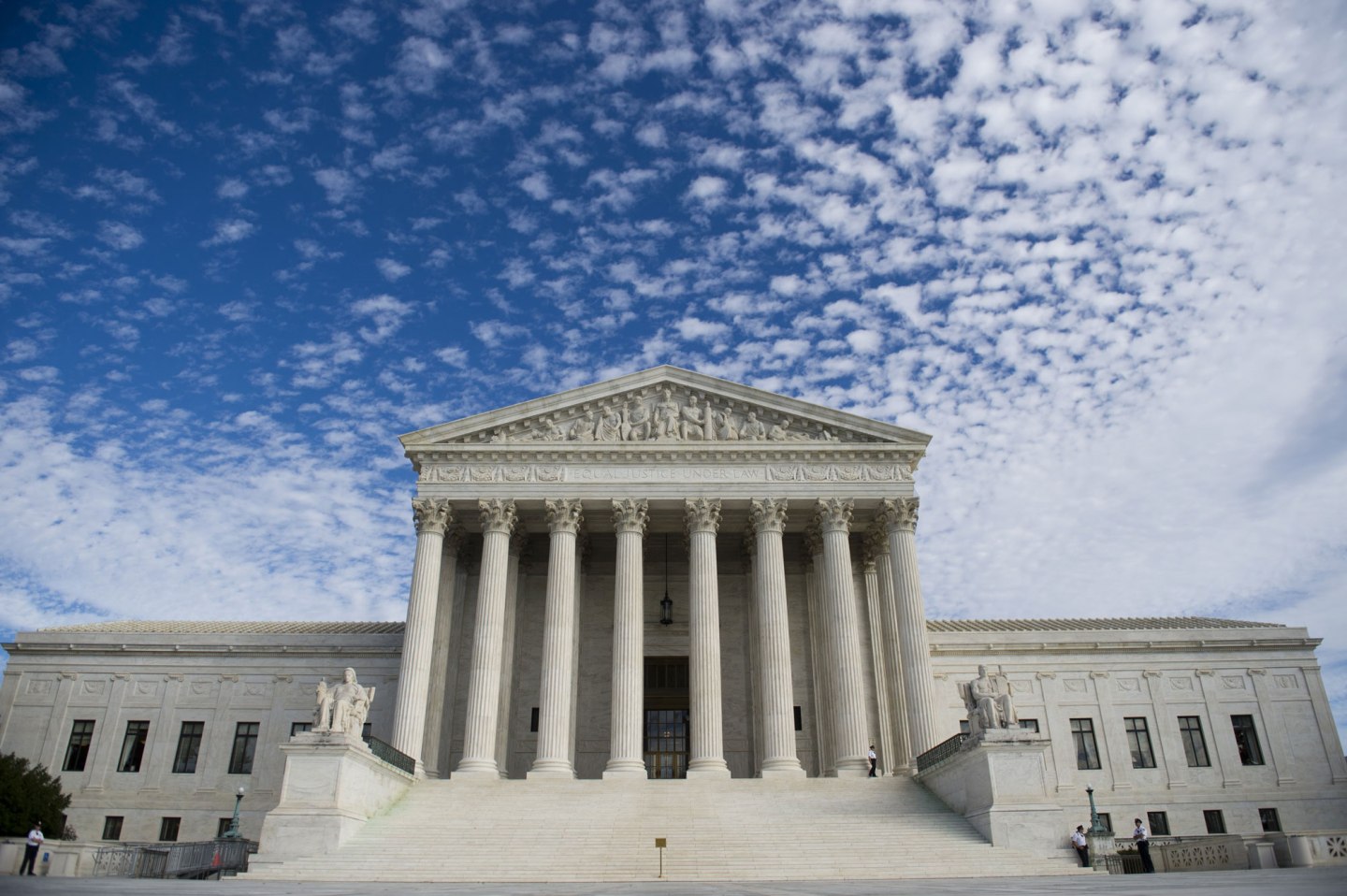
When the U.S. Supreme Court’s term starts Monday, the business docket will feature an array of intriguing cases relating to pregnancy discrimination, wage-and-hours issues, antitrust, securities class-actions, and prosecutorial overreaching.
There’s the case of John Yates, for instance, the captain of the commercial fishing boat Miss Katie, who somehow wound up getting prosecuted under the “anti-shredding provisions” of the Sarbanes-Oxley Act of 2002, for throwing undersize red grouper into the Gulf of Mexico. There’s also a case from North Carolina, in which a state dental board—composed mainly of private dentists—is trying to ban non-dentists from selling teeth-whitening services. More on those in a moment.
While there are no business blockbusters on the docket, the Court will continue adding new cases for a few months, so weightier ones may be on their way. There is great interest in the business community, for instance, in whether the court will take Spokeo Inc. v. Robins, according to Andy Pincus, a Supreme Court advocate at Mayer Brown. It raises the question of whether Congress violates the Constitution when it permits consumers to sue for technical violations of the law—recovering a statutorily set damage award of $100 to $1000, say—even when they’ve suffered no harm. There are dozens of statutes that currently purport to do this—laws concerning, for instance, privacy, truth-in-lending, fair credit reporting, or the use of stored online information—and these have engendered many class actions seeking billions of dollars. (The great thing about uninjured plaintiffs, from a plaintiffs attorney’s perspective, is that there are so darn many of them.)
Google (GOOG), Facebook (FB), eBay (EBAY), Yahoo (YHOO), and the U.S. Chamber of Commerce have all submitted or joined friend-of-the-court briefs asking the Court to hear Spokeo, in hopes of striking down such laws. The laws are strongly favored, on the other hand, by consumer, privacy, and civil rights groups. (The same issue was raised three terms ago in First American Financial v. Edwards, a case that attracted 26 friend-of-the-court briefs. But the Court punted that time, deciding that that particular case wasn’t procedurally fit for review.)
Based on interviews with Pincus and four other appellate specialists, I have selected the following seven cases as the most important business disputes currently on the docket. The other experts I consulted were Kate Todd of the U.S. Chamber Litigation Center (the Chamber of Commerce’s legal arm); Scott Nelson of the Public Citizen Litigation Group; Michael Scodro of Jenner & Block; and Jeff Harris of Bancroft.
Pregnancy discrimination
As a United Parcel Service (UPS) driver, Peggy Young was required to be able to lift 70-pound boxes. After she got pregnant, though, her doctor told her not to lift more than 20 pounds. As a consequence, UPS said she couldn’t work till she could meet the rule again. Young sued under the Pregnancy Discrimination Act (PDA) of 1978. She argues that since UPS makes accommodations for drivers with disabilities, or those who’ve been injured on the job, it must accommodate her pregnancy, too. In an unexpected turn, Young is being supported not just by women’s health and civil rights advocates, but also by 23 pro-life groups. They argue that the “PDA protects the unborn child as well as the working mother,” by reducing “pressure on women in the workforce to have an abortion.” “
Wage and hours
Many class actions are brought against employers for allegedly failing to count work hours properly under federal or state labor laws, and for failing to pay overtime wages as a consequence. Last term, the Court heard a case about whether the time steelworkers spent “donning and doffing” protective gear had to be counted. (It didn’t.) This term, in Integrity Staffing Solutions v. Busk, the Court will decide if warehouse workers in Nevada, fulfilling orders placed by customers on Amazon.com (AMZN), should be paid for the 25 minutes or so they spend at the end of their shifts passing through a security screening—to make sure they’re not stealing, basically. The AFL-CIO is supporting the workers, while the Chamber, the National League of Cities, and the U.S. Solicitor General are siding with Integrity Staffing.
Antitrust
Teeth-whitening has become a lucrative service for dentists. In 2003, North Carolina dentists began to see competition from non-dentists offering similar but cheaper services at spas, salons, and mall kiosks. The North Carolina State Board of Dental Examiners then issued cease and desist letters to those doing so, claiming their rivals were practicing dentistry without a license—a misdemeanor. Sensing a cartel, the U.S. Federal Trade Commission sued the dental board for antitrust violations. As a defense, the board invoked the “state action” doctrine. Under that doctrine, state officials, pursuing state policy, are immune from federal antitrust laws. The question here is whether the dental board—most of whose members are private, practicing dentists and subject to little, if any, oversight by state officials—is entitled to that defense. Public Citizen and the Cato Institute are among those supporting the FTC, while 23 states are backing the dental board.
Prosecutorial overreaching:
In using a rubric like “prosecutorial overreaching,” I’m probably tipping my hand in terms of who I think will win this case. But several of the experts I spoke with likened Yates v. United States to last term’s Bond v. United States. In Bond the Court unanimously overturned the “chemical weapons” conviction of a woman who spread poison on a mail box belonging to her husband’s mistress and thereby caused her, as Chief Justice John Roberts, Jr., put it, “a minor thumb burn readily treated by rinsing with water.”
In Yates, a commercial fisherman in the Gulf of Mexico was caught with about 70 red grouper that were an inch or two shorter than the 20-inch minimum. (This is not a crime.) He was issued a civil citation and told to bring the offending fish to dock for remeasurement and seizure. He disobeyed, alas, throwing at least some of the undersize fish overboard, and replacing them with larger fish, a jury found.
That conduct did constitute a crime, called “destruction . . . of property to prevent seizure,” which carries a five-year maximum penalty. Yates was convicted and sentenced to 30 days. But he was also convicted under the anti-shredding provisions of the Sarbanes-Oxley Act of 2002, which carries a potential maximum term of 20 years imprisonment. The law was enacted in the wake of Arthur Andersen’s notorious shredding, in October 2001, of documents relating to its audits of Enron, which was then collapsing in one of the most egregious accounting scandals in corporate history. The anti-shredding provisions forbid “destruction” of “any record, document, or tangible object” with intent to impede an investigation. The prosecutor reasoned that Yates’s red grouper were “tangible objects.”
Yates contends that this is not what Congress had in mind, and among the many amicus briefs echoing that view is one from Michael Oxley, the Ohio Congressman who co-authored the law.
Patents
While Teva Pharmaceuticals USA (TEVA) v. Sandoz (NVS) does not pack the emotional wallop of several of the patent cases last term, where outcomes were easily associated with curtailing or punishing abusive patent suits, it poses a question that impacts virtually every patent case. The issue is whether a district judge’s interpretation of the terms of the patent, known as “claims construction,” is entitled to deference by the U.S. Court of Appeals for the Federal Circuit—the court that hears all patent appeals—or whether the Federal Circuit should be able to re-interpret those terms from scratch, exercising “de novo” review. Notwithstanding that the Federal Circuit has been historically seen as pro-patent enforcement, a dozen technology giants, including Google, Facebook, Intel (INTC), and Verizon (VZ), have all joined friend-of-the-court briefs that favor giving the Federal Circuit de novo review. They cite concern about inconsistent interpretations by district judges. They evidently prefer the predictability and uniformity that a single appeals court can provide—even if it’s the Federal Circuit—to rolling the dice with judges inexperienced with patent law or, worse, judges at reputedly pro-plaintiff magnet courts, like the Eastern District of Texas.
Securities class actions
Whenever there’s a public stock offering, class actions can be filed over a materially false statement in the registration statement even if the inaccuracy isn’t intentional. The question in Omnicare (OCR)v. Laborers District Council Construction Industry Pension Fund, is over exactly what the plaintiffs have to show when the false statement is a matter of opinion. Is it enough if the opinion turns out to be have been wrong, even though the issuer thought it was true at the time? Or is subjective belief in the opinion at the time it was given an iron-clad defense? What if the issuer thought it was true when the opinion was given, but his belief was objectively unreasonable even at the time? The Court is expected to provide clarity here.
False Claims Act cases
The Court has already taken one False Claims Act case for this term, Kellogg Brown & Root Services (KBR) v. U.S. ex rel. Carter, and Kate Todd, of the U.S. Chamber Litigation Center, says her organization is hopeful it will also hear two more that are still in the pipeline. These are so-called qui tam cases, in which private whistleblowers file suits purporting to expose fraud being committed by government contractors. If they prevail, the whistleblowers can receive 25% or more of the entire recovery due the government—potentially hundreds of millions of dollars—plus attorneys fees. The precise issues presented are technical, but have to do with interpretations of procedural rules that industry groups claim can, in effect, subject companies to an infinite series of stale and duplicative suits arising from the same event. A surprisingly wide swath of trade groups—including PhRMA, the American Medical Association, the American Hospital Association, and The Clearing House (a banking association) have joined the Chamber in seeking review.