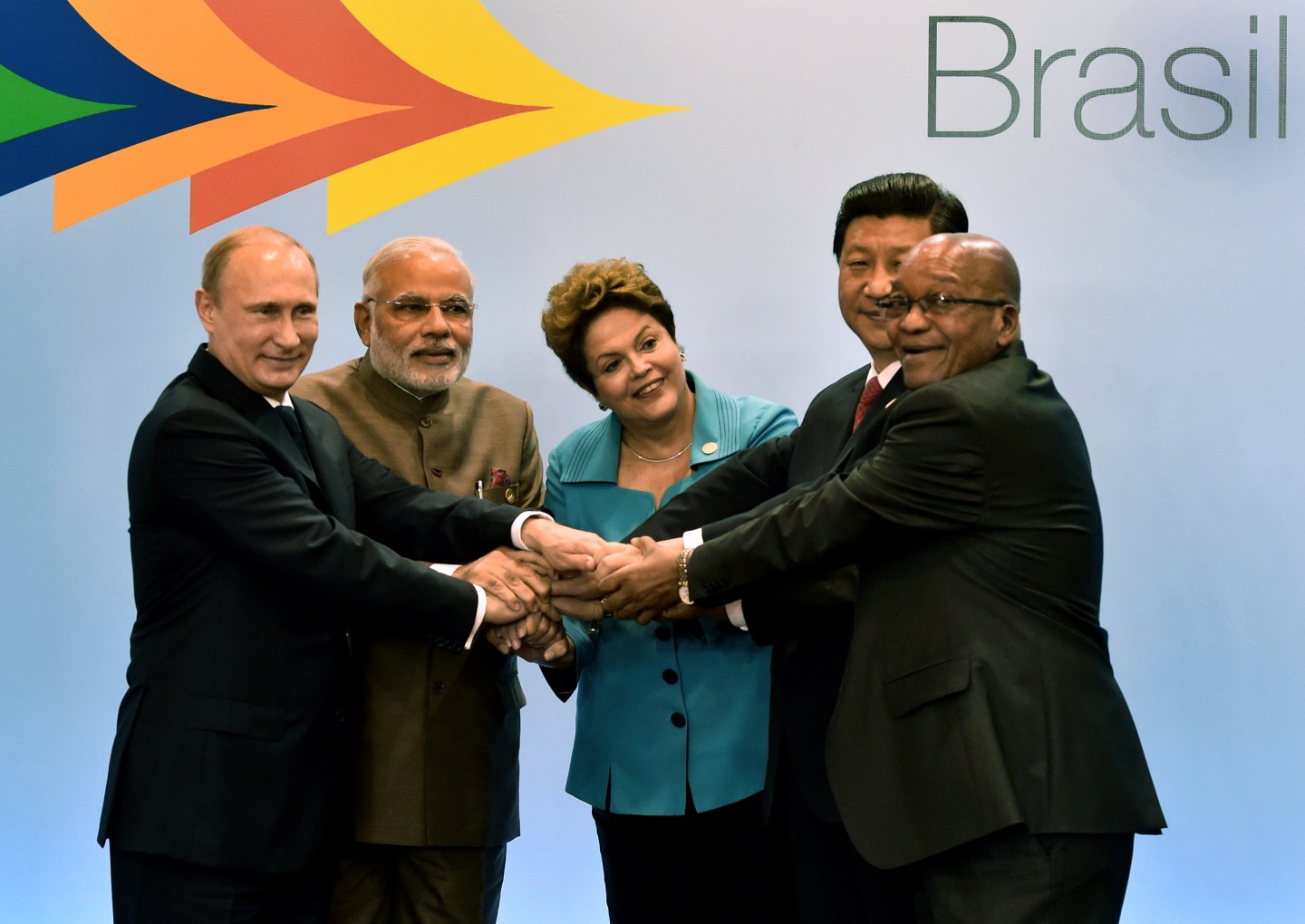
Leaders of the five emerging economies known by the acronym BRICS recently moved to deepen their role in the global financial system by agreeing to base a new development bank in Shanghai. The New Development Bank, as it’s called, is designed to provide Brazil, Russia, India, China and South Africa an alternative way to finance new roads, bridges and other infrastructure projects.
The NDB has been given $50 billion in initial capital, with each of the five countries contribution $10 billion. Although final approval by the BRICS nations could be months if not years away, the idea of a new bank that could potentially be bigger than the World Bank or the International Monetary Fund has unnerved critics.
This reminds me of the remake of a classic science-fiction horror film, “The Fly,” in which Geena Davis delivers the memorable lines, “Be afraid, be very afraid.” Amidst a world in flux, the original 1958 film had drawn on America’s anxieties as new rivals, challenges and technologies loomed. Around that time, the Korean War had ended in stalemate in 1953 after China’s intervention. And the Cold War continued to intensify as a nuclear-weapons armed Soviet Union won the space race in 1957 with the launch of Sputnik, the first artificial earth satellite.
Today, the world is in flux again. This was underscored last month when officials announced creation of the New Development Bank. Accounting for a growing share of the global economy, Brazil, Russia, India, China, South Africa and other emerging market economies and developing nations are exploring new financial institutions and trade relationships, often no longer dominated by the West.
An increasingly assertive China under President Xi Jinping has only intensified fears. China has deepened its footing in the global economy, as it’s now the world’s second largest economy. Chinese businesses continue their move up the rankings of the largest companies globally. What’s more, New York awaits what could be one of the largest listings, as Chinese e-commerce firm Alibaba prepares to go public.
Having served on the board of the Asian Development Bank, an international financial institution focused much like the World Bank on poverty reduction and economic growth, I believe that one should not fear this shifting landscape or, as one well-known commentator, Fareed Zakaria, calls it, the “rise of the rest.”
The world should welcome a BRICS bank. This new international financial institution can serve as an additional source of funds and knowledge, helping meet the developing world’s tremendous infrastructure needs. Perhaps China might also appropriately use the occasion to begin phasing out its own borrowings from the World Bank and Asian Development Bank. With tremendous resources of its own, China should graduate from these more traditional sources of funding, allowing those international financial institutions to focus on lesser developed nations more in need, from Afghanistan to Haiti.
Existing institutions should welcome the challenge and see it as competition to be more impactful, more responsive and more effective for world economics. As in the private sector, competition can be good for status quo development institutions that have not done enough to embrace critical reforms in how they do business. The world will be better off if – due to the challenge of new, emerging institutions – we find that the World Bank, the Asian Development Bank and similar organizations are forced to focus more on results and development impact in the field instead of on lending volume as the key metric for success.
Under the New Development Bank’s current plans, India, Russia and Brazil are expected to each name top executives. The creation of a “mini-International Monetary Fund” that can serve as a source of lending during times of international crises is also expected, capitalized at $100 billion in foreign exchange reserves. China reportedly will contribute $41 billion and Russia, Brazil and India would each contribute $18 billion to the currency reserve pool. South Africa would contribute $5 billion.
Taken together, these funds are intended to finance joint development ventures and serve, by some accounts, as a counterbalance to the World Bank and the IMF – “Bretton Woods” institutions perceived by China and other developing nations as unduly influenced by Western shareholders.
At issue is that many in the established development community fear the new bank may have weaker safeguards against environmental damage, pollution and other hazards often associated with massive infrastructure projects. Social and environmental safeguards are indeed critical issues. At the end of the day, however, sovereign nations must choose for themselves how to build a better life for their own people.
Let’s not condemn an institution before it even exists.
To be sure, major shareholders may well find that vested interests are soon focusing more on personnel picks, prerogatives and political points than on how best to speed development to places underserved by present development institutions.
BRICS nations must also recognize that the true economic constraint to growth is often not a lack of funds or multilateral organizations, but the “little bric” of bureaucracy, regulation, interventionism and corruption that too frequently gets in the way of sustainable business development. The private sector – and not state-owned companies or government mandates – ultimately in all of the BRICS nations will be the key driver of job creation and economic growth.
The New Development Bank is a sign of a changing world. Change can be difficult, and it can be for the worse, but my hope is that new institutions can also drive change for the better. And that is nothing to be afraid of, but something we should be prepared for.
Curtis S. Chin, a former U.S. Ambassador to the Asian Development Bank, is managing director of advisory firm RiverPeak Group, LLC. Follow him on Twitter at @CurtisSChin