
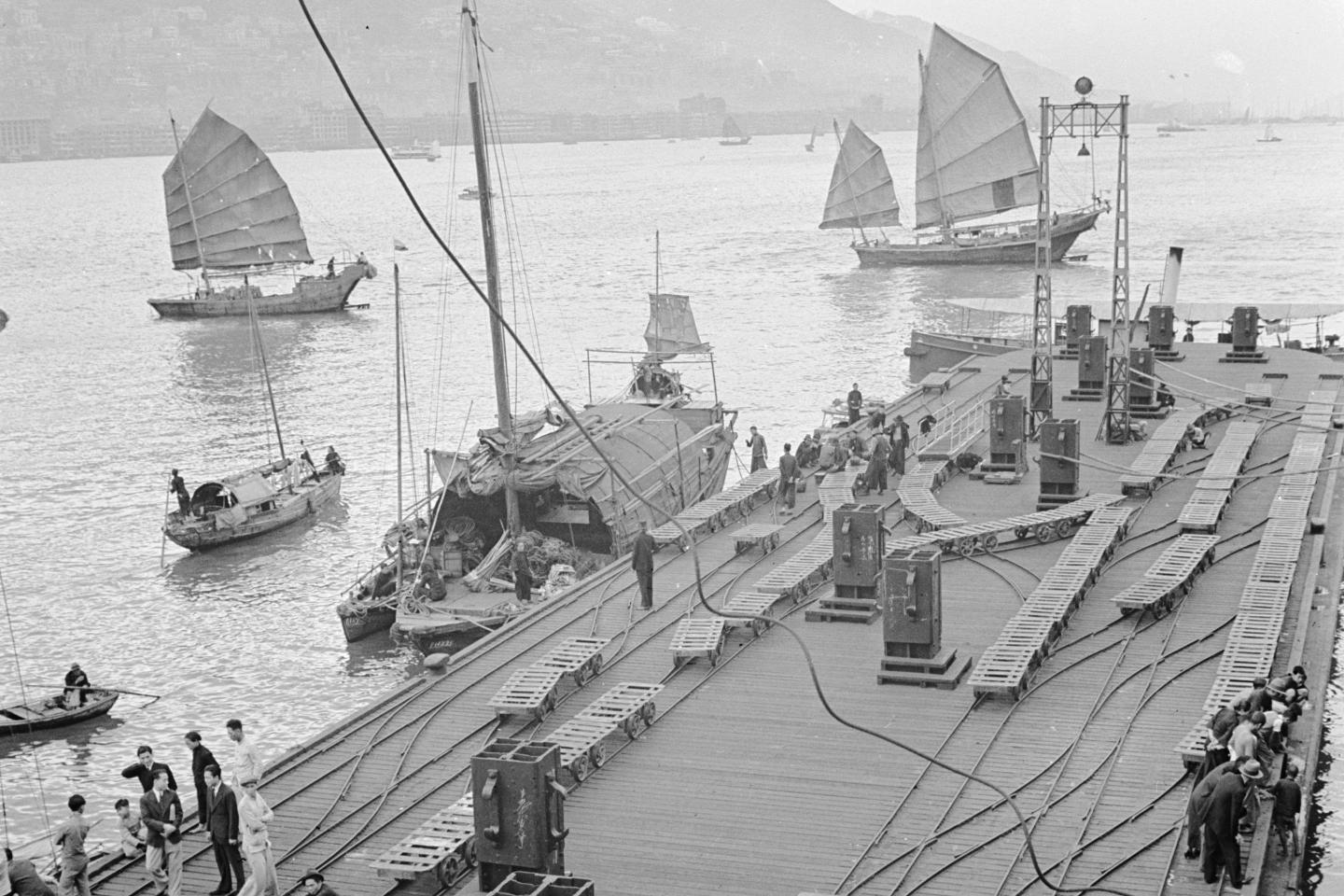
The Crown Colony of Hong Kong, well located at the entrance to South China’s best harbor, is part of an Asia marked by alarms and of a British Empire marked by breakdowns. But Hong Kong is quiet and stable. It is also, unlike other Asiatic cities, prosperous and, unlike many British possessions, a source of income rather than of strategically justified outlay. Here profits run to 15 or even 30 per cent on investment, and Occidentals—the taipans or big businessmen of Hong Kong—still run an Asiatic show on their own terms. But the terms are rather new. Since what the taipans seek is profits on trade, the colony is open to all comers; since what the British economy requires is exports, trade nowadays is sufficiently controlled to preserve Hong Kong’s favorable position on the British balance sheet.
Hong Kong means trade. Apart from the British-American Tobacco Co., a few small textile, joss-stick, and rubber-shoe factories, and the like, there are no manufacturing companies of more than local importance. There is no income from raw materials, little from finished materials, and government services cost more than they bring in. Everything is up to the traders—the export-import houses, banks, ships, docks, and godowns (warehouses). About half of what they import—in particular, oils, fats, food, medicine, paper, metals, textiles, and the home remittances of overseas Chinese—goes to China, whence come tung oil, bristles, hides, tungsten, tea, and silk. The colony keeps 15 per cent for its own use and scatters what is left around East Asia. Since Hong Kong operates on the principle that what passes in must pass out, it collects a two-way percentage on trade (11 million tons in 1946) in the form of direct commissions or of charges for storage, insurance, and exchange.
For middlemen to be well located in a relatively free port under relatively mild controls is an advantage, but location is no guarantee of business. Hong Kong has lost business to Shanghai in the past, and could again. The only guarantee is an intangible—a Victorian devotion to the ideas of stability and probity. The colony, for instance, redeemed without discussion 120 million Hong Kong dollars worth of duress notes that the Japanese had extracted from interned Britons.
Hong Kong has anchored its dollar at the prewar rate of four of its dollars to one U.S. dollar and, except for a brief period immediately following reoccupation, has kept the open-market discount from fluctuating beyond 25 per cent. Living costs of the native population have been pared down to three times the prewar level. And the business result is marked. Hong Kong’s total 1946 trade was $1,699 million (HK), compared with $1,128 million in 1939. Price rises, of course, accounted for the dollar increase, since tonnage was but half what it was in 1939. But in the first quarter of 1947, bulk cargoes began to reach the prewar level and dollar value was nearly double.
Prosperity is reflected in the gloss of postwar automobiles. Chinese workmen smoke Camels on the expensive upper decks of trams. There are Swiss watches, French perfumes, U.S. fountain pens, and British and Australian woolens unobtainable by Britons at home. New business is crowding into the two-by-three-block central district: Chinese wealth from the mainland—perhaps as much as $50 million (U.S.)—has taken refuge in Hong Kong, swelling the volume of bank deposits, pushing up the values of real estate and Hong Kong company shares, and financing scores of one-room trading houses that are cashing in on the demand for Western imports. Two hundred and twenty-eight Shanghai concerns, preferring to do business as British companies rather than incorporate under Chinese law, have shifted registry to Hong Kong, now an Asiatic Delaware.
Will the bustle last? The answer to that question, asked daily by every taipan and civil servant in town, involves everything from local social geography to the state of the world.
The three facets of the jewel
The colony is, first, the island of Hong Kong, seat of government and taipans, a narrow, mountainous ridge eleven miles long. It is, next, the peninsula of Kowloon, site of docks, wharves, and airfield. It is, finally, the New Territories, 356 square miles that give the colony water and the British their hunting. Hong Kong lives on three social levels, and much of its effort to keep itself soundly and simply British has resolved itself into keeping the levels distinct. At the top is the Peak, the summit of the 1,800-foot island ridge that for years has stood for money and power and standing, and that long excluded Chinese. Below the Peak is an area of schools, churches, apartments, and homes of well-off Britishers and very rich Chinese. In the third area along the sea live the Chinese masses.
Beyond working for the colony and making a living, the lower-level people have no part in the workings of Hong Kong, and ask for none. Distinct from them are the mid-level Chinese, who have learned to do business the British way and have thereby prospered. They have some importance in the workings of the colony. But the say belongs to the people on the Peak.
The three-way division runs through all the colony’s non-trading activities. For select heads and partners of the British hongs (as Hong Kong calls its firms), high government officials, and senior service officers, there is the patrician Hong Kong Club and the Peak Club. The Royal Hong Kong Golf Club and the Royal Hong Kong Yacht Club unbend to junior executives and service officers. The Governor is patron of the Jockey Club, and the chief manager of the Bank (no one uses the full title, Hong Kong and Shanghai Banking Corp.) is chairman of the board of stewards. And the top firm, Jardine, Matheson & Co., Ltd., looks on racing as a company tradition. For the middle layer there are clubs where Westerners and Chinese mix.
The three most important institutions in Hong Kong are the Hong Kong and Shanghai Banking Corp., the government, and Jardine’s. The Bank, which has forty-four branches, has a prestige in Asia that matches that of the Old Lady of Threadneedle Street in Britain. It is Asia’s biggest commercial bank, most important foreign-exchange bank and bank of issue, and most popular bank of safekeeping. It issues 85 per cent of Hong Kong’s currency. In U.S. terms it is Nicholas Biddle, the elder Morgan, and the Federal Reserve System put together. There are a hundred Hong Kong banks—Chartered Bank of India, Australia, and China, National City, Bank of China, Banque Belge Pour L’Etranger, etc.—but there is only one Bank.
Its chief stockholders are the trading houses, first and oldest of which is the respected Jardine’s. Incorporated at Canton in 1832, it bought property at Hong Kong’s first land sale, built the first permanent building, pioneered the Peak, became the first foreign firm to own real estate in China and later in Japan. Its status is represented by its hong mark, EWO (number one), probably the most valued trademark in China. While primarily interested in export-import, it has also created big subsidiaries in shipping, railway finance, textiles, breweries, meat packing, real estate, wharves, warehousing, and insurance.
While privately owned, Jardine’s has followed sound British practice with its subsidiaries: nurse them along until sturdy and then turn them into public companies—keeping, of course, control of management, and using the capital gained for other enterprises. Various of the colony’s larger businesses—the Hong Kong Land Investment Co., the Hong Kong and Whampoa Dock Co., and the Star Ferry Co.—have been converted in such fashion. Jardine’s controls Hong Kong’s tallest hotel (nine stories by American count), the largest dockyard, the principal ferry system, and 75 per cent of the buildings and land in the central business district.
The first function of Hong Kong government is to help trade. The Governor regularly consults the taipans and makes few important policies without their approval. In theory the Governor is omnipotent. Subject to approval by the Colonial Office, he has sole control over everything but the courts and the auditors. But governors of Hong Kong operate not so much by order as by compromise, paying close attention to such advisers as the “colonial cadets”—thirty-five civil servants in such bodies as the Colonial Secretariat and the Secretariat for Chinese Affairs.
The government can ration any item, fix prices, freeze goods in godowns with the excuse of customs control, and give or withhold licenses for export or import and permits for automobile ownership. For the Chinese it provides a low-tuition school system, free health clinics, and public works. For the businessmen it provides rules enforceable by courts and police. It is, in effect, in the business of selling trade, and it tries to keep its customers contented. Government expenses for the 1947-48 fiscal year are estimated at $109 million (HK), about three times higher than before the war. In exchange for more government, the colony is now getting an income tax.
Brave new day
The colony’s future looks rosier today than before the Japanese occupied it. For, after a high point of trade in 1924—57 million tons of it—Hong Kong gradually lost business to Shanghai, a decline speeded up by the approach of war. Today the trend is reversed, for all former treaty ports now share China’s instability. Yet Hong Kong has all the problems of any war-stricken community: far too little housing, far too high land costs, far too little food. Chinese have poured in by the hundred thousands, more than doubling the wartime low of 750,000 population. White-collar workers are badly off, and there is some corruption in government. Demand for goods still exceeds supply and the colony suffers from the widespread selling back and forth of everything from fountain pens to real estate, not for satisfying normal business and consumer needs but for cornering markets and profiting by price jumps. Labor, suddenly a bit restive, costs three to five times as much as it used to. Hong Kong is no longer the cheapest port in the world for ship repairs, but one of the most expensive. A shoddy beer-bottle case made in Hong Kong costs only 10 cents less than a better one from the U.S. The future holds problems of greater competition and of a threat of recession. Hong Kong’s present prosperity is built in part on the quickly expressed, quickly satisfied demand of Asiatic markets for the goods of which war deprived them.
The only answer to such problems is a degree of manipulation and control of trade. Promptly after reoccupation, the government rationed basic foods and fuel, and spread price controls to necessary and overpriced goods. By a neat balance of promises (raw materials for the cooperative, punishment for the recalcitrant), it persuaded even the notoriously free-trading Chinese to price-tag their merchandise. It managed to halve retail prices, institute a priority system for new cars, and—after conference with employers—set up a “rehabilitation allowance” to ease the problems of the working population. By such measures was introduced a very necessary degree of stability.
Once there were price controls in Hong Kong there was danger that local merchandise would promptly be drained off for sale at inflated prices in China. Government marshaled its powers over foreign-exchange and export licenses. Importers willing to bring in needed products were offered American dollar exchange at the legal rate. Exporters of scarce products—cotton yarn, building materials—were given licenses only if they would market a percentage of their cargo in Hong Kong at a low price fixed informally with the government. The profit motive was no longer to be trusted as the best insurance of prosperity, but was to be controlled and checked lest it bring to the colony the insecurity of the surrounding world. In the confused East, there are many opportunities for high-yielding deals and Hong Kong could not afford to be the goat. Nor could it afford to let non-British trade capture too much business.
In 1946, American trade provided 12.8 per cent of the colony’s imports—a share a third greater than it enjoyed before the war. In the first quarter of 1947, American imports, freed from the U.S. shipping strike, boomed. In January they all but equaled the total from all of the empire: $27 million (HK) compared with $28 million (HK), 25 per cent of all imports. The products were chiefly foodstuffs, automobiles, cigarettes, drugs, oils and fats, canned goods, along with fountain pens, watches, and plastic sundries in great quantities, most of them destined for China. About half of these products were handled by British concerns, but such U.S. companies as William Hunt, Getz Bros., and Dodge & Seymour, Ltd., handled most of the rest, along with Texaco, Standard-Vacuum, Chase, National City, and American Express. Besides, the movies used up U.S. dollars to the amount of 100,000 a month, despite a new local ordinance requiring picture houses to show British films at least three days a month. Hong Kong was anxious to remain hospitable to all trade, but American trade involves American dollar exchange—a camel that the empire is not trying to swallow—and American competition in a trade on which Britain counts heavily.
In such a situation the exchange restrictions of mid-April came as a matter of course. U.S. shipments to Hong Kong are still considerable but they may not again match in volume those of the first months of the year. The colony can decide what it wants and how much it wants, confident at the same time that the security of doing business in Hong Kong will compensate U.S. business for the annoyances of controls.
Stricken West meets stricken East
The U.S. dollar problem is neutralized, at least for a time, but a greater problem remains. Hong Kong’s big customer is China, which in normal times absorbs up to half of all the goods that come into Hong Kong and provides more than half the goods that go out. But the Chinese economy is stricken. Its wants in foreign exchange are almost bottomless, and every product not essential to national survival that is imported from the U.S. or Britain makes its wants more urgent. Its unfavorable balance of trade during 1946 was about $700 million (U.S.)—more than seven times what it used to be. And the British economy, though not so desperate, is also stricken. Its great need is to export. But the Chinese Government has clamped down on foreign exchange, banned many luxury imports, and put prohibitive duties on others. It has even asked Hong Kong to restrict imports and exports.
This request epitomizes Hong Kong’s great dilemma. The colony is entirely aware that what makes for prosperity in the short run is not likely to make for prosperity in the long run. Hong Kong’s stability since the war has been won in part because China is unstable: its level of trade has been increased by imports into China of goods not calculated to strengthen the Chinese economy. Both the colony and the empire depend on Hong Kong’s business, and at the same time Hong Kong must do its best for its best customer. For the very insecurities that have brought trade into Hong Kong will in the long run take trade away. A little instability in China hurts Hong Kong not at all, but let that little become a lot and it kills Hong Kong off. The colony would be left without its major market. Hong Kong control of U.S. exports into China goes some distance toward meeting the Chinese request for luxury restrictions, at the same time that it keeps the U.S. from becoming too great a creditor on the colony’s balance sheet. But this measure by no means solves the fundamental dilemma of relations with China.
Politics and the future
Hong Kong has a political as well as an economic dilemma, and here it is by no means inactive. The fact of British Hong Kong confronts the resurgence of Chinese nationalism, which has long looked upon foreign control of Chinese soil as a matter of shame and humiliation. Mainland agitation stresses that the British took Hong Kong at the point of a gun. The British observe that it was a barren island to which the Chinese came because of what Britain made of it. But trade is the essence of the argument again. An official Chinese request for Hong Kong would be very difficult to ignore if ever made. In 1925, Hong Kong felt the weight of Kuomintang agitation against colonialism and trade fell off heavily. Hong Kong knows it is an anachronism in the New Asia, and intends to take all friendly measures possible to convince the Chinese that it ought to remain one.
The first measure is a partial breaking down of social barriers. For the first time in Hong Kong’s history, a Chinese has been appointed a colonial cadet. Another, Oxford-educated, is rice controller. Others have been named to succeed Europeans as doctors, nurses, and school supervisors in the government service. The second measure is official permission for Chinese political parties to operate throughout the colony—even the Communists, who run a small-scale and not very effective propaganda center. The colony has raised no question of Kuomintang control over almost all the vernacular newspapers, most of the 300-odd middle schools, and most labor unions.
A degree of popular government is the third step on the British agenda. A plan that establishes an advisory Municipal Council, one-third elected by Chinese, one-third by non-Chinese, and the rest by a variety of civic groups, has been approved in principle by London. The Legislative Council will also be broadened. Control, however, will remain in the hands of the Governor and his chief advisers, the taipans. Incidentally, the British have taken measures directly friendly to China, such as turning over war surpluses and booty.
Whether the Chinese can thus be appeased is a question for which there is no clear answer. Two groups in the colony are inclined to believe not. One urges that Hong Kong be made into a show window of democracy in the East by further liberalization of the government. By this plan it would eventually become a self-governing unit within the empire. The second group, determined at all costs to preserve some citadel of Western business on the coast of Asia, would settle for an internationalized Hong Kong, perhaps under the U.N.
But these are the arguments of intellectuals on the one hand and traders on the other. They are not the arguments of the colonists. To them Hong Kong is a gem in the British economy, a unique dispensation of law and order, an island of stability in a troubled Orient, a citadel of tradition, a center of sound trade—in short, a crown colony. Here British rule lengthens, if it cannot perpetuate, the reign of the last of the merchant princes.