• Home
  • Latest
  • Fortune 500
  • Finance
  • Tech
  • Leadership
  • Lifestyle
  • Rankings
  • Multimedia
CommentaryChina

China Has More To Lose Than the U.S. Under a Trump Administration

By
Minxin Pei
Down Arrow Button Icon
By
Minxin Pei
Down Arrow Button Icon
January 16, 2017, 6:00 PM ET
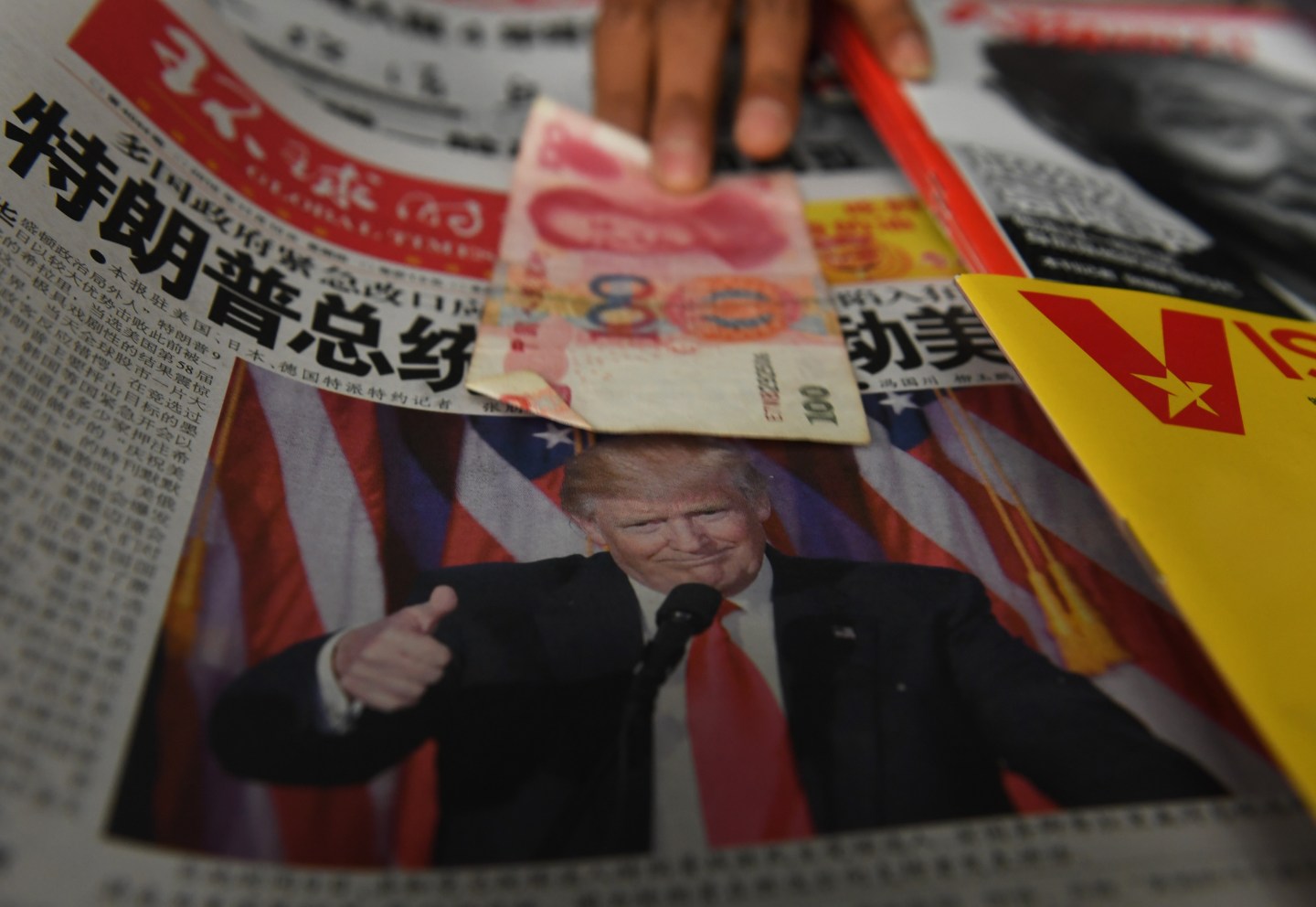
TOPSHOT-CHINA-US-VOTE-TRUMP-ECONOMY
Photograph by Greg Baker—AFP/Getty Images

As Donald Trump is sworn into office this week, among many of the possible disruptive initiatives his administration may launch is a trade war with China. Some may still harbor hopes that pragmatists in his administration could counterbalance the anti-trade China hawks, but former Exxon CEO Rex Tillerson, Trump’s pick for the Secretary of State, should dispel such illusions.

During his confirmation hearings last week, Tillerson took a hardline on China over its trade practices, expansionist moves in the South China Sea, and unwillingness to punish North Korea for its nuclear and missile programs even as he prevaricated on Russia. Since Tillerson would play a key role in determining policy toward Beijing if he is confirmed, his remarks suggest that he would not stand in the way if Trump wants to launch a costly trade war with China.

Trump knows that the U.S. is in a stronger position than China, since America is much less dependent on trade than China (total foreign trade is equivalent of 28% of GDP for the U.S. in 2015 while it is 41% of GDP for China). In addition, China sells far more to the U.S. than the other way around. In 2015, U.S. exports to China totaled $116 billion while Chinese exports to the U.S. were more than triple that at $483 billion. Most importantly, with full employment, low inflation, and a healthy financial system, the U.S. economy is at its strongest since the financial crisis of 2008. The Chinese economy, by comparison, is weighed down by a mountain of bad debt, overcapacity, and capital flight.

To be sure, we have no idea what Trump might actually do. But he would be wrong to assume that Chinese leaders will not push back or that their actions would not amount to much. Politically, China’s President Xi Jinping, has portrayed himself, just like Trump, as a strong leader whose mission is to make China great again. He cannot afford to appear to be a weakling. Economically, China may be highly vulnerable and will suffer worse consequences than the U.S. in a trade war, but as the world’s second-largest economy, it can still deliver a powerful counter punch.

In all likelihood, Chinese leaders will respond to the actions taken by Trump by targeting vulnerable American firms and sectors and following a strategy that minimizes costs to China while maximizing pain to the U.S.

The first set of actions would be those that would hurt the U.S. without harming China. For example, canceling orders of Boeing aircraft (China accounts for nearly 12 percent of Boeing’s sales in 2015) will have no adverse impact since Boeing employs few workers in China and Beijing can buy from Airbus. Cutting the imports of American wheat, soybeans, and other agricultural products will not cause starvation in China because there are alternative producers (Canada, Brazil, and Argentina).

Restricting Chinese investments in the U.S. is another retaliatory measure attractive to Beijing. According to the Rhodium Group, an American consulting firm, Chinese companies invested $45.6 billion in the U.S. in 2015. Curtailing such investments would not only hurt the American economy, but also help Beijing slow down capital outflows.

Since the U.S. runs a large surplus in its exports of services to China, $33.3 billion in 2015, Beijing would be highly tempted to single out this sector for retaliation as well. In terms of U.S. services exported to China, the bulk consists of Chinese tourists dollars (1.8 million Chinese tourists visited the U.S. in 2014 and spent $21 billion). Cutting down America-bound Chinese tourists can both send Trump a message and help plug the leakage of precious foreign currency.

There are, of course, other options available to Beijing. But these measures are less attractive because these American targets, vulnerable as they are, all employ large numbers of workers in China. They include Apple (which relies on China for a quarter of its iPhone sales but also indirectly employs hundreds of thousands of workers in China through its contract manufacturer, Foxxcon). GM and Wal-Mart also belong in the same category. They may be on Beijing’s target list, but Chinese leaders are less likely to go after them first unless their trade war with Trump escalates to a more vicious level.

It is unclear whether Trump and his trade advisers have thought through the consequences and objectives of a trade war with China. What is clear is that such a war will do little to help Trump’s core supporters (manufacturing workers without college education) because companies hit with Trump’s punitive tariffs will simply move their production facilities to other countries in Asia. Worse still, both China and the U.S. will lose – the idea that China will lose more than the U.S. is no consolation for those whose lives and jobs are upended in a totally needless and self-destructive trade war.

Minxin Pei is a professor of government at Claremont McKenna College and author of China’s Crony Capitalism (2016).

About the Author
By Minxin Pei
See full bioRight Arrow Button Icon

Latest in Commentary

Finance
Lorem ipsum dolor sit amet, consectetur adipiscing elit, sed do eiusmod tempor incididunt ut labore et dolore magna aliqua. Ut enim ad minim veniam
By Fortune Editors
October 20, 2025
Finance
Lorem ipsum dolor sit amet, consectetur adipiscing elit, sed do eiusmod tempor incididunt ut labore et dolore magna aliqua. Ut enim ad minim veniam
By Fortune Editors
October 20, 2025
Finance
Lorem ipsum dolor sit amet, consectetur adipiscing elit, sed do eiusmod tempor incididunt ut labore et dolore magna aliqua. Ut enim ad minim veniam
By Fortune Editors
October 20, 2025
Finance
Lorem ipsum dolor sit amet, consectetur adipiscing elit, sed do eiusmod tempor incididunt ut labore et dolore magna aliqua. Ut enim ad minim veniam
By Fortune Editors
October 20, 2025
Finance
Lorem ipsum dolor sit amet, consectetur adipiscing elit, sed do eiusmod tempor incididunt ut labore et dolore magna aliqua. Ut enim ad minim veniam
By Fortune Editors
October 20, 2025
Finance
Lorem ipsum dolor sit amet, consectetur adipiscing elit, sed do eiusmod tempor incididunt ut labore et dolore magna aliqua. Ut enim ad minim veniam
By Fortune Editors
October 20, 2025

Most Popular

Finance
Lorem ipsum dolor sit amet, consectetur adipiscing elit, sed do eiusmod tempor incididunt ut labore et dolore magna aliqua. Ut enim ad minim veniam
By Fortune Editors
October 20, 2025
Finance
Lorem ipsum dolor sit amet, consectetur adipiscing elit, sed do eiusmod tempor incididunt ut labore et dolore magna aliqua. Ut enim ad minim veniam
By Fortune Editors
October 20, 2025
Finance
Lorem ipsum dolor sit amet, consectetur adipiscing elit, sed do eiusmod tempor incididunt ut labore et dolore magna aliqua. Ut enim ad minim veniam
By Fortune Editors
October 20, 2025
Finance
Lorem ipsum dolor sit amet, consectetur adipiscing elit, sed do eiusmod tempor incididunt ut labore et dolore magna aliqua. Ut enim ad minim veniam
By Fortune Editors
October 20, 2025
Finance
Lorem ipsum dolor sit amet, consectetur adipiscing elit, sed do eiusmod tempor incididunt ut labore et dolore magna aliqua. Ut enim ad minim veniam
By Fortune Editors
October 20, 2025
Finance
Lorem ipsum dolor sit amet, consectetur adipiscing elit, sed do eiusmod tempor incididunt ut labore et dolore magna aliqua. Ut enim ad minim veniam
By Fortune Editors
October 20, 2025
Rankings
  • 100 Best Companies
  • Fortune 500
  • Global 500
  • Fortune 500 Europe
  • Most Powerful Women
  • Future 50
  • World’s Most Admired Companies
  • See All Rankings
Sections
  • Finance
  • Leadership
  • Success
  • Tech
  • Asia
  • Europe
  • Environment
  • Fortune Crypto
  • Health
  • Retail
  • Lifestyle
  • Politics
  • Newsletters
  • Magazine
  • Features
  • Commentary
  • Mpw
  • CEO Initiative
  • Conferences
  • Personal Finance
  • Education
Customer Support
  • Frequently Asked Questions
  • Customer Service Portal
  • Privacy Policy
  • Terms Of Use
  • Single Issues For Purchase
  • International Print
Commercial Services
  • Advertising
  • Fortune Brand Studio
  • Fortune Analytics
  • Fortune Conferences
  • Business Development
About Us
  • About Us
  • Editorial Calendar
  • Press Center
  • Work At Fortune
  • Diversity And Inclusion
  • Terms And Conditions
  • Site Map

© 2025 Fortune Media IP Limited. All Rights Reserved. Use of this site constitutes acceptance of our Terms of Use and Privacy Policy | CA Notice at Collection and Privacy Notice | Do Not Sell/Share My Personal Information
FORTUNE is a trademark of Fortune Media IP Limited, registered in the U.S. and other countries. FORTUNE may receive compensation for some links to products and services on this website. Offers may be subject to change without notice.


Latest in Commentary

Sridhar Ramaswamy is CEO of Snowflake, the AI Data Cloud company.
CommentarySoftware
Snowflake CEO: Big Tech’s grip on AI will loosen in 2026 — plus 6 more predictions that will define the year
By Sridhar RamaswamyDecember 28, 2025
1 day ago
Federal Reserve Gov. Chris Waller engages 200 top CEOs at the Yale CEO Summit in December, 2025. (Photo courtesy of the Yale Chief Executive Leadership Institute/Photographer Donovan Marks)
CommentaryFederal Reserve
Why over 80% of America’s top CEOs think Trump would be wrong not to pick Chris Waller for Fed chair
By Jeffrey Sonnenfeld and Steven TianDecember 27, 2025
2 days ago
Kence Anderson is the founder and CEO of AMESA 
CommentarySoftware
I pioneered machine teaching at Microsoft. Building AI agents is like building a basketball team, not drafting a player 
By Kence AndersonDecember 27, 2025
2 days ago
Butch Meily
Commentaryempathy
The global empathy crisis that confronts us this Christmas
By Butch MeilyDecember 25, 2025
5 days ago
economy
CommentaryGDP
Why 4.3% GDP growth proves the ‘vibecession’ theory is historically wrong
By Brian HamiltonDecember 24, 2025
6 days ago
students
CommentaryEducation
Why restricting graduate loans will bankrupt America’s talent supply chain
By Katica RoyDecember 23, 2025
6 days ago

Most Popular

placeholder alt text
Success
MacKenzie Scott's close relationship with Toni Morrison long before Amazon put her on the path give more than $1 billion to HBCUs
By Sasha RogelbergDecember 28, 2025
1 day ago
placeholder alt text
Future of Work
Malcolm Gladwell tells young people if they want a STEM degree, 'don’t go to Harvard.' You may end up at the bottom of your class and drop out
By Sasha RogelbergDecember 27, 2025
3 days ago
placeholder alt text
Arts & Entertainment
Gen Zers and millennials flock to so-called analog islands 'because so little of their life feels tangible'
By Michael Liedtke and The Associated PressDecember 28, 2025
1 day ago
placeholder alt text
Success
Gen Z could wave goodbye to résumés because most companies have turned to skills-based recruitment—and find it more effective, research shows
By Orianna Rosa RoyleDecember 29, 2025
10 hours ago
placeholder alt text
Banking
Russian official warns a banking crisis is possible amid nonpayments. 'I don’t want to think about a continuation of the war or an escalation'
By Jason MaDecember 27, 2025
2 days ago
placeholder alt text
Success
Billionaire philanthropy's growing divide: Mark Zuckerberg stops funding immigration reform as MacKenzie Scott doubles down on DEI
By Ashley LutzDecember 22, 2025
7 days ago