• Home
  • News
  • Fortune 500
  • Tech
  • Finance
  • Leadership
  • Lifestyle
  • Rankings
  • Multimedia
TechUber Technologies

Uber’s New Tracking Tool Is More Convenient Than Creepy

By
Jeff John Roberts
Jeff John Roberts
Editor, Finance and Crypto
Down Arrow Button Icon
By
Jeff John Roberts
Jeff John Roberts
Editor, Finance and Crypto
Down Arrow Button Icon
December 6, 2016, 7:19 PM ET
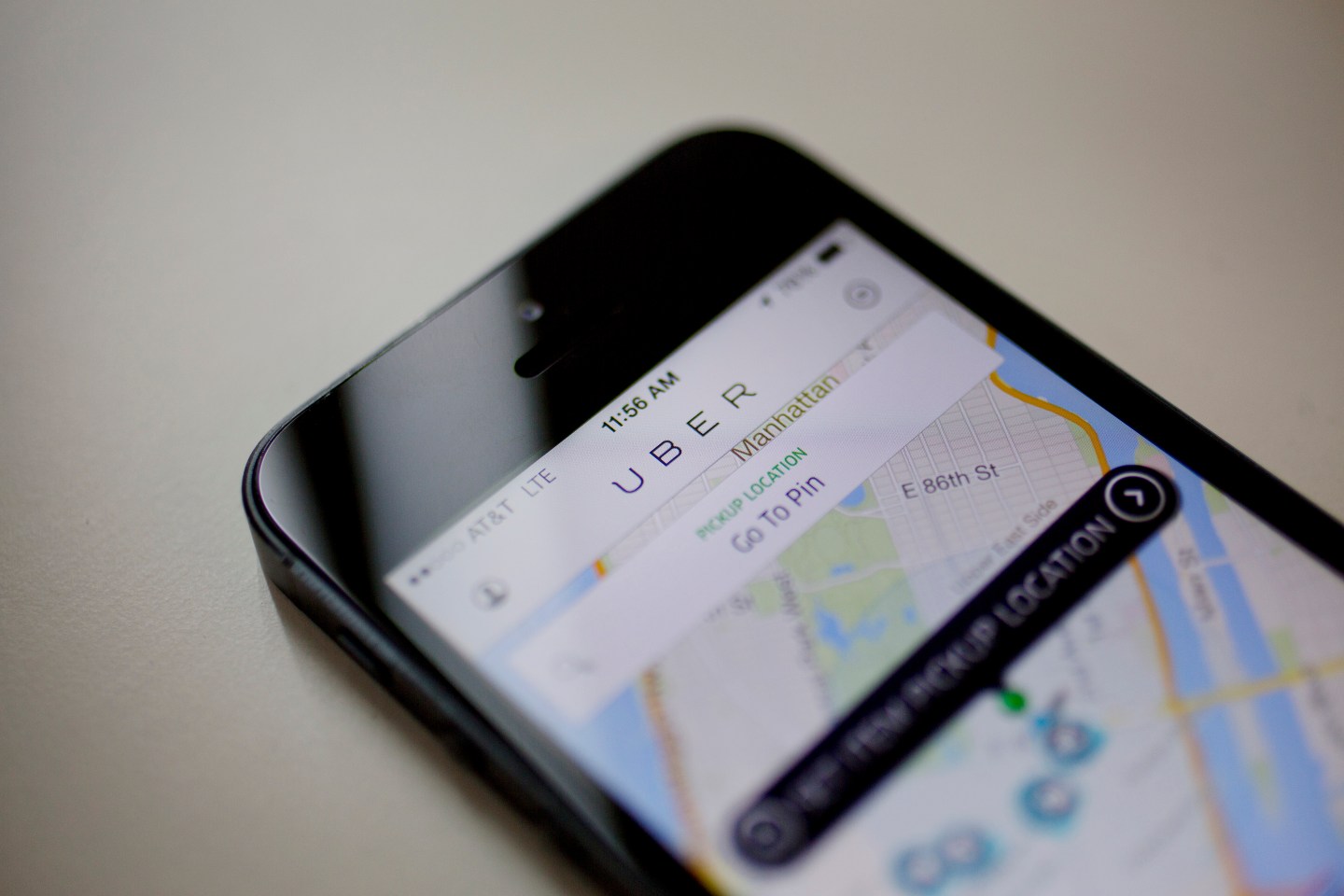
The Hamptons Lure Uber Top Drivers Amid NYC Slow Summer Weekends
Bloomberg Bloomberg -- Getty Images

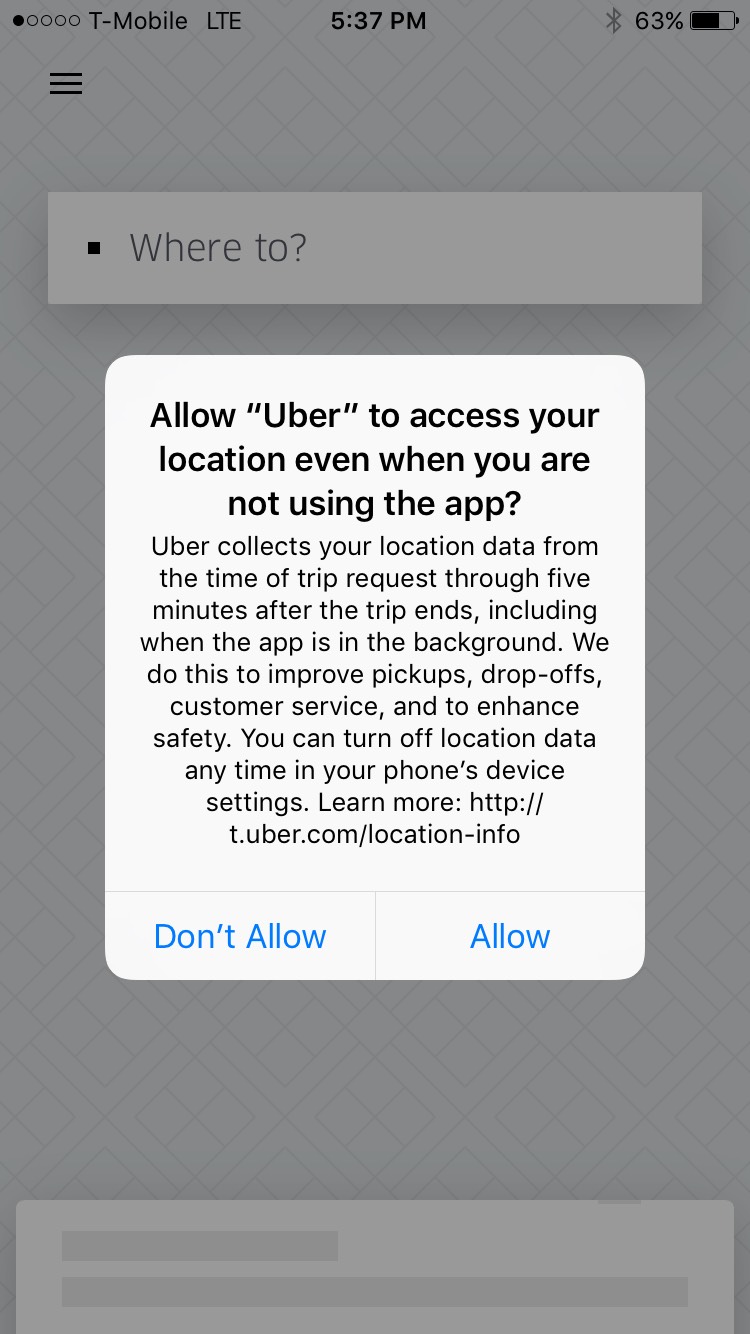
If you opened up your Uber app in the last few days, you probably encountered a message like the one below that pressed you to let the ride-hailing service “access your location even when you are not using the app.”

The message gave rise to a predictable series of hand-wringing headlines warning how Uber would now track its users even after they completed a trip. While this might sound sinister, the reality is more banal—and it might even be a good idea.

In a conversation with Fortune, a company spokesperson discussed what is going on, and explained why Uber users can probably rest easy about the recent message.
img_3544

As the company makes clear on its website, the act of saying “Allow” will not lead to the company recording every step you take. Instead, it grants Uber permission to record your location from the time you request a trip until five minutes after a trip is ended.

Some may wonder why the extra permissions are necessary in the first place given that Uber appeared to track their location already. Indeed, as regular users know, the trip history feature in the app will a display a history of all the rides a customers has taken.

But as it turns out, Uber’s previous permission rules only let the company gather location in the event the app was open and in the foreground of a user’s phone. (Information about ride history is gleaned from driver records).

Get Data Sheet, Fortune’s technology newsletter.

The downside to the old rules is that many users would summon a car and then switch to another app — leading a driver seeking out a static location marker that did not correspond to the user’s exact location. This could lead to a familiar (and frustrating) series of calls or texts as the Uber driver and passenger sought to find each other outside a crowded event or airport terminal.

Under the new permission rules, such mix-ups are less likely since the driver will have the customer’s precise location. Meanwhile, Uber says the five minutes of location data collected after a trip has ended will provide data to ensure a customer was dropped off at an optimal spot—not on the wrong side of a busy street.

The five minute after-the-fact data collection, however, dismays privacy groups like the Electronic Frontier Foundation.

“They may be concerned about getting into some database about their location and may get dropped off across the street. It’s sad to take that away,” EFF’s deputy counsel Kurt Opsahl told Buzzfeed.

This concern may be overblown, however, given that any user uncomfortable with Uber’s changes can simply deny location access to to the company in their phone settings and enter an address manually instead.

Long story short, Uber does not appear to be collecting much more information than it already had through driver records, and the new data would allow it to offer better service. Moreover, the company can even claim credit for being upfront about the change rather than burying it deep in an terms-of-service update.

Uber’s privacy practices have certainly raised cause for concern in the past but the current controversy appears to be a false alarm.


About the Author
By Jeff John RobertsEditor, Finance and Crypto
LinkedIn iconTwitter icon

Jeff John Roberts is the Finance and Crypto editor at Fortune, overseeing coverage of the blockchain and how technology is changing finance.

See full bioRight Arrow Button Icon

Latest in Tech

Mark Zuckerberg laughs during his 2017 Harvard commencement speech
SuccessMark Zuckerberg
Mark Zuckerberg says the ‘most important thing’ he built at Harvard was a prank website: ‘Without Facemash I wouldn’t have met Priscilla’
By Dave SmithDecember 6, 2025
2 hours ago
AIMeta
It’s ‘kind of jarring’: AI labs like Meta, Deepseek, and Xai earned some of the worst grades possible on an existential safety index
By Patrick Kulp and Tech BrewDecember 5, 2025
13 hours ago
Elon Musk
Big TechSpaceX
Musk’s SpaceX discusses record valuation, IPO as soon as 2026
By Edward Ludlow, Loren Grush, Lizette Chapman, Eric Johnson and BloombergDecember 5, 2025
14 hours ago
data center
EnvironmentData centers
The rise of AI reasoning models comes with a big energy tradeoff
By Rachel Metz, Dina Bass and BloombergDecember 5, 2025
14 hours ago
netflix
Arts & EntertainmentAntitrust
Hollywood writers say Warner takeover ‘must be blocked’
By Thomas Buckley and BloombergDecember 5, 2025
14 hours ago
person
CybersecurityDigital
Dictionaries’ words of the year are trying to tell us something about being online in 2025
By Roger J. KreuzDecember 5, 2025
15 hours ago

Most Popular

placeholder alt text
Economy
Two months into the new fiscal year and the U.S. government is already spending more than $10 billion a week servicing national debt
By Eleanor PringleDecember 4, 2025
2 days ago
placeholder alt text
Success
‘Godfather of AI’ says Bill Gates and Elon Musk are right about the future of work—but he predicts mass unemployment is on its way
By Preston ForeDecember 4, 2025
2 days ago
placeholder alt text
Success
Nearly 4 million new manufacturing jobs are coming to America as boomers retire—but it's the one trade job Gen Z doesn't want
By Emma BurleighDecember 4, 2025
2 days ago
placeholder alt text
Success
Nvidia CEO Jensen Huang admits he works 7 days a week, including holidays, in a constant 'state of anxiety' out of fear of going bankrupt
By Jessica CoacciDecember 4, 2025
2 days ago
placeholder alt text
Real Estate
‘There is no Mamdani effect’: Manhattan luxury home sales surge after mayoral election, undercutting predictions of doom and escape to Florida
By Sasha RogelbergDecember 4, 2025
2 days ago
placeholder alt text
Big Tech
Mark Zuckerberg rebranded Facebook for the metaverse. Four years and $70 billion in losses later, he’s moving on
By Eva RoytburgDecember 5, 2025
18 hours ago
Rankings
  • 100 Best Companies
  • Fortune 500
  • Global 500
  • Fortune 500 Europe
  • Most Powerful Women
  • Future 50
  • World’s Most Admired Companies
  • See All Rankings
Sections
  • Finance
  • Leadership
  • Success
  • Tech
  • Asia
  • Europe
  • Environment
  • Fortune Crypto
  • Health
  • Retail
  • Lifestyle
  • Politics
  • Newsletters
  • Magazine
  • Features
  • Commentary
  • Mpw
  • CEO Initiative
  • Conferences
  • Personal Finance
  • Education
Customer Support
  • Frequently Asked Questions
  • Customer Service Portal
  • Privacy Policy
  • Terms Of Use
  • Single Issues For Purchase
  • International Print
Commercial Services
  • Advertising
  • Fortune Brand Studio
  • Fortune Analytics
  • Fortune Conferences
  • Business Development
About Us
  • About Us
  • Editorial Calendar
  • Press Center
  • Work At Fortune
  • Diversity And Inclusion
  • Terms And Conditions
  • Site Map

© 2025 Fortune Media IP Limited. All Rights Reserved. Use of this site constitutes acceptance of our Terms of Use and Privacy Policy | CA Notice at Collection and Privacy Notice | Do Not Sell/Share My Personal Information
FORTUNE is a trademark of Fortune Media IP Limited, registered in the U.S. and other countries. FORTUNE may receive compensation for some links to products and services on this website. Offers may be subject to change without notice.