• Home
  • Latest
  • Fortune 500
  • Finance
  • Tech
  • Leadership
  • Lifestyle
  • Rankings
  • Multimedia
Commentary

How Rocky U.S.-China Relations Benefit North Korea’s Nuclear Missiles

By
Minxin Pei
Down Arrow Button Icon
By
Minxin Pei
Down Arrow Button Icon
September 29, 2016, 1:00 AM ET
NKOREA-POLITICS-KIM
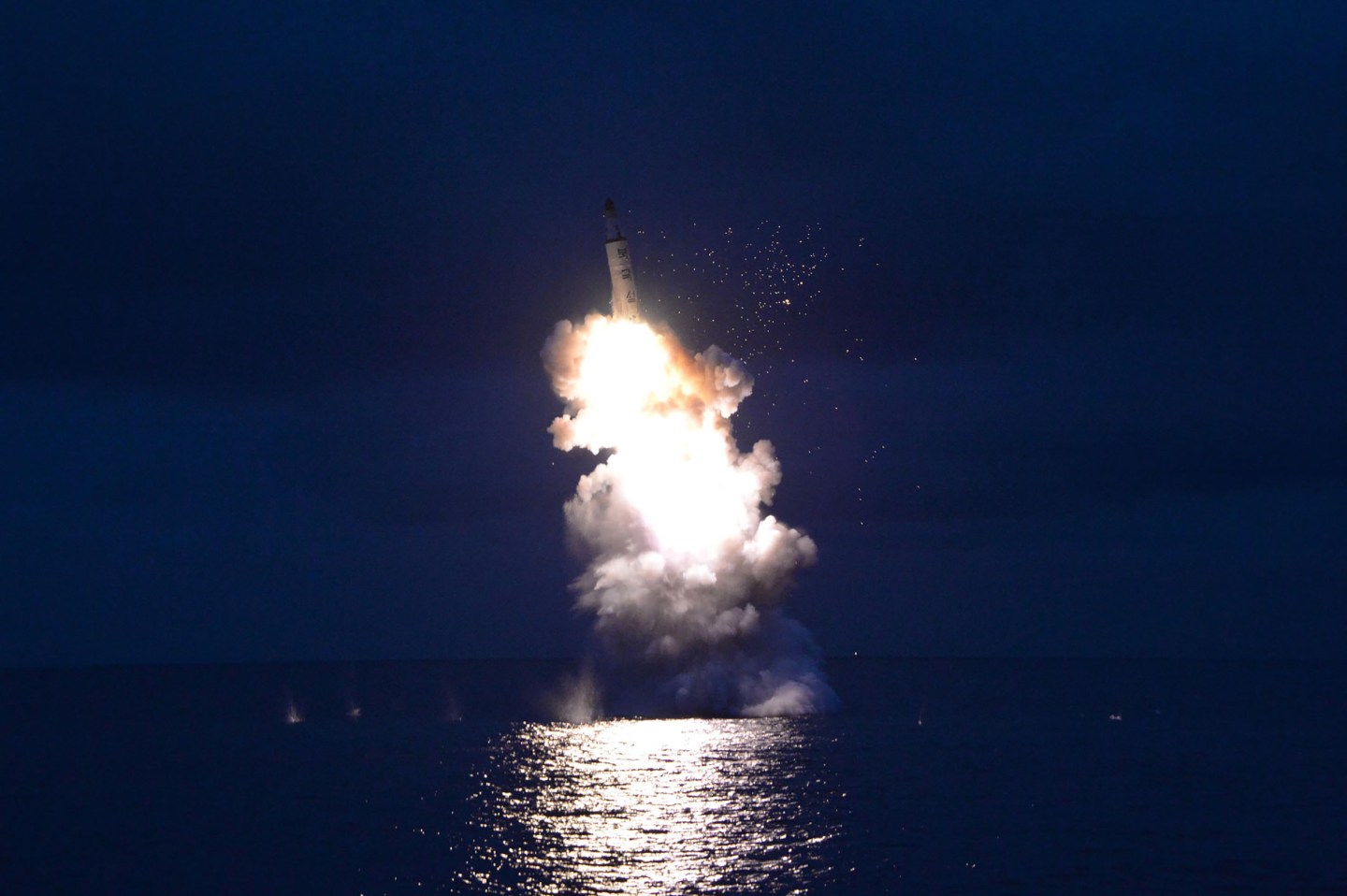
This undated picture released from North Korea's official Korean Central News Agency (KCNA) on August 25, 2016 shows a test-fire of strategic submarine-launched ballistic missile being launched at an undisclosed location. / AFP / KCNA / KNS / South Korea OUT / REPUBLIC OF KOREA OUT / SOUTH KOREA OUT ---EDITORS NOTE--- RESTRICTED TO EDITORIAL USE - MANDATORY CREDIT "AFP PHOTO/KCNA VIA KNS" - NO MARKETING NO ADVERTISING CAMPAIGNS - DISTRIBUTED AS A SERVICE TO CLIENTS THIS PICTURE WAS MADE AVAILABLE BY A THIRD PARTY. AFP CAN NOT INDEPENDENTLY VERIFY THE AUTHENTICITY, LOCATION, DATE AND CONTENT OF THIS IMAGE. THIS PHOTO IS DISTRIBUTED EXACTLY AS RECEIVED BY AFP. / (Photo credit should read KNS/AFP/Getty Images)KNS—AFP/Getty Images

Ever since North Korea tested its fifth – and most powerful – nuclear device earlier this month, the international community has been waiting for a response from the United Nations Security Council (UNSC). Unfortunately, those hoping that the UNSC would impose swift and punishing sanctions on North Korea will have to wait a bit longer. When North Korea conducted its fourth nuclear test in January, it took two months for the UNSC to cobble together a unanimous resolution that included tough sanctions but left major loopholes because of China’s opposition.

This time, however, Washington does not appear to have the patience. This week, the Justice Department indicted Ma Xiaohong, a prominent Chinese businesswoman who owns Dandong Hongxiang Industrial Development Co., for acting as a front for North Korean firms under U.S. sanctions and providing materials for Pyongyang’s nuclear and missile programs. Ma’s company’s business with North Korea accounts for more than 20% of the bilateral trade between Beijing and Pyongyang. With this indictment, the U.S. government is signaling to Beijing that, if China sits idle by as North Korea ratchets up tensions, Washington and its allies will further tighten the screws on Pyongyang and take steps that will inevitably harm Chinese interests.

If one looks at Pyongyang’s recent escalations, Kim Jong En, the 32-year old dictator, is unmistakably in a rush to acquire deployable nuclear warheads and delivery vehicles. In February, North Korea successfully launched a satellite into the earth’s orbit, indicating major progress in developing long-range missiles. At the end of August, Pyongyang tested a submarine-launched missile that flew roughly 300 miles, another milestone in its military capabilities.

Even though analysts are divided whether the Kim regime is attempting to strengthen its bargaining position by becoming a de facto nuclear state or achieve other strategic objectives, what is clear is that Pyongyang’s escalations are creating tensions between China and the United States, an outcome that Kim welcomes since a serious U.S.-China rift could only benefit him.

The most recent sign that Kim’s provocations are causing the U.S. and China to drift further apart on the North Korea issue is the deployment of America-made advanced anti-missile system in South Korea. Called Terminal High Altitude Area Defense (Thaad), this system can shoot down short to medium range ballistic missiles. Even though China’s nuclear deterrent will not be neutralized by Thaad, Beijing fears that Thaad’s powerful radar, which has a range of 3,000 miles, will enable the United States to spy on Chinese military deployments. Consequently, instead of pressuring Pyongyang, which cannot survive without Chinese aid and trade, Beijing has decided to link its Korea policy to the deployment of Thaad system.

In other words, China will not cooperate with the U.S. in containing North Korea’s nuclear ambitions if the U.S. does not cancel its plans to deploy Thaad in South Korea.

In the eyes of Washington, Beijing is putting the cart before the horse. The reasoning of President Barack Obama and his national security team is that the very deployment of Thaad is necessitated by China’s reluctance to force North Korea to abandon or curtail its nuclear and missile programs. Since China is either unwilling or unable to make North Korea behave less recklessly, the U.S. and its allies have no choice but to take measures to defend themselves.

In an ideal world, Chinese leaders may be persuaded by the logic of Washington’s argument. However, the escalations by Pyongyang occur in the context of the geopolitical rivalry between China and the United States. For Beijing, a nuclear-armed North Korea is a menace it does not want. But North Korea also is a strategic asset to China, which is convinced that a divided Korean peninsula constitutes a security buffer against the United States. Should Chinese pressures contribute to the collapse of the Kim dynasty, a reunified Korea under democratic rule would be a nightmare far worse than a nuclear Pyongyang.

Unfortunately, such strategic reasoning has led Beijing to a policy that seeks to resolve North Korea’s nuclear challenge not through its own coercive efforts, but through American concessions. For Washington, Beijing’s policy makes little sense since North Korea is not going to trade its hard-won nuclear capabilities for concessions. Pyongyang wants to get concessions (massive economic aid) and keep its nuclear weapons.

Needless to say, Kim Jong Un is no fool. The U.S.-China rift plays into his hand. With the two great powers bickering with each other, he can exploit the resulting tensions and speed up the development of his nuclear arsenal.

So it would be unrealistic to expect that the United States will get China’s backing in imposing a new round of water-tight sanctions against North Korea after its latest nuclear test. If anything, the security conditions on the Korean peninsula will continue to deteriorate.

Minxin Pei is a professor of government at Claremont McKenna College and the author of China’s Crony Capitalism (Harvard 2016).

About the Author
By Minxin Pei
See full bioRight Arrow Button Icon

Latest in Commentary

Finance
Lorem ipsum dolor sit amet, consectetur adipiscing elit, sed do eiusmod tempor incididunt ut labore et dolore magna aliqua. Ut enim ad minim veniam
By Fortune Editors
October 20, 2025
Finance
Lorem ipsum dolor sit amet, consectetur adipiscing elit, sed do eiusmod tempor incididunt ut labore et dolore magna aliqua. Ut enim ad minim veniam
By Fortune Editors
October 20, 2025
Finance
Lorem ipsum dolor sit amet, consectetur adipiscing elit, sed do eiusmod tempor incididunt ut labore et dolore magna aliqua. Ut enim ad minim veniam
By Fortune Editors
October 20, 2025
Finance
Lorem ipsum dolor sit amet, consectetur adipiscing elit, sed do eiusmod tempor incididunt ut labore et dolore magna aliqua. Ut enim ad minim veniam
By Fortune Editors
October 20, 2025
Finance
Lorem ipsum dolor sit amet, consectetur adipiscing elit, sed do eiusmod tempor incididunt ut labore et dolore magna aliqua. Ut enim ad minim veniam
By Fortune Editors
October 20, 2025
Finance
Lorem ipsum dolor sit amet, consectetur adipiscing elit, sed do eiusmod tempor incididunt ut labore et dolore magna aliqua. Ut enim ad minim veniam
By Fortune Editors
October 20, 2025

Most Popular

Finance
Lorem ipsum dolor sit amet, consectetur adipiscing elit, sed do eiusmod tempor incididunt ut labore et dolore magna aliqua. Ut enim ad minim veniam
By Fortune Editors
October 20, 2025
Finance
Lorem ipsum dolor sit amet, consectetur adipiscing elit, sed do eiusmod tempor incididunt ut labore et dolore magna aliqua. Ut enim ad minim veniam
By Fortune Editors
October 20, 2025
Finance
Lorem ipsum dolor sit amet, consectetur adipiscing elit, sed do eiusmod tempor incididunt ut labore et dolore magna aliqua. Ut enim ad minim veniam
By Fortune Editors
October 20, 2025
Finance
Lorem ipsum dolor sit amet, consectetur adipiscing elit, sed do eiusmod tempor incididunt ut labore et dolore magna aliqua. Ut enim ad minim veniam
By Fortune Editors
October 20, 2025
Finance
Lorem ipsum dolor sit amet, consectetur adipiscing elit, sed do eiusmod tempor incididunt ut labore et dolore magna aliqua. Ut enim ad minim veniam
By Fortune Editors
October 20, 2025
Finance
Lorem ipsum dolor sit amet, consectetur adipiscing elit, sed do eiusmod tempor incididunt ut labore et dolore magna aliqua. Ut enim ad minim veniam
By Fortune Editors
October 20, 2025
Rankings
  • 100 Best Companies
  • Fortune 500
  • Global 500
  • Fortune 500 Europe
  • Most Powerful Women
  • Future 50
  • World’s Most Admired Companies
  • See All Rankings
Sections
  • Finance
  • Leadership
  • Success
  • Tech
  • Asia
  • Europe
  • Environment
  • Fortune Crypto
  • Health
  • Retail
  • Lifestyle
  • Politics
  • Newsletters
  • Magazine
  • Features
  • Commentary
  • Mpw
  • CEO Initiative
  • Conferences
  • Personal Finance
  • Education
Customer Support
  • Frequently Asked Questions
  • Customer Service Portal
  • Privacy Policy
  • Terms Of Use
  • Single Issues For Purchase
  • International Print
Commercial Services
  • Advertising
  • Fortune Brand Studio
  • Fortune Analytics
  • Fortune Conferences
  • Business Development
About Us
  • About Us
  • Editorial Calendar
  • Press Center
  • Work At Fortune
  • Diversity And Inclusion
  • Terms And Conditions
  • Site Map

© 2025 Fortune Media IP Limited. All Rights Reserved. Use of this site constitutes acceptance of our Terms of Use and Privacy Policy | CA Notice at Collection and Privacy Notice | Do Not Sell/Share My Personal Information
FORTUNE is a trademark of Fortune Media IP Limited, registered in the U.S. and other countries. FORTUNE may receive compensation for some links to products and services on this website. Offers may be subject to change without notice.


Most Popular

placeholder alt text
Economy
America's $38 trillion national debt 'exacerbates generational imbalances' with Gen Z and millennials paying the price, warns think tank
By Eleanor PringleDecember 16, 2025
2 days ago
placeholder alt text
Success
As millions of Gen Zers face unemployment, McDonald's CEO dishes out some tough love career advice for navigating the market: ‘You've got to make things happen for yourself’
By Preston ForeDecember 16, 2025
1 day ago
placeholder alt text
Innovation
An MIT roboticist who cofounded bankrupt Roomba maker iRobot says Elon Musk's vision of humanoid robot assistants is 'pure fantasy thinking'
By Marco Quiroz-GutierrezDecember 16, 2025
1 day ago
placeholder alt text
AI
IBM, AWS veteran says 90% of your employees are stuck in first gear with AI, just asking it to ‘write their mean email in a slightly more polite way’
By Marco Quiroz-GutierrezDecember 16, 2025
1 day ago
placeholder alt text
Politics
Exclusive: After citations against Elon Musk’s Boring Company were suddenly withdrawn, federal regulators are now investigating Nevada OSHA
By Jessica MathewsDecember 16, 2025
1 day ago
placeholder alt text
Banking
Trump turns on CBS, Kushner pulls out and Paramount's hostile bid for Warner Bros. shows signs of collapse
By Eva RoytburgDecember 16, 2025
1 day ago

Latest in Commentary

layoffs
CommentaryLayoffs
The AI layoff wave is just beginning — and it’s by design
By Kevin OakesDecember 17, 2025
12 hours ago
Norbert Jung
Commentary
Factory 2030 runs on more than code. As a CEO, I see the power of agentic AI—and the trust gap that we must close
By Norbert JungDecember 17, 2025
15 hours ago
TD Jakes
CommentaryReligion
To heal a divided nation, America’s next chapter must rediscover a common unity
By T.D. JakesDecember 16, 2025
1 day ago
tree
CommentaryInflation
Colorado is suffering from Christmas Tree inflation because Denver imports most of them—from North Carolina and the Pacific Northwest
By Ali Besharat and The ConversationDecember 16, 2025
2 days ago
Charles Lamanna
CommentaryMicrosoft
I lead Microsoft’s enterprise AI agent strategy. Here’s what every company should know about how agents will rewrite work
By Charles LamannaDecember 15, 2025
2 days ago
Julian Braithwaite is the Director General of the International Alliance for Responsible Drinking
CommentaryProductivity
Gen Z is drinking 20% less than Millennials. Productivity is rising. Coincidence? Not quite
By Julian BraithwaiteDecember 13, 2025
4 days ago