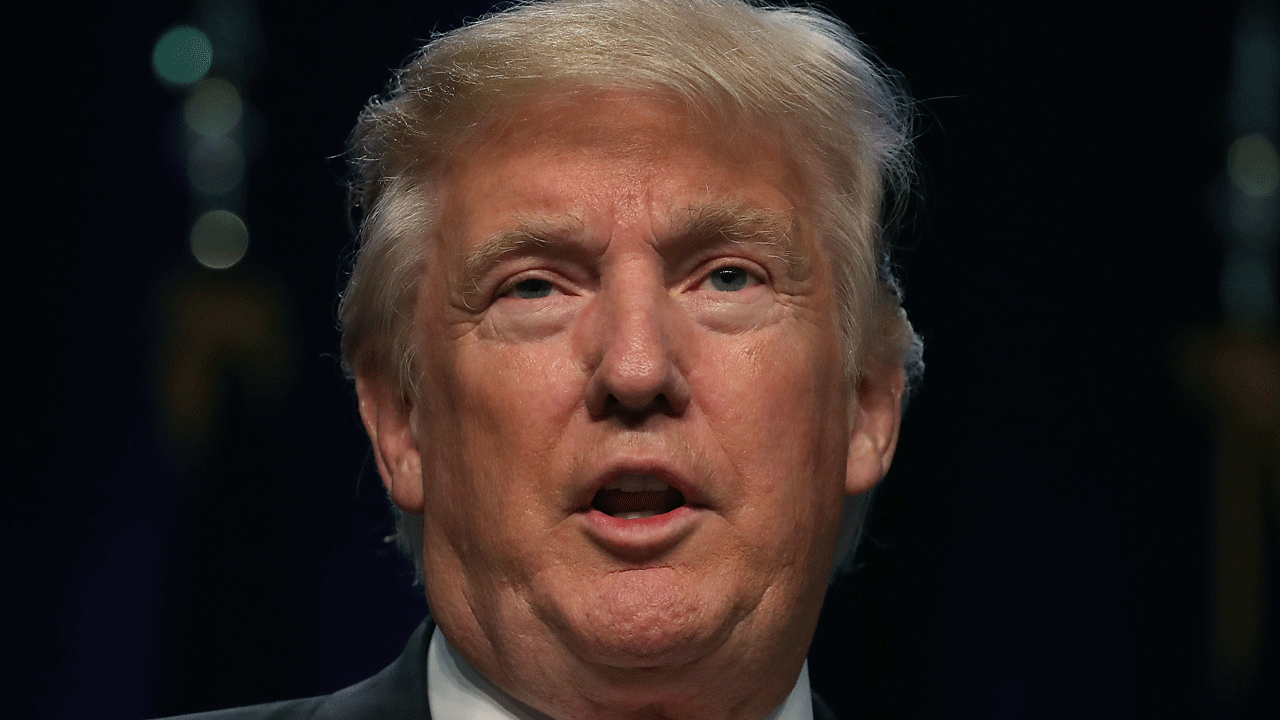
Donald Trump, who’s long sold himself as a great philanthropist, is facing a deluge of criticism for allegedly using his foundation as a personal slush fund. A recent expose in the Washington Post charged that Trump funneled $258,000 from the charity’s coffers to settle lawsuits dogging his businesses, and his staff has admitted to sending an illegal, $25,000 contribution to the reelection campaign of Florida Attorney General Pam Bondi, sparking widespread accusations that Bondi declined to investigate Trump University in exchange for the tycoon’s largesse.
The “donate-gate” revelations prompted Eric Schneiderman, the New York State Attorney General, to launch a criminal investigation. But bad as using his philanthropy’s funds for his own benefit may look, the maximum penalties the IRS is likely to levy on Trump are surprisingly, even shockingly, mild.
The total: $700,000.
The Donald J. Trump Foundation Is a Most Unusual Charity
IRS designates two types of non-profits: public charities and private foundations. Though the distinctions are technical, the crux is that public charities collect most of their contributions from lots of small donors––think of the Red Cross––while a private foundation is generally funded by a wealthy family, although they may also accept a small number of large donations from the outside. An example is the Ford Foundation.
In a previous story, I mistakenly called the Trump Foundation a public charity, thinking that it must fit that category because it distributes money only from outside contributors, and none from Trump or his family members, who haven’t given the charity anything since 2008. In fact, it’s a private foundation because it gets just tiny amounts from small contributions. In fact, it attracted only 12 donors in total from 2011 to 2014, the last year for which IRS records are available. And three of them, ticket broker Richard Ebers, NBC Universal, and Comedy Central, gave $2.8 million of 86% of the $3.27 million in total donations.
So the Trump Foundation is an oddity, a “private foundation” run by a family, where the family gives nothing, and all the contributions flow come from OPM, other people’s money, the Donald’s favorite source.
The IRS Penalties for Self-Dealing Are Weak
The IRS regulations strictly prohibit using a charity’s funds for the personal benefit of the people who control it, or to aid their businesses. The Washington Post cites no less than five cases in which Trump allegedly used his foundation’s funds to pay business expenses, saving himself around $300,000 he would otherwise need to pay from his own treasury.
Most of that money came in two big payments. In 2007, the Town of Palm Beach sued Trump for displaying Old Glory at his Mar-a-Lago resort on a flagpole so towering that it violated the municipal codes. Trump settled the suit by writing a $100,000 check from his foundation to a Veteran’s charity chosen by the city. Three years later, a lucky golfer who shot a hole-in-one at a Trump course sued to claim the $1 million prize Trump advertised, then declined to pay. Trump resolved litigation by contributing $158,000 to the golfer’s family charity, all paid by the Donald J. Trump Foundation.
The IRS classifies such transactions, using charitable funds to satisfy personal or business obligations, as “self-dealing.” The penalty is an excise tax of 10% on the foundation money that was misused. That tax is cumulative, meaning that it’s assessed each year that the misuse isn’t corrected, including interest on the unpaid penalties. It’s as if the violation happened every year. In addition, the official who benefited must refund the original amount to the foundation, once again, with interest added.
By Fortune’s estimates, Trump would have to pay a total of around $650,000 in excise taxes, refunds, and interest in 2016 to satisfy the IRS’s potential claims. Trump also famously kept two portraits of himself that he and his wife Melania purchased with foundation money at charity auctions for a total of $30,000, as well as football souvenirs autographed by celebrity quarterback Tim Tebow. But the IRS imposes excise taxes only on the “excess benefit” to the recipient, meaning in this case the difference between what Trump “donated” at the auctions and the value of the art and memorabilia he kept. Since those items are likely worth far less than what Trump donated in foundation funds at charity auctions, the penalties would be miniscule.
All the supposed abuses so reviled by pundits would cost the Trump less than $700,000, birdseed for mogul who claims to be worth $10 billion (even if he’s really worth only $3.5 billion).
The IRS Won’t Revoke the Foundation’s Tax-Free Status
The big danger is that IRS considers Trump’s self-dealing so bad that it revokes his foundation’s tax-exempt status, shuttering the controversial charity. But that’s not likely to happen.
The IRS only takes such drastic measures when a charity is “operating primarily for private benefit.” IRS rulebook offers no precise definition of “primarily.” What’s more, only three major cases of alleged misuse have emerged––the $25,000 donation to Bondi, and the two big donations deployed to settle legal claims. Those alleged misdeeds span eight years of filings. In that period, the foundation has made $6.9 million in contributions to hundreds of renowned charities. The $300,000 or so in question is a small fraction of that amount. Unless far more pervasive self-dealing emerges, the Trump Foundation, master of OPM, stays in business.
Even If the IRS Investigates, It Won’t Influence the Election
Given the seemingly serious violations already exposed, the IRS could initiate an audit to examine if the Trump Foundation is a sham operated mainly for the billionaire’s benefit. Nonetheless, the IRS has a policy not to make public announcements about investigations. So even if it does investigate, we won’t know. What’s more, the audit would take many months. So the findings would emerge long after the election. Meanwhile, America is getting a deep look at a charity as unorthodox as the celebrity non-benefactor whose name it bears.