• Home
  • Latest
  • Fortune 500
  • Finance
  • Tech
  • Leadership
  • Lifestyle
  • Rankings
  • Multimedia
TechFortune 500

Wireless Companies Join Tech and Security Firms for Big Bid on Emergency Spectrum

Jeff John Roberts
By
Jeff John Roberts
Jeff John Roberts
Editor, Finance and Crypto
Down Arrow Button Icon
Jeff John Roberts
By
Jeff John Roberts
Jeff John Roberts
Editor, Finance and Crypto
Down Arrow Button Icon
June 7, 2016, 8:00 AM ET
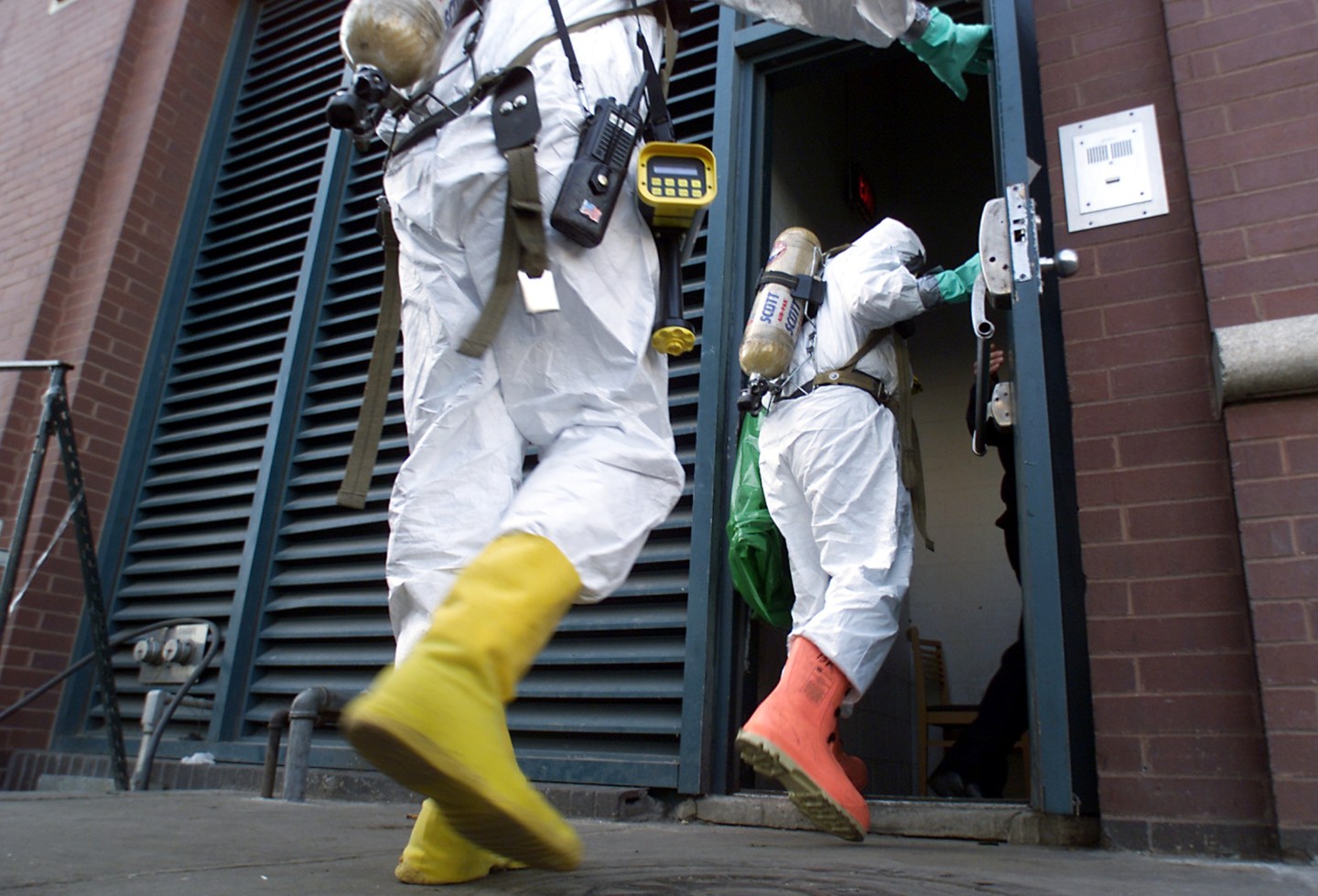
UNITED STATES - OCTOBER 19:  Firefighters in hazmat suits enter offices of Jefferies, Inc., in Jersey City, N.J., to investigate suspicious white powder found in an envelope.  (Photo by Mike Albans/NY Daily News Archive via Getty Images)
UNITED STATES - OCTOBER 19: Firefighters in hazmat suits enter offices of Jefferies, Inc., in Jersey City, N.J., to investigate suspicious white powder found in an envelope. (Photo by Mike Albans/NY Daily News Archive via Getty Images)Photograph by Mike Albans — New York Daily News Archive/Getty Images

Companies spanning the telecom, tech, and security industries announced a partnership on Tuesday that seeks to win a $6.5 billion contract to build a national emergency network. Their bid also contains a major economic twist that could, if successful, see the companies shake up how companies buy and sell precious wireless spectrum.

The consortium, which is holding a press conference at 10 a.m. ET, includes wireless network makers Nokia (NOK) and Ericsson (ERIC), Intel Security (INTC), and Harris Corporation (HRS), a defense and IT contractor.

The companies together are backing an upstart called Rivada Mercury, which is leading the bid to create a long-awaited communications platform for emergency responders across the country. On the ground, this would mean building the country’s first nationwide 4G LTE network for public safety.

The origins of the proposed emergency network, which has reportedly attracted two other bidders in addition to Rivada, dates back more than a decade.

It began when the 9/11 Commission, citing snafus that snarled telecommunications on that tragic day, called for a dedicated platform for emergency communications. Today the goal of the proposed platform is to ensure firefighters and other first responders can always talk to each other, and across state lines, even in the event of a major blow to urban infrastructure.

Congress gave the go-ahead in 2012, but the project was tangled in bureaucracy and technical disputes until last year. But since then FirstNet, the government agency responsible, has moved it forward, and is expected to select a winner by the fall, allowing construction to begin in 2017.

The winning bidder will receive at least $6.5 billion to build out towers and other infrastructure needed for a national network. But the real prize, in the eyes of telecom types, is the 20 MHz the winning bidder will receive to operate the network.

The reason the spectrum is so valuable is it sits in Section D of the 700 MHz block, which is considered the beachfront realty of the airwaves. It is highly suitable for transmitting the sort of wireless data consumers gobble on their cell phones.

While FirstNet wants bidders (unsurprisingly) to guarantee reliable emergency service, the process also lets them deploy the spectrum for commercial purposes. This is possible since the vast bulk of the 20MHz will not be needed by first responders on any given day.

In the event of a disaster, the network operator will be able to flip a switch and allocate the entire block for emergency purposes. Rivada co-CEO Declan Ganley described the technique to Fortune as “ruthless pre-emption.” Most of the time, however, Rivada (or whoever wins the bid) will get to sling the spectrum as they wish.

Selling Spectrum on the Open Market

A national emergency network will likely be a useful service, and may even offer room for innovation — some have floated the idea of an app store full of home-spun apps for firefighters. But if Rivada Networks wins the bid, the real disruption could come in the way bandwidth is bought and sold.

Currently, big telecom companies like AT&T and Verizon acquire spectrum and then hoard it. They deploy it, of course, but only to their own subscribers or occasionally to small discount resellers called MVNOs, which they largely control.

Get Data Sheet, Fortune’s technology newsletter.

What Rivada Networks wants to do is create something closer to a commodities arrangement. The company wants to take all that prime 700 MHz spectrum and sell it on the spot market, and even create a futures market.

The scheme may sound far-fetched but for the recent surge in spectrum demand, in which everyone from car companies to home appliance makers are scrambling to stuff their products with Internet features. A source close to the company says Rivada has already been in discussion with utilities, automakers, and MVNOs about selling spectrum a la carte.

In a release, Rivada’s co-CEO Joe Euteneuer described the overall pitch like this:

“As a pioneer in dynamic spectrum arbitrage, Rivada Mercury’s innovative technology will both fund the FirstNet build out and sustained operation and maintenance by selling excess capacity to commercial users.”

The question, of course, is whether the agency receiving the bid will buy into Rivada’s vision enough to award the contract.

High-Stakes Bid

If FirstNet awards the bid to Rivada, the consortium will receive at least $6.5 billion and a chance to remake the broadband market. If it loses, it will get nothing.

One factor that could tip the bid in Rivada’s favor is money. Under the terms of the FirstNet process, companies that bid must pledge to pay a minimum of $5.65 billion to the government over 25 years in exchange for using the spectrum. If Rivada thinks its open market spectrum plan will pull in a lot, it may have pledged to pay out a lot more when the bids closed at the end of May.

Rivada also has a formidable team in place. Ganley ran telecom operations during Hurricane Katrina, while his co-CEO, Euteneuer, was CFO at Sprint (S) and Comcast (CMCSA). The company has also named former governors and recent presidential candidates Jeb Bush and Martin O’Malley to its board.

Finally, the country’s broad-ranging partnerships, including Harris Corporation, which has a long track record of emergency services, could persuade the government that Rivada has the chops to do the job. (The company is also partnering with two other familiar telecom names, Black & Veatch and Fujitsu Network Communications, to help with back-end engineering.)

On the other hand, Rivada isn’t the only one bidding. While FirstNet’s procurement rules do not permit the government to disclose the bidders, the source close to Rivada believes that there are two other bids, including one led by AT&T (T) and Motorola (MSI), and another by a fellow upstart.

Any bid by AT&T would receive strong consideration given the company’s size and its deep influence in Washington lobbying circles. While AT&T’s interest in FirstNet has been reported by the trade press, the company has yet to announce a bid. A company spokesperson, reached by phone and email, did not provide a formal answer as to the nature of AT&T’s bid, or even confirm that a bid was submitted.

Meanwhile, rival phone giant Verizon (VZ) has likewise been identified in the press as a contender, but has yet to announce its intentions.

“Federal contracting rules prohibit us from commenting until after the contract has been officially awarded,” said a Verizon spokesperson.

FirstNet is expected to announce the outcome in the fall. The result could deliver the U.S. a national platform for emergency broadcasts—and possibly a brand new type of broadband market.

This story was updated at 12:45ET to include Verizon’s statement. It was corrected at 5:30pm to describe Nokia and Ericsson as wireless network firms, not phone makers.


About the Author
Jeff John Roberts
By Jeff John RobertsEditor, Finance and Crypto
LinkedIn iconTwitter icon

Jeff John Roberts is the Finance and Crypto editor at Fortune, overseeing coverage of the blockchain and how technology is changing finance.

See full bioRight Arrow Button Icon

Latest in Tech

Finance
Lorem ipsum dolor sit amet, consectetur adipiscing elit, sed do eiusmod tempor incididunt ut labore et dolore magna aliqua. Ut enim ad minim veniam
By Fortune Editors
October 20, 2025
Finance
Lorem ipsum dolor sit amet, consectetur adipiscing elit, sed do eiusmod tempor incididunt ut labore et dolore magna aliqua. Ut enim ad minim veniam
By Fortune Editors
October 20, 2025
Finance
Lorem ipsum dolor sit amet, consectetur adipiscing elit, sed do eiusmod tempor incididunt ut labore et dolore magna aliqua. Ut enim ad minim veniam
By Fortune Editors
October 20, 2025
Finance
Lorem ipsum dolor sit amet, consectetur adipiscing elit, sed do eiusmod tempor incididunt ut labore et dolore magna aliqua. Ut enim ad minim veniam
By Fortune Editors
October 20, 2025
Finance
Lorem ipsum dolor sit amet, consectetur adipiscing elit, sed do eiusmod tempor incididunt ut labore et dolore magna aliqua. Ut enim ad minim veniam
By Fortune Editors
October 20, 2025
Finance
Lorem ipsum dolor sit amet, consectetur adipiscing elit, sed do eiusmod tempor incididunt ut labore et dolore magna aliqua. Ut enim ad minim veniam
By Fortune Editors
October 20, 2025

Most Popular

Finance
Lorem ipsum dolor sit amet, consectetur adipiscing elit, sed do eiusmod tempor incididunt ut labore et dolore magna aliqua. Ut enim ad minim veniam
By Fortune Editors
October 20, 2025
Finance
Lorem ipsum dolor sit amet, consectetur adipiscing elit, sed do eiusmod tempor incididunt ut labore et dolore magna aliqua. Ut enim ad minim veniam
By Fortune Editors
October 20, 2025
Finance
Lorem ipsum dolor sit amet, consectetur adipiscing elit, sed do eiusmod tempor incididunt ut labore et dolore magna aliqua. Ut enim ad minim veniam
By Fortune Editors
October 20, 2025
Finance
Lorem ipsum dolor sit amet, consectetur adipiscing elit, sed do eiusmod tempor incididunt ut labore et dolore magna aliqua. Ut enim ad minim veniam
By Fortune Editors
October 20, 2025
Finance
Lorem ipsum dolor sit amet, consectetur adipiscing elit, sed do eiusmod tempor incididunt ut labore et dolore magna aliqua. Ut enim ad minim veniam
By Fortune Editors
October 20, 2025
Finance
Lorem ipsum dolor sit amet, consectetur adipiscing elit, sed do eiusmod tempor incididunt ut labore et dolore magna aliqua. Ut enim ad minim veniam
By Fortune Editors
October 20, 2025
Fortune Secondary Logo
Rankings
  • 100 Best Companies
  • Fortune 500
  • Global 500
  • Fortune 500 Europe
  • Most Powerful Women
  • Future 50
  • World’s Most Admired Companies
  • See All Rankings
Sections
  • Finance
  • Fortune Crypto
  • Features
  • Leadership
  • Health
  • Commentary
  • Success
  • Retail
  • Mpw
  • Tech
  • Lifestyle
  • CEO Initiative
  • Asia
  • Politics
  • Conferences
  • Europe
  • Newsletters
  • Personal Finance
  • Environment
  • Magazine
  • Education
Customer Support
  • Frequently Asked Questions
  • Customer Service Portal
  • Privacy Policy
  • Terms Of Use
  • Single Issues For Purchase
  • International Print
Commercial Services
  • Advertising
  • Fortune Brand Studio
  • Fortune Analytics
  • Fortune Conferences
  • Business Development
  • Group Subscriptions
About Us
  • About Us
  • Editorial Calendar
  • Press Center
  • Work At Fortune
  • Diversity And Inclusion
  • Terms And Conditions
  • Site Map
  • About Us
  • Editorial Calendar
  • Press Center
  • Work At Fortune
  • Diversity And Inclusion
  • Terms And Conditions
  • Site Map
  • Facebook icon
  • Twitter icon
  • LinkedIn icon
  • Instagram icon
  • Pinterest icon

Latest in Tech

The Navy confirmed an ‘abundant amount’ of Uncrustables when the Artemis II crew lands. Smucker’s just offered them a lifetime supply
PoliticsFood and drink
The Navy confirmed an ‘abundant amount’ of Uncrustables when the Artemis II crew lands. Smucker’s just offered them a lifetime supply
By Catherina GioinoApril 10, 2026
2 hours ago
Three people sit behind a desk and look at the phone screen of the person in the middle.
Future of WorkConsulting
Meet ‘trendslop,’ the new, AI-fueled scourge of workplace consultants everywhere
By Sasha RogelbergApril 10, 2026
2 hours ago
Amazon is still paying Jeff Bezos an $80,000 yearly salary—but $1.6 million for travel and security
Big TechCEO salaries and executive compensation
Amazon is still paying Jeff Bezos an $80,000 yearly salary—but $1.6 million for travel and security
By Marco Quiroz-GutierrezApril 10, 2026
3 hours ago
Kash Patel sits with his two fingers on lips
CybersecurityIran
First they went after medtech, then Kash Patel. Iranian hackers’ next target is likely ‘low-hanging fruit’ in water, energy, and tourism, experts say
By Jacqueline MunisApril 10, 2026
4 hours ago
scott bessent
CybersecurityFederal Reserve
The AI that found 27-year-old vulnerabilities no human ever caught before just forced an emergency meeting with every major Wall Street CEO
By Jake AngeloApril 10, 2026
6 hours ago
Ukraine will have the most important defense industrial base in the free world, former CIA chief predicts
InnovationDefense
Ukraine will have the most important defense industrial base in the free world, former CIA chief predicts
By Jason MaApril 10, 2026
8 hours ago

Most Popular

The U.S. government is spending $88 billion a month in interest on national debt—equal to spending on defense and education combined
Economy
The U.S. government is spending $88 billion a month in interest on national debt—equal to spending on defense and education combined
By Fortune EditorsApril 9, 2026
2 days ago
A Meta employee created a dashboard so coworkers can compete to be the company's No. 1 AI token user—and Zuckerberg doesn't even rank in the top 250
AI
A Meta employee created a dashboard so coworkers can compete to be the company's No. 1 AI token user—and Zuckerberg doesn't even rank in the top 250
By Fortune EditorsApril 9, 2026
2 days ago
Mark Cuban admits he made a mistake letting go of the Mavericks: 'I don't regret selling. I regret who I sold to'
Investing
Mark Cuban admits he made a mistake letting go of the Mavericks: 'I don't regret selling. I regret who I sold to'
By Fortune EditorsApril 9, 2026
1 day ago
Schools across America are quietly admitting that screens in classrooms made students worse off and are reversing years of tech-first policies
Innovation
Schools across America are quietly admitting that screens in classrooms made students worse off and are reversing years of tech-first policies
By Fortune EditorsApril 10, 2026
15 hours ago
'I hate working 5 days': Zoom CEO says traditional work schedules are becoming obsolete—and predicts a 3-day workweek by 2031
Success
'I hate working 5 days': Zoom CEO says traditional work schedules are becoming obsolete—and predicts a 3-day workweek by 2031
By Fortune EditorsApril 9, 2026
1 day ago
 The world's 500 richest people made more than a quarter trillion yesterday as volatile markets react to fragile Iran war ceasefire
Economy
 The world's 500 richest people made more than a quarter trillion yesterday as volatile markets react to fragile Iran war ceasefire
By Fortune EditorsApril 9, 2026
1 day ago

© 2026 Fortune Media IP Limited. All Rights Reserved. Use of this site constitutes acceptance of our Terms of Use and Privacy Policy | CA Notice at Collection and Privacy Notice | Do Not Sell/Share My Personal Information
FORTUNE is a trademark of Fortune Media IP Limited, registered in the U.S. and other countries. FORTUNE may receive compensation for some links to products and services on this website. Offers may be subject to change without notice.