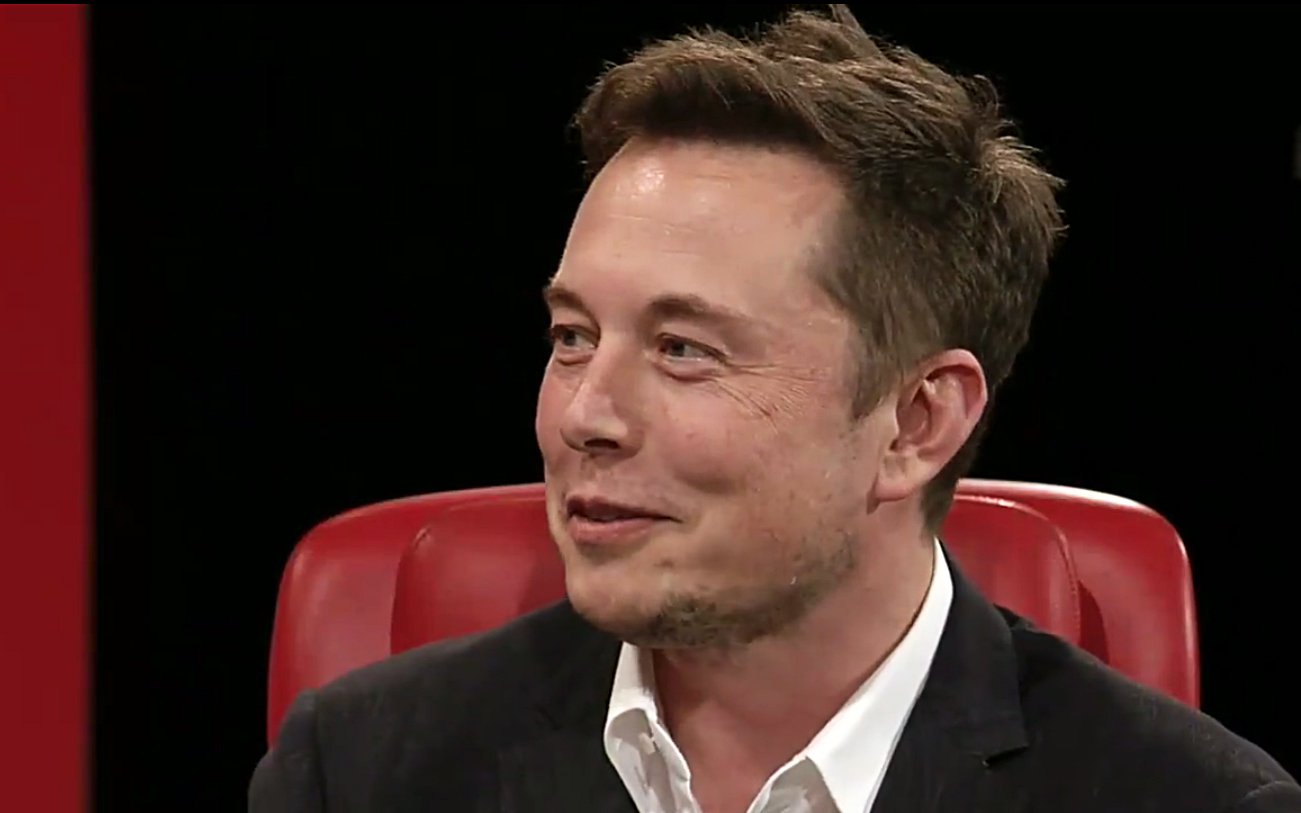
Rocket Man was running late. His landing gear wouldn’t retract when his private jet lifted off the runway. The pilot said that if he retracted the landing gear it might not deploy again. And so Elon Musk, chief executive of SpaceX, the high-risk space exploration company hellbent on manufacturing and launching spacecraft, flew to Rancho Palos Verdes, Calif. with wheels out.
“Sorry I’m late,” he somewhat bashfully told an audience of technologists at the annual Code Conference.
Musk quickly made up for it with a master class in physics and candor about his work to successfully launch reusable rockets and his broader goal to colonize Mars. (Musk is also CEO of Tesla Motors and chairman of SolarCity.)
“There are a lot of things where I didn’t think we would be successful,” Musk acknowledged. But he was. The most significant recent achievement to Musk is being able to land an orbital-class rocket on land at Cape Canaveral, Fla. as well as on a drone ship in the ocean.
“A lot of people were confused: ‘Why the heck are you landing a rocket on a ship in the ocean? That seems pretty inconvenient,'” Musk said. “Going up and staying up is actually about velocity horizontal to the Earth’s surface. There’s a huge difference between space and orbit.”
The reason that things go up and stay up, Musk said, is because they are moving so fast around the Earth—yes, around, rather than straight up—that their outward radial navigation is equal to the inward acceleration of gravity. Those balance out, creating net zero gravity. The science of this is called orbital dynamics, and it’s the reason the International Space Station looks immobile even though it’s orbiting the Earth at 17,000 miles per hour—more than 25 times faster than the bullet from a .45 caliber handgun.
“There’s no such thing as the term ‘escape altitude,’ just ‘escape velocity,'” Musk said.
Get Data Sheet, Fortune’s technology newsletter.
So what’s all that have to do with SpaceX? Well, it’s horizontal velocity—not altitude—that allows the company’s rockets to reach orbit. Normally, if SpaceX wants to save that rocket from certain destruction, it would have to burn fuel to halt and reverse speeds of up to 10 times the speed of sound—”physically impossible” in the vacuum of space, Musk said. That’s not going to happen.
So SpaceX instead continues the ballistic arc the rocket takes and land it far out to sea on a ship pre-positioned within a meter of specified latitudinal and longitudinal coordinates. In April, it managed to do just that, proving that a $35 million Falcon 9 rocket stage could be saved and reused.
“I tell my team, imagine there’s a pallet of cash that was plummeting through the atmosphere and it’s going to burn up and smash into tiny pieces. Would you try to save it? Probably yes. That sounds like a good idea,” Musk said as his audience giggled. “So we want to get it back and that way we don’t have to make another one. I think it’s quite tragic that rockets would get smashed up into tiny pieces.”
Musk hopes to reuse one of the landed rocket boosters “hopefully in about two or three months.” By the end of this year—a delay from previous announcements—SpaceX hopes to launch in a demonstration its Falcon Heavy, “the most powerful rocket in the world by more than a factor of two.” That’s five million pounds of thrust at liftoff, or two-thirds the size of the Saturn V—the rocket that took the first astronauts to the moon.
The long view is to use the new rocket for both research (about one quarter of SpaceX launches are for NASA) and commercial ends (the rest of that share is for broadcast and communications satellites as well as research missions for other countries).
“There’s quite a backlog,” Musk said, adding that the company was working its way through a six month backlog.
It’s not just orbital exercises that captivate the SpaceX executive. Asked about his public statements on how and why humans should colonize Mars, which were echoed by Amazon CEO Jeff Bezos earlier this week, Musk elaborated.
“It’s important to ultimately be out there among the stars,” Musk said. “It’s the exciting, inspiring future that I think people want.”
Humans could be a “multi-planet species” that ultimately extend to other star systems, Musk said.
“You need things like that to be glad to wake up in the morning,” he said. “Life can’t be just about solving problems. There have to be things that are inspiring and exciting and make you glad to be alive.”
And when might that fantasy actually become reality? Sooner rather than later. Musk says SpaceX wants to be the Union Pacific of Mars—an “entrepreneurial enabler” for the planet. His company hopes to send the second version of its Dragon spacecraft to Mars in 2018, and send humans in 2024 or 2025.
But he won’t be on that flight, he said with a grin. Asked about how that aligns with his earlier remarks on the subject—in 2013, Musk told an audience at the South by Southwest festival in Austin that he’d “like to die on Mars, just not on impact”—Musk grinned.
“If you’ve got to choose a place to die, then Mars is probably not a bad choice,” he said to audience laughter. “It’s not some sort of Martian death wish or something. But, you know–be born on Earth, die on Mars—that’s pretty good.”
Well, hang on, Elon. Are you saying civilization should abandon Earth altogether? Is it really that bad?
“No, no. I think it’s great,” Musk said, stifling a smile. “Why would we abandon Earth? It’s really nice here.”