• Home
  • News
  • Fortune 500
  • Tech
  • Finance
  • Leadership
  • Lifestyle
  • Rankings
  • Multimedia
TechSupreme Court

Supreme Court Rejects Privacy Claim in Data Broker Case

By
Jeff John Roberts
Jeff John Roberts
Editor, Finance and Crypto
Down Arrow Button Icon
By
Jeff John Roberts
Jeff John Roberts
Editor, Finance and Crypto
Down Arrow Button Icon
May 16, 2016, 10:42 AM ET
Supreme Court Delivers Decisions Against Aereo And Rules In Favor Of Cellphone Privacy
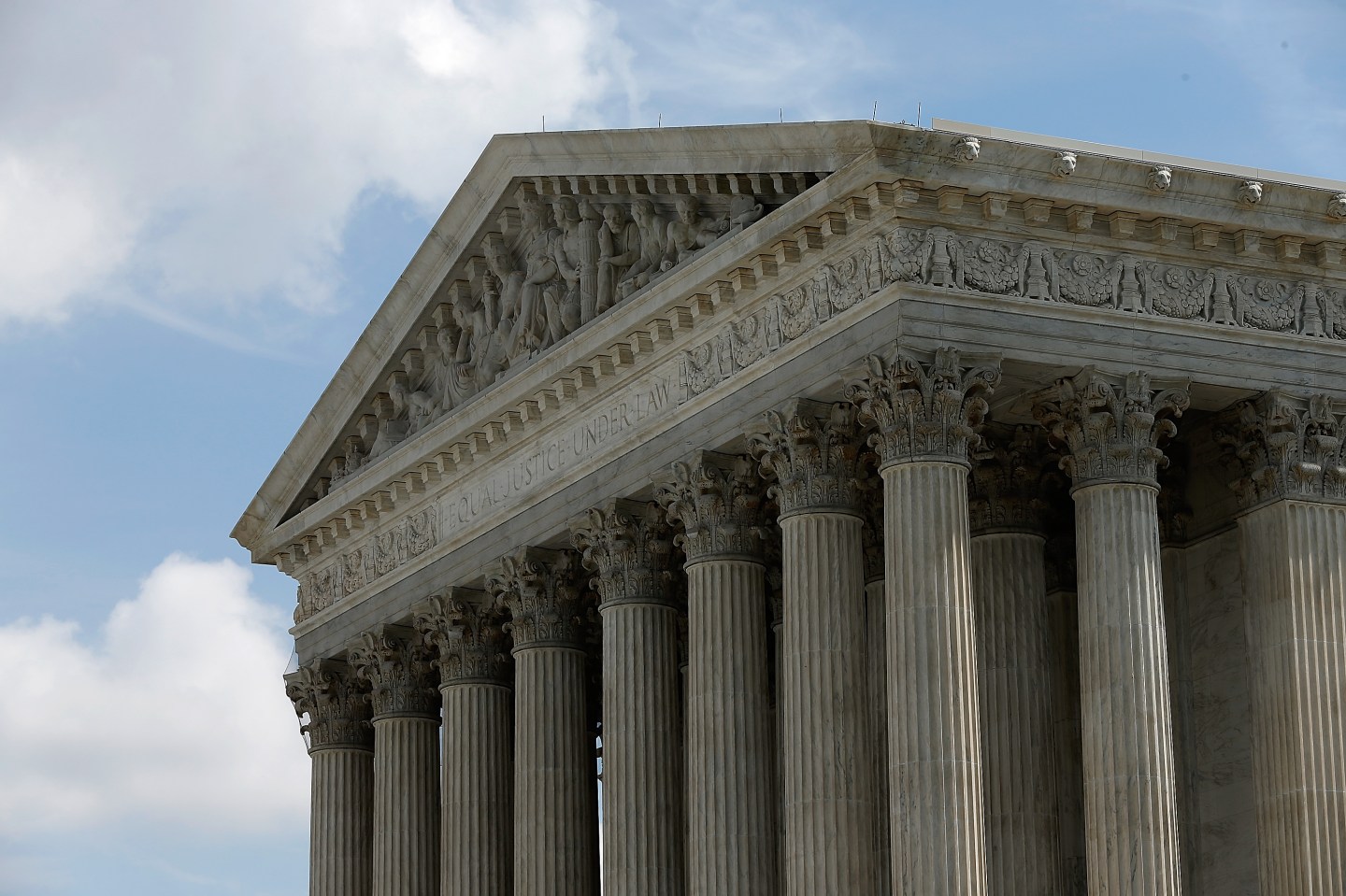
WASHINGTON, DC - JUNE 25: The U.S. Supreme Court is shown after members of the court issued major rulings on cell phone privacy and copyright law June 25, 2014 in Washington, DC. The Supreme Court issued a ruling requiring law enforcement officials to have a search warrant to search the cellphones of suspects they arrest. In another case, the court ruled that the streaming service Aereo was in violation of existing copyright law by retransmitting broadcast televisions programs via miniature antennas for a fee from the company's subscribers. (Photo by Win McNamee/Getty Images)Photograph by Win McNamee—Getty Images

The Supreme Court on Monday sided with an online “people search” company in a closely-watched case over when and how consumers can sue for privacy violations.

The case involved a data broker, Spokeo, that told the world that a Virginia man Thomas Robins was in his 50’s, married, affluent and held a graduate degree — none of which was true. In response, the 29-year-old Robins filed a lawsuit saying the false online information had caused him harm.

The Supreme Court, however, disagreed and reversed a lower court’s ruling by a 6-2 vote. In an opinion by Justice Samuel Alito, it found the lower court had failed to consider whether Robins had suffered a “concrete” harm.

“We have made it clear time and time again that an injury in fact must be both concrete and particularized,” wrote Alito, who added that certain types of mistakes wouldn’t qualify. “An example that comes readily to mind is an incorrect zip code. It is difficult to imagine how the dissemination of an incorrect zip code, without more, could work any concrete harm.”

The ruling means the case will go back to the 9th Circuit Court of Appeals for the judges to take a closer at how or if Robins had been harmed.

The opinion also amounts to a victory for companies that handle consumer data since a loss for Spokeo would have opened the door to other class action complaints, like the one filed by Robins, and potentially billions of dollars in damages. In a blog post, the company hailed the ruling for affirming the need for consumers to point to a “real” harm.

“Spokeo looks forward to the chance to continue advocating against no-injury class action lawsuits that threaten American businesses and the overall economy,” said the blog post.

An attorney for Robins, meanwhile, predicted he would prevail when the case returns to the lower court.

“[W]e are very confident that Robins — and his class — will ultimately get to present their case to a jury,” said Jay Edelson of Edelson LLC. “We have more work to do, but this decision puts us 90% there.”

The decision drew mixed early reaction from the legal community on Twitter, some of whom complained that the court’s zip code example was flawed. Here are observations from two law professors:

One of the only specific examples in entire Spokeo privacy opinion and it's clearly wrong. Because redlining. https://t.co/nloQiVQ95a

— William McGeveran (@BillMcGev) May 16, 2016

My kid gets kicked out of our public school because we supposedly don't live there#spokeo#zipcodeharms

— Ryan Calo (@rcalo) May 16, 2016

The case is not a total victory for Spokeo and other companies, however, since it invites lower courts to continue exploring the issue of when consumers are harmed by publishing their information online. The ruling concluded:

Because the Ninth Circuit failed to fully appreciate the distinction between concreteness and particularization, its standing analysis was incomplete. It did not address the question framed by our discussion, namely, whether the particular procedural violations alleged in this case entail a degree of risk sufficient to meet the concreteness requirement. We take no position as to whether the Ninth Circuit’s ultimate conclusion—that Robins adequately alleged an injury in fact—was correct.

Some lawyers on Twitter suggested the ruling is not decisive, and the issues in the case are likely to resurface:

https://twitter.com/sbagen/status/732218458830741504
https://twitter.com/dispositive/status/732220772274438144

Re: Spokeo, it just shouldn't have taken #SCOTUS so long to hand down an 11-page vacate-and-remand. Another example of the Scalia effect?

— Steve Vladeck (@steve_vladeck) May 16, 2016

Monday’s ruling also sidestepped another major legal issue in the case: whether consumers can bring a class action suits over so-called “statutory violations.”

These refer to laws that provide automatic penalties for certain actions, even if they amount to minor technical violations. Companies fear such laws will encourage frivolous lawsuits led by plaintiff-side lawyers eager to cash in.

Get Data Sheet, Fortune’s technology newsletter.

In the case of Robins, his privacy claim alleged in part that Spokeo had violated information provisions in the Fair Credit Reporting Act of 1970.

The Spokeo case alarmed a broad segment of corporate America, including the tech sector. When the case went to the Supreme Court, firms like Google, Facebook and Netflix all argued in support of Spokeo, claiming a ruling for Robins would threaten them with a cascade of lawsuits even in cases on inconsequential privacy violations.

In a dissent, Justice Ruth Bader Ginsburg, disagreed that the lower court had failed to identify a concrete injury. She argued that Robins had already showed enough harm.

“Far from an incorrect zip code, Robins complains of misinformation about his education, family situation, and economic status, inaccurate representations that could affect his fortune in the job market,” wrote Ginsburg in a decision joined by Justice Sonia Sotomayor.

Justice Clarence Thomas added a concurrence in support of the majority.

This story was updated several times.
About the Author
By Jeff John RobertsEditor, Finance and Crypto
LinkedIn iconTwitter icon

Jeff John Roberts is the Finance and Crypto editor at Fortune, overseeing coverage of the blockchain and how technology is changing finance.

See full bioRight Arrow Button Icon

Latest in Tech

Nvidia CEO Jensen Huang said China is better equipped for an AI data center buildout than the U.S.
AITech
Nvidia CEO says data centers take about 3 years to construct in the U.S., while in China ‘they can build a hospital in a weekend’
By Nino PaoliDecember 6, 2025
9 minutes ago
Arts & EntertainmentMedia
Former Amazon Studios boss warns the Netflix-Warner Bros. deal will make Hollywood ‘a system that circles a single sun’
By Jason MaDecember 6, 2025
52 minutes ago
Jay Clayton
LawCrime
25-year DEA veteran charged with helping Mexican drug cartel launder millions of dollars, secure guns and bombs
By Dave Collins, Michael R. Sisak and The Associated PressDecember 6, 2025
2 hours ago
Elon Musk
LawSocial Media
Elon Musk’s X fined $140 million by EU for breaching digital regulations
By Kelvin Chan and The Associated PressDecember 6, 2025
2 hours ago
Sarandos
InvestingM&A
Netflix’s $5.8 billion breakup fee for Warner among largest ever
By Elizabeth Fournier and BloombergDecember 6, 2025
2 hours ago
index
Investingindex funds
Quant who said passive era is ‘worse than Marxism’ doubles down
By Denitsa Tsekova, Vildana Hajric and BloombergDecember 6, 2025
4 hours ago

Most Popular

placeholder alt text
Economy
Two months into the new fiscal year and the U.S. government is already spending more than $10 billion a week servicing national debt
By Eleanor PringleDecember 4, 2025
2 days ago
placeholder alt text
Success
Nvidia CEO Jensen Huang admits he works 7 days a week, including holidays, in a constant 'state of anxiety' out of fear of going bankrupt
By Jessica CoacciDecember 4, 2025
2 days ago
placeholder alt text
Success
‘Godfather of AI’ says Bill Gates and Elon Musk are right about the future of work—but he predicts mass unemployment is on its way
By Preston ForeDecember 4, 2025
2 days ago
placeholder alt text
Big Tech
Mark Zuckerberg rebranded Facebook for the metaverse. Four years and $70 billion in losses later, he’s moving on
By Eva RoytburgDecember 5, 2025
1 day ago
placeholder alt text
Success
Nearly 4 million new manufacturing jobs are coming to America as boomers retire—but it's the one trade job Gen Z doesn't want
By Emma BurleighDecember 4, 2025
2 days ago
placeholder alt text
Real Estate
‘There is no Mamdani effect’: Manhattan luxury home sales surge after mayoral election, undercutting predictions of doom and escape to Florida
By Sasha RogelbergDecember 4, 2025
2 days ago
Rankings
  • 100 Best Companies
  • Fortune 500
  • Global 500
  • Fortune 500 Europe
  • Most Powerful Women
  • Future 50
  • World’s Most Admired Companies
  • See All Rankings
Sections
  • Finance
  • Leadership
  • Success
  • Tech
  • Asia
  • Europe
  • Environment
  • Fortune Crypto
  • Health
  • Retail
  • Lifestyle
  • Politics
  • Newsletters
  • Magazine
  • Features
  • Commentary
  • Mpw
  • CEO Initiative
  • Conferences
  • Personal Finance
  • Education
Customer Support
  • Frequently Asked Questions
  • Customer Service Portal
  • Privacy Policy
  • Terms Of Use
  • Single Issues For Purchase
  • International Print
Commercial Services
  • Advertising
  • Fortune Brand Studio
  • Fortune Analytics
  • Fortune Conferences
  • Business Development
About Us
  • About Us
  • Editorial Calendar
  • Press Center
  • Work At Fortune
  • Diversity And Inclusion
  • Terms And Conditions
  • Site Map

© 2025 Fortune Media IP Limited. All Rights Reserved. Use of this site constitutes acceptance of our Terms of Use and Privacy Policy | CA Notice at Collection and Privacy Notice | Do Not Sell/Share My Personal Information
FORTUNE is a trademark of Fortune Media IP Limited, registered in the U.S. and other countries. FORTUNE may receive compensation for some links to products and services on this website. Offers may be subject to change without notice.