
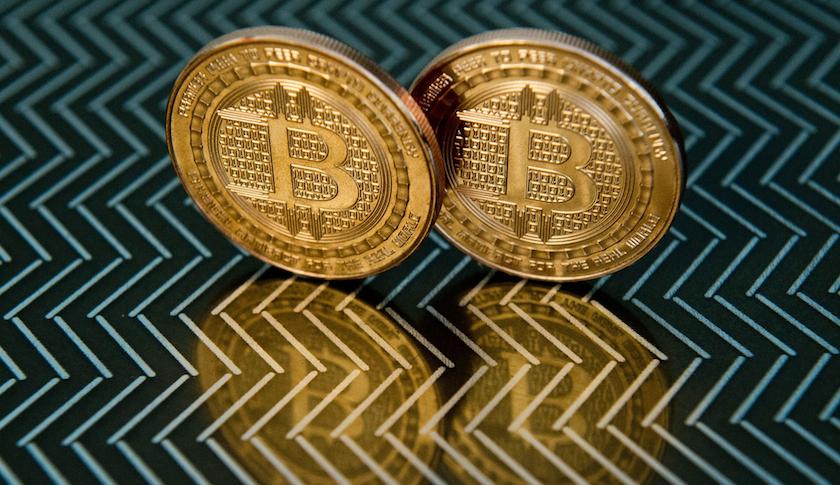
Remember the hype over bitcoin? The crypto-currency that so tantalized techies and excited investors is today in a sorry state: Its core supporters are at war with each other and ordinary consumers still don’t care about this supposedly revolutionary form of money.
But that’s only half of the story. The other half is about the remarkable rise of blockchain, the core technology underlying bitcoin that is enjoying unprecedented adoption by banks and big business.
This development—the fall of bitcoin and the rise of blockchain—has accelerated in recent months, and it has big implications for those who have sunk hundreds of millions of dollars into these technologies. Here’s the latest on the story of bitcoin, which has turned out far differently than many imagined.
How We Got Here
Flash back five years, the bitcoin scene was an exciting place to be. A motley mix of coders, libertarians, and get-rich-quick hucksters latched onto the promise of bitcoin founder Satoshi Nakamoto’s new distributed, tamper-proof money system and ledger run from millions of computers. The ledger provided an indelible record of near-anonymous financial transactions in offering a global payment platform to ordinary merchants, drug dealers, and everyone in between.
The early bitcoin buzz soon exploded, and the currency’s value briefly soared to $1,200. The mainstream news media caught onto the story while venture capitalists lined up to fund any business with “bit” in its name. Meanwhile, businesses from Virgin Galactic to the NBA’s Sacramento Kings realized they could get a heap of free press just by announcing they would accept bitcoin.
The currency never caught on, however. Despite all the startups offering wallets and other tools to popularize the payment technology, average consumers never took to bitcoin—even as they did adopt another person-to-person mobile payment platform, known as Venmo (PYPL) , in droves.
So what happened? One problem is that bitcoin never shook its sordid side. While there is nothing intrinsically evil about bitcoin, its most famous adopters have always been a rogue’s gallery of fraudsters, prostitutes, dark web drug lords, and Ponzi schemers. Even some members of bitcoin’s governing foundation, who sought to make the currency respectable, are on the lam or in jail.
This rogue reputation certainly didn’t help bitcoin. But it wasn’t the crypto-currency’s biggest problem. Instead, the main reason bitcoin didn’t catch on is because it’s just not practical. Even if you can find merchants who accept it, the process involves exotic apps, currency transactions, and a verification process that takes minutes to get the okay. Compare that to swiping a credit card, and you see the problem.
In recent months, bitcoin’s adoption problem has suddenly worsened. Meanwhile, big banks are finding they can use bitcoin’s best feature and leave the currency itself behind.
Get Data Sheet, Fortune’s technology newsletter.
The Current Crisis and the Rise of Blockchain
“Bitcoin’s nightmare scenario has come to pass,” read a headline this week from tech site, The Verge. That’s a pretty fair way to describe a recent schism within the bitcoin developer community—the collection of gnomes who decide on the protocols and computer code under the hood.
The Verge report offers a good run-down of the technical specifics but, for present purposes, they can be summed up like this: the bitcoin community failed to agree on a system upgrade, which means the ledger’s infrastructure faces a growing backlog, and it now takes over 40 minutes to confirm a transaction. As a result, bitcoin is less practical than ever and merchants (the few who accepted it in the first place) are bolting.
This schism deals a further blow to bitcoin’s hopes of ever becoming a mainstream currency. This is a setback for the bitcoin community, but here’s the kicker: it doesn’t really matter.
That’s because the true value of bitcoin is not the currency itself. Instead, it’s the blockchain technology underneath it. Banks and other big businesses have already reaped the benefit of this technology.
As Fortune reported in December, IBM (IBM) , Intel (INTC) , JP Morgan (JPM), and several other big banks are betting on the blockchain’s ledger system. As with bitcoin, the system requires a set of diffuse computers to prove that a transaction has occurred. Once a confirmation occurs, it’s recorded in a common ledger and cannot be reversed.
Why is this such a big deal? It has to do with record keeping.
The idea of a tamper-proof ledger created by computers is so significant because it could let a number of industries—especially banking, brokerages, and law firms—overhaul the way they do business. Instead of relying on slow and cumbersome settlement systems to notarize and record documents, they can let a blockchain do it for them.
“The clearing and settlement will be done in a matter of seconds. An efficiency comes with this that is a pretty significant force multiplier,” explains Jeff Garzik, a former bitcoin developer who recently launched a consultancy called Bloq that advises banks and others how to deploy blockchain technology.
Garzik and his partner Matt Roszack expect the financial industry will begin using the blockchain for stock and loan settlements as soon as the end of this year. Likewise, they think banks’ transactions at the discount window of the Federal Reserve will soon be recorded on a blockchain.
And that’s just the beginning. Garzik and Roszack say the Big Four auditing firms will soon have a blockchain-based transaction feed that will be visible to regulators, who have been studying the potential of blockchain technology for years.
The Future: Blockchain Without Bitcoin
Even for those familiar with crypto-currency, it can be hard to get one’s head around just how the blockchain can operate without bitcoin. The reason is that bitcoin supplies the financial incentive for people around the world, known as miners, to operate the ledger in the first place.
For more about bitcoin, watch our video:
In return for devoting their computers to running the blockchain (which publishes the ledger), they receive a reward in the form of a bitcoin that can be spent online or exchanged for traditional currency. In the absence of such an incentive, how do the banks plan to develop the blockchain?
The answer is they are building their own version of blockchain and running it themselves. As Garzik explains, this process involves taking the core protocol underlying bitcoin and then stripping off all the “mining” and compensation functions. He says the miners are an interesting way to creating a ledger, but they are not essential in the case of a “private chain,” like the one the banks are developing.
“The mining is a really elegant software solution that equally distributes who is going to validate the next set of bitcoin transactions,” Garzik says. “A private chain replaces the entire trust-less aspect with a more private closed network of participants.”
In practice, this will involve the banks rejecting a global federation of miners in favor of a handful of trusted verification partners within their own network—a process already underway. For instance, a group of 15 banks might agree that the ledger becomes official once computers from seven group members agree to record a set of transactions.
So what happens to bitcoin in this scenario? As The Economist noted in a recent feature, it may become no more than a novelty or a historical curiosity. If this is the case, the venture capitalists who made big bets on consumer bitcoin startups like Coinbase and Xapo could see a pool of wealth vanish. Ditto the U.S. government, which has seized a large pile of bitcoins in high-profile drug investigations.
For now, that worst case scenario for bitcoin hasn’t come to pass yet. Despite the recent convulsions in the developer community, its price has held fairly steady around $400 for months. It may find niche roles as a currency, such as for foreign remittances.
Meanwhile, bitcoin still has defenders such as Jeremy Allaire, a successful entrepreneur who raised over $60 million for his startup, Circle, a money transfer service for consumers using bitcoin behind the scenes. Allaire says there is still time for bitcoin to break through in place of services like Venmo.
“Venmo is another AOL—I don’t want another walled garden. I want the Google of money,” Allaire said in a recent interview. “We’ve gone from a world where everyone is in denial about the tech and its usefulness. Now traditional financial institutes say, ‘We love the technology but we want to control it with our own private technology.’ That’s not practical.”
Other defenders include my former colleague at Fortune, Dan Roberts, who said the bull case outstrips the bear case for bitcoin in 2016.
Still, based on recent developments, a bitcoin resurgence looks like a long shot. When the final history of bitcoin is written, the currency itself is likely to be just a colorful footnote in the tale of the emergence of a powerful new blockchain technology.