• Home
  • Latest
  • Fortune 500
  • Finance
  • Tech
  • Leadership
  • Lifestyle
  • Rankings
  • Multimedia
CommentaryMiddle East

What Saudi Arabia’s Spat With Iran Means for the U.S.

By
Robert M. Danin
Robert M. Danin
Down Arrow Button Icon
By
Robert M. Danin
Robert M. Danin
Down Arrow Button Icon
January 6, 2016, 1:42 PM ET
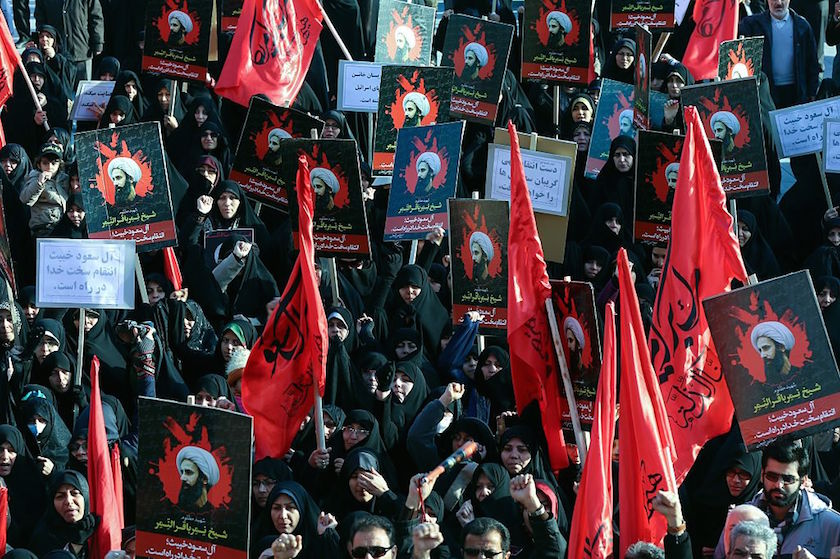
Protest in Tehran against execution of Shiite cleric
TEHRAN, IRAN - JANUARY 4: Demonstrators hold posters of Nimr Baqir al-Nimr during a protest rally against the execution of prominent Saudi Shia cleric Nimr Baqir al-Nimr by Saudi authorities, in Tehran, Iran on January 4, 2016. (Photo by Fatemeh Bahrami/Anadolu Agency/Getty Images)Anadolu Agency—Getty Images

Earlier this week, Saudi Arabia cut off diplomatic ties with Iran after authorities executed a popular Shiite cleric. Anyone watching this meltdown unfold has every reason to think of worse-case scenarios, as it will only deepen the Middle East’s widening sectarian divide, intensify the region’s multiple conflicts, and set back efforts to defeat the Islamic State and end the bloodshed in Syria.

For years, the Middle East has been defined by political instability, and the execution of Sheikh Nimr al-Nimr and subsequent attack on the Saudi embassy in Teheran is only the most recent episode in a longstanding rivalry between the two powers dominating opposite shores of the Gulf — the world’s most important oil chokehold through which 30% of global oil and liquefied natural gas flows.

Each claims to be the face of the true and authentic variant of Islam. Saudi Arabia, custodian of Islam’s two leading holy places in Mecca and Medina, sees in the Islamic Republic of Iran a revolutionary Shiite Persian power expanding its reach into the Sunni Arab heartland. Having seen Tehran spread its influence into Iraq, Lebanon, Yemen, and Syria, the Saudis, led by a new and more activist king, are sending a strong message to the world that it will not sit by passively.

The most immediate casualty of intensified Saudi-Iranian tensions will be the recently launched U.S.-led diplomatic effort to end the horrific Syrian war that has already claimed more than 250,000 dead. Iranian forces are fighting and dying in Syria to preserve president Bashar al Assad’s regime, while Saudi Arabia is actively backing rebels seeking to topple the dictator. Just getting the Iranian and Saudi foreign ministers into the same room last month was touted as a major accomplishment by Secretary of State John Kerry. While Iran and Saudi Arabia profess a desire to cooperate diplomatically, both countries are now sure to double down their support for the opposing sides in Syria’s war. The Syrian opposition, meanwhile, has urged all Arab countries to break relations with Tehran.

A second casualty of Iran’s strained relations with Saudi Arabia is likely to be the regional effort to combat the so-called Islamic State, or Daesh, that currently occupies a large swath of territory across Iraq and Syria. While the United States and Europe, reeling from Islamist terrorism, see defeating Daesh as the paramount objective in the Middle East, this sense of priority is not shared by many Arab allies within the anti-Daesh coalition. That a number of Gulf states have followed Saudi Arabia’s lead and suspended relations with Tehran reflects the fact that they see Shiite Iran, not the Sunni Islamists in Daesh, as their paramount enemy.

In Iraq, efforts to unify the multi-ethnic society and mobilize Sunni tribal forces against Daesh will likely be set back as the region’s Sunni-Shiite chasm widens. Tensions have already risen back to the fore in other multi-sectarian countries like Bahrain and Lebanon. And other proxy battles in the region are likely to experience the same polarizing influence. The war in Yemen, where Saudi Arabia has been fiercely battling Iranian-backed Houthi rebels, will likely intensify in the period ahead. This intervention has proven costly in terms of civilian and military casualties, and costs Riyadh close to $1 billion per month.

The situation could even get more heated at home for both countries. Low oil prices, sustained in large part by Riyadh’s efforts to deprive Iran of keenly sought after petroleum revenues, is also causing social strains within the Saudi kingdom. Riyadh faces a nearly $100 billion annual budget deficit, forcing the kingdom to cut subsidies and welfare programs, further straining domestic pressures. In nearby Iran, the agreement to suspend its nuclear quest was shaped by the economic pain caused by crippling international sanctions. Yet low oil prices means that the lifting of sanctions may only provide partial and disappointing economic relief to the ailing Iranian economy, which is Riyadh’s intent. Rather than moderate their stand-off, both Iran and Saudi Arabia will seek to deflect their respective domestic pressures by stepping up their regional activism against one other.

U.S. led-efforts to negotiate a halt to Iran’s nuclear program, however effective, have exacerbated Saudi and other Sunni Arab states’ fears that long-standing Western protectors are now moving towards a broader accommodation with Iran. This in turn has fueled current Saudi hostility and bellicosity. Unsure of Washington’s ultimate intentions, these Arabs, like Israel, have adopted more strident positions against their Iranian adversary. Administration efforts to then reassure the Arabs have largely fallen on deaf ears. Administration steps to display even-handedness between Iran and Saudi Arabia, rather than reassure the parties, may further estrange and provoke further acts of defiance.

Since the nuclear agreement last July, Iran has continued to challenge the U.S. and the international community, conducting missile tests proscribed by the United Nations Security Council and firing in close proximate to U.S. shipping in the Gulf. Administration efforts to blunt the blow of potential new sanctions against Iran for its behavior— apparently in an effort not to jeopardize the nuclear agreement–have sewn further confusion about America’s future plans.

The Arab backlash over the past few days may have served as a wake up call in Tehran, including among some of its hard-liners, who are now trying to walk back the damage from the Saudi embassy attack. Yet Iran will doubtless still soon continue to test the limits of Sunni Arab and Western resolve across the myriad Middle East battle fields currently under contention. Either by design or through miscalculation, elements in Iran, especially those opposed to the country opening up to the West, could take actions that then trigger retaliatory sanctions or actions that could undermine the prospects of an economic payoff provided by sanctions relief. Uncertainty and unpredictability are the order of the day.

The first few days of 2016 have already proven to be eventful and dangerous on both sides of the Gulf waterway. Cross-straight tensions are sure to intensify in the weeks and months ahead in what is sure to be a tumultuous year of instability and unrest in the Middle East.

Robert M. Danin is a senior fellow at the Council on Foreign Relations and at Harvard University’s Belfer Center. He previously served in a variety of senior Middle East positions at the White House and U.S. Department of State.

About the Author
By Robert M. Danin
See full bioRight Arrow Button Icon

Latest in Commentary

Finance
Lorem ipsum dolor sit amet, consectetur adipiscing elit, sed do eiusmod tempor incididunt ut labore et dolore magna aliqua. Ut enim ad minim veniam
By Fortune Editors
October 20, 2025
Finance
Lorem ipsum dolor sit amet, consectetur adipiscing elit, sed do eiusmod tempor incididunt ut labore et dolore magna aliqua. Ut enim ad minim veniam
By Fortune Editors
October 20, 2025
Finance
Lorem ipsum dolor sit amet, consectetur adipiscing elit, sed do eiusmod tempor incididunt ut labore et dolore magna aliqua. Ut enim ad minim veniam
By Fortune Editors
October 20, 2025
Finance
Lorem ipsum dolor sit amet, consectetur adipiscing elit, sed do eiusmod tempor incididunt ut labore et dolore magna aliqua. Ut enim ad minim veniam
By Fortune Editors
October 20, 2025
Finance
Lorem ipsum dolor sit amet, consectetur adipiscing elit, sed do eiusmod tempor incididunt ut labore et dolore magna aliqua. Ut enim ad minim veniam
By Fortune Editors
October 20, 2025
Finance
Lorem ipsum dolor sit amet, consectetur adipiscing elit, sed do eiusmod tempor incididunt ut labore et dolore magna aliqua. Ut enim ad minim veniam
By Fortune Editors
October 20, 2025

Most Popular

Finance
Lorem ipsum dolor sit amet, consectetur adipiscing elit, sed do eiusmod tempor incididunt ut labore et dolore magna aliqua. Ut enim ad minim veniam
By Fortune Editors
October 20, 2025
Finance
Lorem ipsum dolor sit amet, consectetur adipiscing elit, sed do eiusmod tempor incididunt ut labore et dolore magna aliqua. Ut enim ad minim veniam
By Fortune Editors
October 20, 2025
Finance
Lorem ipsum dolor sit amet, consectetur adipiscing elit, sed do eiusmod tempor incididunt ut labore et dolore magna aliqua. Ut enim ad minim veniam
By Fortune Editors
October 20, 2025
Finance
Lorem ipsum dolor sit amet, consectetur adipiscing elit, sed do eiusmod tempor incididunt ut labore et dolore magna aliqua. Ut enim ad minim veniam
By Fortune Editors
October 20, 2025
Finance
Lorem ipsum dolor sit amet, consectetur adipiscing elit, sed do eiusmod tempor incididunt ut labore et dolore magna aliqua. Ut enim ad minim veniam
By Fortune Editors
October 20, 2025
Finance
Lorem ipsum dolor sit amet, consectetur adipiscing elit, sed do eiusmod tempor incididunt ut labore et dolore magna aliqua. Ut enim ad minim veniam
By Fortune Editors
October 20, 2025
Rankings
  • 100 Best Companies
  • Fortune 500
  • Global 500
  • Fortune 500 Europe
  • Most Powerful Women
  • Future 50
  • World’s Most Admired Companies
  • See All Rankings
Sections
  • Finance
  • Leadership
  • Success
  • Tech
  • Asia
  • Europe
  • Environment
  • Fortune Crypto
  • Health
  • Retail
  • Lifestyle
  • Politics
  • Newsletters
  • Magazine
  • Features
  • Commentary
  • Mpw
  • CEO Initiative
  • Conferences
  • Personal Finance
  • Education
Customer Support
  • Frequently Asked Questions
  • Customer Service Portal
  • Privacy Policy
  • Terms Of Use
  • Single Issues For Purchase
  • International Print
Commercial Services
  • Advertising
  • Fortune Brand Studio
  • Fortune Analytics
  • Fortune Conferences
  • Business Development
About Us
  • About Us
  • Editorial Calendar
  • Press Center
  • Work At Fortune
  • Diversity And Inclusion
  • Terms And Conditions
  • Site Map
  • Facebook icon
  • Twitter icon
  • LinkedIn icon
  • Instagram icon
  • Pinterest icon

Latest in Commentary

TrumpRx
CommentaryPharmaceutical Industry
TrumpRx is here and it helps, though a bit less than advertised
By Jeffrey Sonnenfeld, Stephen Henriques, Ferron Chen, Asuka Koda and Vanessa McLennanFebruary 11, 2026
11 hours ago
saunders
CommentaryLeadership
Bausch + Lomb CEO: Standing still is the new falling behind
By Brent SaundersFebruary 11, 2026
18 hours ago
shumer
CommentaryEntrepreneurship
Something big is happening in AI — and most people will be blindsided
By Matt ShumerFebruary 11, 2026
18 hours ago
profusek
CommentaryCorporate Governance
It isn’t partisan politics to admit that stakeholder capitalism went too far, too fast 
By Robert ProfusekFebruary 11, 2026
19 hours ago
CommentaryE-commerce
Agentic commerce will reward the fastest learners, not the biggest retailers
By Simon JamesFebruary 10, 2026
2 days ago
abhas
CommentaryCloud
I’m Cloudera’s chief strategy officer and here’s why your $1 billion AI budget just became obsolete
By Abhas RickyFebruary 10, 2026
2 days ago

Most Popular

placeholder alt text
Economy
America borrowed $43.5 billion a week in the first four months of the fiscal year, with debt interest on track to be over $1 trillion for 2026
By Eleanor PringleFebruary 10, 2026
2 days ago
placeholder alt text
Economy
It turns out that Joe Biden really did crush Americans' dreams for the future. Just look at how the vibe changed 5 years ago
By Jake AngeloFebruary 10, 2026
1 day ago
placeholder alt text
Commentary
Something big is happening in AI — and most people will be blindsided
By Matt ShumerFebruary 11, 2026
18 hours ago
placeholder alt text
Crypto
Bitcoin reportedly sent to wallet associated with Nancy Guthrie’s ransom letter providing potential clue in investigation
By Carlos GarciaFebruary 11, 2026
14 hours ago
placeholder alt text
Law
Law enforcement thought Nancy Guthrie's smart camera was disconnected, but Google Nest still had the tape
By Safiyah Riddle, Michael Liedtke and The Associated PressFebruary 11, 2026
21 hours ago
placeholder alt text
Economy
America’s national debt borrowing binge means interest payments will rocket to $2 trillion a year by 2036, CBO says
By Eleanor PringleFebruary 11, 2026
17 hours ago

© 2026 Fortune Media IP Limited. All Rights Reserved. Use of this site constitutes acceptance of our Terms of Use and Privacy Policy | CA Notice at Collection and Privacy Notice | Do Not Sell/Share My Personal Information
FORTUNE is a trademark of Fortune Media IP Limited, registered in the U.S. and other countries. FORTUNE may receive compensation for some links to products and services on this website. Offers may be subject to change without notice.