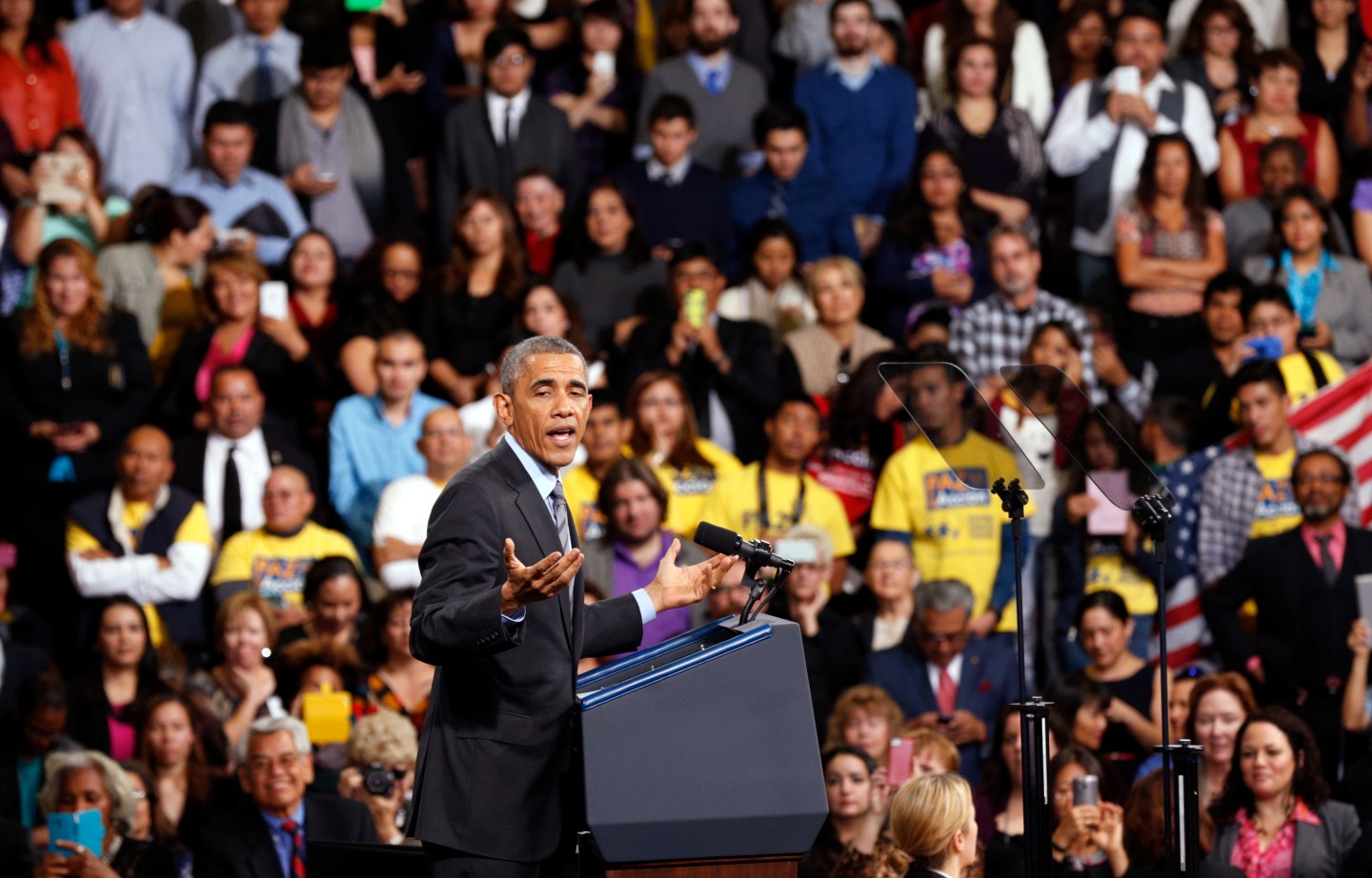
Earlier this week, President Barack Obama’s executive actions on immigration aimed at easing deportation threats for millions of undocumented immigrants suffered another setback. The U.S. Court of Appeals for the Fifth Circuit, in New Orleans, ruled 2 to 1 against an appeal by the Obama administration that would have changed the immigration classification of millions of undocumented immigrants on a class-wide basis. Obama’s plan came in the face of Congress’s sustained failure to pass comprehensive immigration reform legislation, and if enacted, they could have offered 5 million people who are currently living in the US the opportunity to work legally.
Even more importantly, perhaps, a positive ruling from the court would have finally sent out a clear message of hope and conciliation rather than continued indecision. This ruling, which was supposed to focus on procedural issues, aggrandized the grey area between the two sides of the immigration debate by challenging the President’s and the director of Homeland Security’s authority to carry out changes in the absence of Congressional approval: “Even with ‘special deference’ to the Secretary, the Immigration and Naturalization Act flatly does not permit the reclassification of millions of illegal aliens as lawfully present and thereby make them newly eligible for a host of federal and state benefits, including work authorization.”
This ruling is yet another sign of the vast distance between Obama’s position that we all benefit from efforts to properly assimilate millions of people whose skills, diligence and ‘family values’ are celebrated in America, and his opposition, who claims that the solution is mass deportation and concrete walls around our country.
The massive stakes of this debate opens up a grey area and a high level of uncertainty even amongst those who are charged with enforcing the law. As a result, immigration officials and others have significant discretionary power on the front lines, where they can choose to either enforce or not enforce our immigration law.
This begins at the border, where law enforcement officers have to make the call as to whether or not to admit someone. It then extends to U.S. soil, where other officials, such as highway patrolmen, are empowered by federal officials to enforce immigration law but at the same time discouraged from doing so by police chiefs wary of their officers playing this role.
What it boils down to, then, is if the highway patrolman thinks that the president’s view of undocumented people is right, and that decent hardworking undocumented people are contributing to the U.S. economy and culture, then he’s likely to treat the traffic stop as he would any other. On the other hand, some other officer might think that living in the US illegally is indeed criminal, and that it’s his duty or even obligation to contact Immigration and Customs Enforcement (ICE). This latter approach sets into motion an array of outlandish and costly penalties, including long prison terms, the imposition of felonies for repeat offenders, heightened sentences for people who already have criminal records, and, finally, mandatory deportation after the sentence is served.
Instead of perpetuating this vicious game of cat and mouse, Obama’s executive orders would have created a pathway to lawful participation in the US, and the millions of undocumented immigrants who are living, working and having (American) children might be excused for thinking that the court should have sided with him. With this new ruling, they probably feel terrified, especially by what they are hearing from Republicans, who are falling over themselves to celebrate the idea of building walls, which even from a business perspective are about as desirable as toxic fumes from the trucks that will idle there waiting to be searched. The combination of the discretion on the front lines and the uncertainty amongst millions of undocumented migrants is bad for business, and it’s likely to drive migrants to avoid officials of all kinds. They are fully aware that any traffic stop, any encounter with an official or a whistle-blowing racist or xenophobe might be his last.
This is indeed why police chiefs are reluctant to have their officers play immigration officers, and why Americans should be terrified of what it means to criminalize such a huge percentage of people in the U.S., and then send them to the prisons and penitentiaries that can easily serve as training camps for real criminal activities. Regrettably, none of this is accounted for in Monday’s ruling or, for the most part, in reports of its potential effects.
The reality, though, is that the U.S. needs not only executive orders, or even immigration reform; instead, it needs to open up its borders for workers on both sides of the existing divide. If the U.S. favors free trade, then it should also favor mobile work forces. And if the U.S. wants accountability, then it should take steps to regularize undocumented immigrants, ensure that they pay their fair share of taxes, and then distribute the benefits of those taxes according to need rather than exclusion and xenophobia.
At the same time, walls should never be built. Instead, America’s borders need to be softened, so as to facilitate the free flow of people through legitimate channels rather than encourage the perilous flow of people around fences. This will ensure that law enforcement officers can pursue criminals, instead of having to hunt law-abiding migrants down in deserts, highways and byways, and then punish them for working, raising families, and peaceably contributing to our communities.
In my recent book, I review the ample evidence that suggests that opening up borders improves local economies, referring to economists such as Phillipe Legrain, former journalist for The Economist magazine; World Bank economist Lant Pritchett, and Wall Street Journal’s editorial board member Jason Riley. But as the U.S. considers this ruling, and the families it affects, we might want to place the emphasis as well upon the kind of society we want to live in, and to wonder aloud if it might not be better to offer people who live here a sense of belonging and of hope, instead of a well-founded belief that they are captive to the whims of fickleness and sadism that crushes dreams, and destroys families.
Robert F. Barsky is a professor of both literature and law at Vanderbilt University, and is the author of Undocumented Immigrants in an Era of Arbitrary Law: The Flight and Plight of Peoples Deemed Illegal (Routledge Law).