• Home
  • Latest
  • Fortune 500
  • Finance
  • Tech
  • Leadership
  • Lifestyle
  • Rankings
  • Multimedia
TechBig Data

How Formula 1 Teams Use Big Data to Win

By
Stacey Higginbotham
Stacey Higginbotham
Down Arrow Button Icon
By
Stacey Higginbotham
Stacey Higginbotham
Down Arrow Button Icon
November 12, 2015, 7:15 AM ET
Formula 1, F1, Circuit of the Americas
handout Armin HarrisPhoto: Keith D. Rizzo—Circuit of the Americas

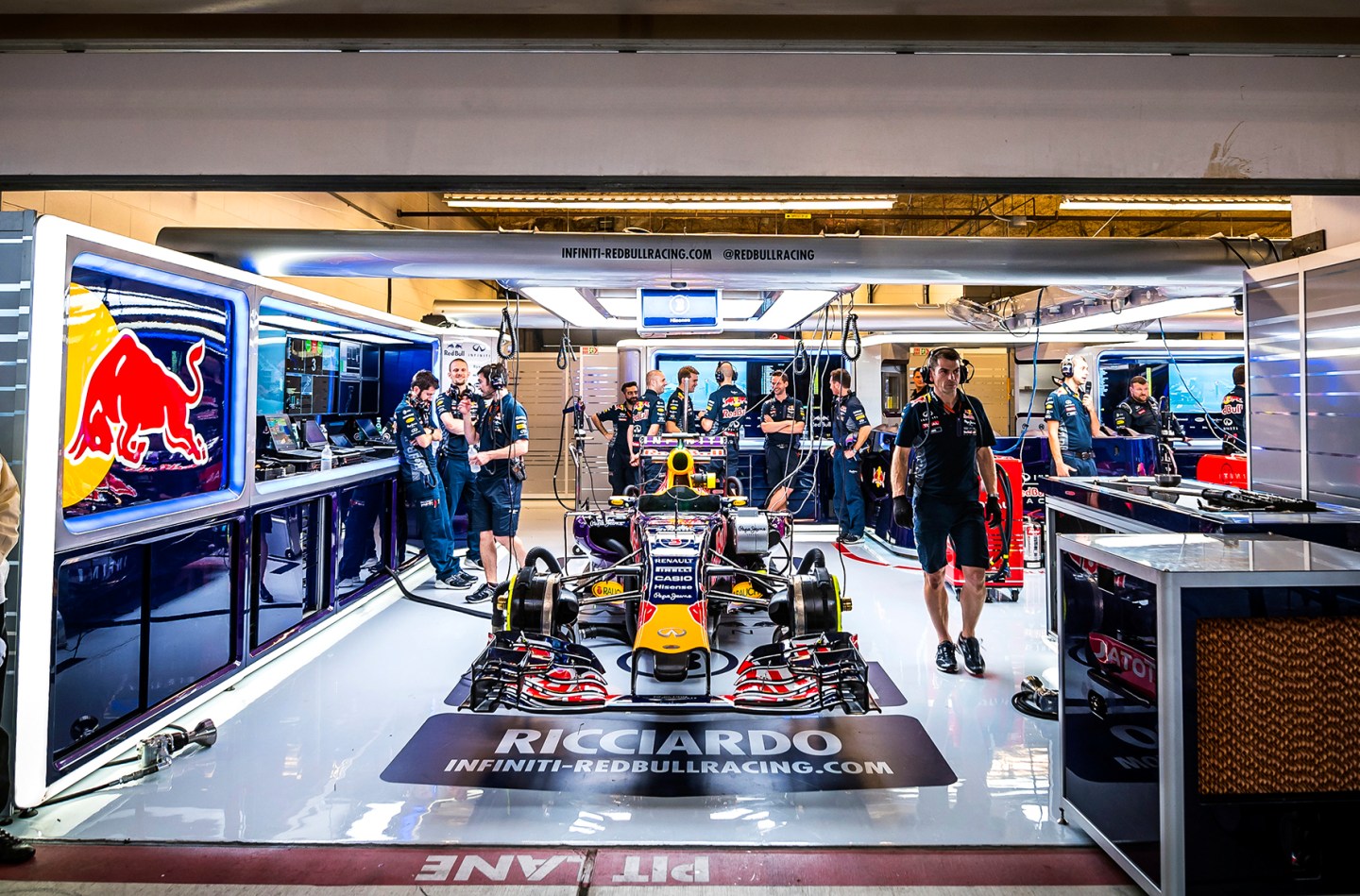
The Pit Row at the Circuit of the Americas in Austin, home to the only Formula 1 championship race in the U.S., is packed with fans. Some people clutch their ponchos and wince as gusts whip along the asphalt. Others snap photos of themselves with the cars and hope for a glimpse of their favorite driver. When one finally makes an appearance, a scrum surrounds him, asking for autographs and selfies. The vehicles are momentarily forgotten.

But these machines, each valued at more than $9 million (a steering wheel alone is worth $77,000 or so) are more than just pricey contraptions capable of whizzing around the track at more than 200 miles per hour. They are also intelligent, thanks to the many dozens of sensors fastened to them. Each sensor communicates with the track, the crew in the pit, a broadcast crew on-site, and a second team of engineers back home in Europe.

Belgium F1, Circuit of the Americas, Formula 1
The steering wheel of Sauber F1 Team driver Felipe Nasr.Photo: Luca Bruno—AP

Most Formula 1 spectators expect the race to be won or lost in the hills and hairpins of a Grand Prix circuit. What few realize is that it’s also playing out in powerful, interconnected computers around the world. A Formula 1 race is a high-stakes example of the so-called Internet of things, where teams tap tremendous amounts of real-time data culled from physical objects. The sport’s use of such information is so sophisticated that some teams are exporting their knowledge to other industries where analyzing enormous amounts of information in the blink of an eye can mean the difference between life and death. For example, British automaker McLaren is sharing its data systems expertise with ConocoPhillips (COP) for use on oil rigs.

“We measure whatever we need to manage during the race, and then we model to get the predictive intelligence on how the cars are going to perform,” says Geoff McGrath, chief innovation officer at McLaren Applied Technologies.

The McLaren team builds its race cars for each track based on historical data and simulations generated by the current season’s sensor data. It builds prototype parts with 3D printers and tests them in wind tunnels. Approved designs are constructed in carbon fiber. The process ensures that every aspect of the car’s design is based on data.

Sensors are installed along a car’s chassis, in its tires, and throughout the engine. They measure the stress and downward force of the air on the car’s nose, brake temperature, tire pressure, and even whether the car is sliding or actively turning a corner. Sensors attached to the suspension measure the car’s speed as well as how force affects the vehicle. And that $77,000 steering wheel? It’s packed with knobs, buttons, and pedals that can do everything from slow down the car to deliver a shot of liquid to the driver through his helmet at the press of a button.

Yet for all the data generated by the car, the driver sees little of it. “We keep it to a minimum,” says Alan Peasland, head of technical partnerships at Infiniti Red Bull Racing. “They are maxed out on their cognitive capacity driving these cars.”

Formula 1 has strict rules about the number of team personnel allowed at the track. Infiniti Red Bull, for example, has 60 engineers on-site and 30 in England. It takes less than 300 milliseconds for the data from the farthest track in Australia to reach Infiniti Red Bull’s U.K. team, Peasland says, which runs simulations to determine race strategy for everything from a tire change to an attempt to overtake another driver. “Gut-feel decisions just aren’t made,” he says.

Data analytics haven’t solved everything. There’s still no way to get an accurate sense of where the cars are laterally on the track, and it’s impossible to determine how well a tire is gripping the roadway. The only person who can tell that is the driver. Says McGrath: “The driver is still the best sensor we have.”

A version of this article appears in the December 1, 2015 issue of Fortune with the headline “Formula 1(01001011).”


About the Author
By Stacey Higginbotham
See full bioRight Arrow Button Icon

Latest in Tech

InvestingStock
There have been head fakes before, but this time may be different as the latest stock rotation out of AI is just getting started, analysts say
By Jason MaDecember 13, 2025
39 minutes ago
Politicsdavid sacks
Can there be competency without conflict in Washington?
By Alyson ShontellDecember 13, 2025
1 hour ago
InnovationRobots
Even in Silicon Valley, skepticism looms over robots, while ‘China has certainly a lot more momentum on humanoids’
By Matt O'Brien and The Associated PressDecember 13, 2025
3 hours ago
Sarandos
Arts & EntertainmentM&A
It’s a sequel, it’s a remake, it’s a reboot: Lawyers grow wistful for old corporate rumbles as Paramount, Netflix fight for Warner
By Nick LichtenbergDecember 13, 2025
7 hours ago
Oracle chairman of the board and chief technology officer Larry Ellison delivers a keynote address during the 2019 Oracle OpenWorld on September 16, 2019 in San Francisco, California.
AIOracle
Oracle’s collapsing stock shows the AI boom is running into two hard limits: physics and debt markets
By Eva RoytburgDecember 13, 2025
8 hours ago
robots
InnovationRobots
‘The question is really just how long it will take’: Over 2,000 gather at Humanoids Summit to meet the robots who may take their jobs someday
By Matt O'Brien and The Associated PressDecember 12, 2025
22 hours ago

Most Popular

placeholder alt text
Economy
Tariffs are taxes and they were used to finance the federal government until the 1913 income tax. A top economist breaks it down
By Kent JonesDecember 12, 2025
1 day ago
placeholder alt text
Success
Apple cofounder Ronald Wayne sold his 10% stake for $800 in 1976—today it’d be worth up to $400 billion
By Preston ForeDecember 12, 2025
1 day ago
placeholder alt text
Success
40% of Stanford undergrads receive disability accommodations—but it’s become a college-wide phenomenon as Gen Z try to succeed in the current climate
By Preston ForeDecember 12, 2025
1 day ago
placeholder alt text
Economy
For the first time since Trump’s tariff rollout, import tax revenue has fallen, threatening his lofty plans to slash the $38 trillion national debt
By Sasha RogelbergDecember 12, 2025
23 hours ago
placeholder alt text
Economy
The Fed just ‘Trump-proofed’ itself with a unanimous move to preempt a potential leadership shake-up
By Jason MaDecember 12, 2025
21 hours ago
placeholder alt text
Success
At 18, doctors gave him three hours to live. He played video games from his hospital bed—and now, he’s built a $10 million-a-year video game studio
By Preston ForeDecember 10, 2025
3 days ago
Rankings
  • 100 Best Companies
  • Fortune 500
  • Global 500
  • Fortune 500 Europe
  • Most Powerful Women
  • Future 50
  • World’s Most Admired Companies
  • See All Rankings
Sections
  • Finance
  • Leadership
  • Success
  • Tech
  • Asia
  • Europe
  • Environment
  • Fortune Crypto
  • Health
  • Retail
  • Lifestyle
  • Politics
  • Newsletters
  • Magazine
  • Features
  • Commentary
  • Mpw
  • CEO Initiative
  • Conferences
  • Personal Finance
  • Education
Customer Support
  • Frequently Asked Questions
  • Customer Service Portal
  • Privacy Policy
  • Terms Of Use
  • Single Issues For Purchase
  • International Print
Commercial Services
  • Advertising
  • Fortune Brand Studio
  • Fortune Analytics
  • Fortune Conferences
  • Business Development
About Us
  • About Us
  • Editorial Calendar
  • Press Center
  • Work At Fortune
  • Diversity And Inclusion
  • Terms And Conditions
  • Site Map

© 2025 Fortune Media IP Limited. All Rights Reserved. Use of this site constitutes acceptance of our Terms of Use and Privacy Policy | CA Notice at Collection and Privacy Notice | Do Not Sell/Share My Personal Information
FORTUNE is a trademark of Fortune Media IP Limited, registered in the U.S. and other countries. FORTUNE may receive compensation for some links to products and services on this website. Offers may be subject to change without notice.