• Home
  • News
  • Fortune 500
  • Tech
  • Finance
  • Leadership
  • Lifestyle
  • Rankings
  • Multimedia
TechGoogle

Google’s New AI Will Reply to Your Emails so You Don’t Have To

By
Stacey Higginbotham
Stacey Higginbotham
Down Arrow Button Icon
By
Stacey Higginbotham
Stacey Higginbotham
Down Arrow Button Icon
November 3, 2015, 12:38 PM ET
Image courtesy of Google

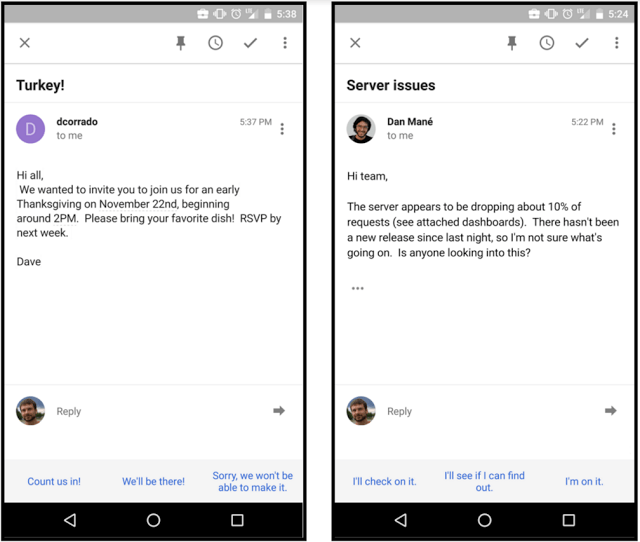
Later this week people who have the Inbox email program on their iPhones or Android devices will soon have a new option when it comes to replying to emails. Instead of coming up with their own responses on their mobile devices, they’ll get to choose between three options created by a neural network built by Google researchers. Google claims it has built an AI that can read incoming emails, understand them, and generate a short, appropriate response that the recipient can then edit or send with just a click.

The tool will launch “later this week” and is called Smart Reply. It’s designed so users can quickly get through their emails on a mobile phone where typing replies, and even dictating them, can be tedious. It’s also an example of how far Google has come with its deep learning efforts—which have so far helped it develop products such as Google Translate and better facial recognition across its photo products.

Google (GOOG), like many other companies including Facebook (FB), Apple (AAPL), and Microsoft (MSFT) are investing big bucks in developing better artificial intelligence as a way of helping consumers handle the information overload coming at them through their many connected devices.

Each of these companies sees their efforts as a competitive advantage in keeping consumers happy with their products, and also as a way to develop new services that tie consumers more tightly with their existing ecosystems. And doing so is a virtuous cycle. Every time a consumer interacts with a Google product, they are providing data that will feed back into the developing neural network to make it better.

In the case of Smart Reply, what Google has done is combine several systems to build a neural network that can read your email, parse what the words in the email mean, and then not only generate a response, but generate three different responses. This is more than just building out rules for common words that fall in an email. This is truly teaching a computer to understand the text of an email. It uses the type of neural networks found in natural language processing to understand what a person means and also generate a reply.

MORE:Meet Google’s Artificial Intelligence Chief

Compounding all of this is the issue of privacy. Because Google can’t let its researchers read your emails, it can’t actually check to see if its AIs are generating the right responses outside of the researchers’ emails. And once Google solved that problem, it found that its replies in many cases were variations on the same reply, which wasn’t really very helpful. The company had to build another neural network to teach the computer how to recognize semantically similar replies and discard those so it would come up with three different options for the user to choose from.

Finally it had a surprising issue in that one of the replies was almost always “I love you.”

Another bizarre feature of our early prototype was its propensity to respond with “I love you” to seemingly anything. As adorable as this sounds, it wasn’t really what we were hoping for. Some analysis revealed that the system was doing exactly what we’d trained it to do, generate likely responses—and it turns out that responses like “Thanks”, “Sounds good”, and “I love you” are super common—so the system would lean on them as a safe bet if it was unsure. Normalizing the likelihood of a candidate reply by some measure of that response’s prior probability forced the model to predict responses that were not just highly likely, but also had high affinity to the original message. This made for a less lovey, but far more useful, email assistant.

So if you plan on trying this out later this week know that not only did a lot of work and deep learning go into this effort to make your life a lot easier, but that apparently Google’s AIs so far are the opposite of Skynet. Instead of being trained to destroy us, they apparently want to respond with love.

For more on AI, watch this Fortune video:

Subscribe to Data Sheet, Fortune’s daily newsletter on the business of technology.

About the Author
By Stacey Higginbotham
See full bioRight Arrow Button Icon

Latest in Tech

LawInternet
A Supreme Court decision could put your internet access at risk. Here’s who could be affected
By Dave Lozo and Morning BrewDecember 2, 2025
2 hours ago
AITikTok
China’s ByteDance could be forced to sell TikTok U.S., but its quiet lead in AI will help it survive—and maybe even thrive
By Nicholas GordonDecember 2, 2025
3 hours ago
United Nations
AIUnited Nations
UN warns about AI becoming another ‘Great Divergence’ between rich and poor countries like the Industrial Revolution
By Elaine Kurtenbach and The Associated PressDecember 2, 2025
4 hours ago
Anthropic cofounder and CEO Dario Amodei
AIEye on AI
How Anthropic’s safety first approach won over big business—and how its own engineers are using its Claude AI
By Jeremy KahnDecember 2, 2025
4 hours ago
Nvidia founder and CEO Jensen Huang reacts during a press conference at the Asia-Pacific Economic Cooperation (APEC) CEO Summit in Gyeongju on October 31, 2025.
AINvidia
Nvidia CFO admits the $100 billion OpenAI megadeal ‘still’ isn’t signed—two months after it helped fuel an AI rally
By Eva RoytburgDecember 2, 2025
6 hours ago
Big TechInstagram
Instagram CEO calls staff back to the office 5 days a week to build a ‘winning culture’—while canceling every recurring meeting
By Marco Quiroz-GutierrezDecember 2, 2025
6 hours ago

Most Popular

placeholder alt text
Economy
Ford workers told their CEO 'none of the young people want to work here.' So Jim Farley took a page out of the founder's playbook
By Sasha RogelbergNovember 28, 2025
4 days ago
placeholder alt text
Success
Warren Buffett used to give his family $10,000 each at Christmas—but when he saw how fast they were spending it, he started buying them shares instead
By Eleanor PringleDecember 2, 2025
13 hours ago
placeholder alt text
Success
Forget the four-day workweek, Elon Musk predicts you won't have to work at all in ‘less than 20 years'
By Jessica CoacciDecember 1, 2025
1 day ago
placeholder alt text
Economy
Elon Musk says he warned Trump against tariffs, which U.S. manufacturers blame for a turn to more offshoring and diminishing American factory jobs
By Sasha RogelbergDecember 2, 2025
6 hours ago
placeholder alt text
Innovation
Google CEO Sundar Pichai says we’re just a decade away from a new normal of extraterrestrial data centers
By Sasha RogelbergDecember 1, 2025
1 day ago
placeholder alt text
Personal Finance
Current price of gold as of December 1, 2025
By Danny BakstDecember 1, 2025
1 day ago
Rankings
  • 100 Best Companies
  • Fortune 500
  • Global 500
  • Fortune 500 Europe
  • Most Powerful Women
  • Future 50
  • World’s Most Admired Companies
  • See All Rankings
Sections
  • Finance
  • Leadership
  • Success
  • Tech
  • Asia
  • Europe
  • Environment
  • Fortune Crypto
  • Health
  • Retail
  • Lifestyle
  • Politics
  • Newsletters
  • Magazine
  • Features
  • Commentary
  • Mpw
  • CEO Initiative
  • Conferences
  • Personal Finance
  • Education
Customer Support
  • Frequently Asked Questions
  • Customer Service Portal
  • Privacy Policy
  • Terms Of Use
  • Single Issues For Purchase
  • International Print
Commercial Services
  • Advertising
  • Fortune Brand Studio
  • Fortune Analytics
  • Fortune Conferences
  • Business Development
About Us
  • About Us
  • Editorial Calendar
  • Press Center
  • Work At Fortune
  • Diversity And Inclusion
  • Terms And Conditions
  • Site Map

© 2025 Fortune Media IP Limited. All Rights Reserved. Use of this site constitutes acceptance of our Terms of Use and Privacy Policy | CA Notice at Collection and Privacy Notice | Do Not Sell/Share My Personal Information
FORTUNE is a trademark of Fortune Media IP Limited, registered in the U.S. and other countries. FORTUNE may receive compensation for some links to products and services on this website. Offers may be subject to change without notice.