It takes a sharp manager to figure out who on a team really clicks with whom—and then carefully coordinate their interactions so that both employees feel good about work, thereby boosting their productivity.
At Concentrix, a customer-service provider, executives think that they may have found the secret to orchestrating group behavior: Make the manager a machine.
“Management has always been a mixture of art and science,” says Scott Anderson, who oversees call centers for Concentrix, a unit of Synnex (SNX).
Anderson, for one, is now leaning more toward the science—specifically, a cloud-based software product from a startup called Tenacity. The Seattle firm grew out of a project that its co-founders, Ron Davis and Hanna Adeyema, tackled a few years ago when they were grad students taking a class at MIT’s Human Dynamics Lab.
Tenacity is tiny, with just six employees and less than a handful of corporate customers running pilots. But its vision—which is nothing less than to automate good management—is big. And it has attracted the attention of some notable investors, including the telecom giant Sprint (S) and Lawrence Summers, the former Treasury Secretary.
“It’s all based on ‘social physics,’” says Davis, who serves as Tenacity’s CEO. He points to research indicating that patterns of communication are, in fact, the best predictor of a team’s success—more so than individual intelligence or skill.
By using digital technology to influence how those patterns unfold, Tenacity hopes to make groups of people function more effectively. “We can administer nudges to change the direction of the flock,” Davis explains.
To do this, Tenacity pulls in a whole bunch of basic data from its clients—the org chart, metrics on employee output, and so forth. Things get interesting when Tenacity then adds in the data that’s generated by workers engaging with its online app.
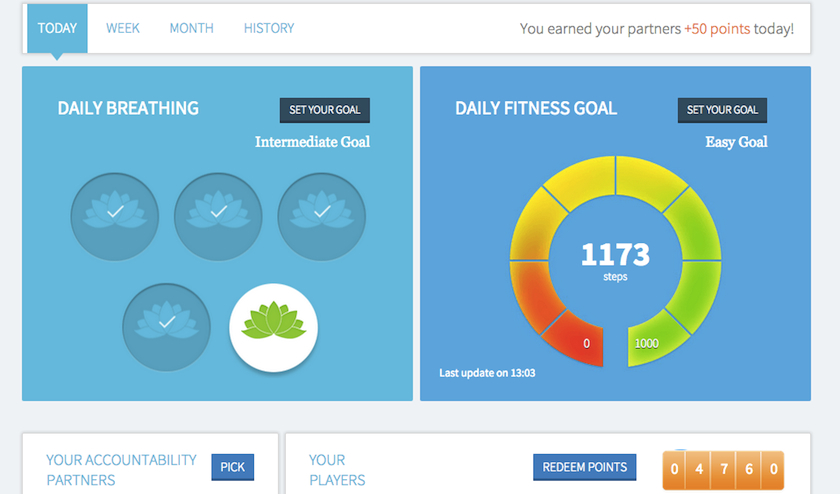
The app promotes wellness by guiding employees through deep-breathing exercises and encouraging other activities designed to reduce stress. It also urges them to find “accountability partners” to help monitor their level of exercise—all tracked by a Fitbit or a Fitbug—and meet their personal fitness goals.
From this alone, Anderson says, Concentrix has witnessed a 25% decline in absenteeism and a significant reduction in turnover during the past two months at a 400-employee call center where it’s experimenting with the Tenacity system.
But that’s only the beginning. By analyzing the chemistry among colleagues who are using its app, Tenacity’s computers can gain insight into who on a team is most cooperative, who may be ostracized socially from the group, and who may be overly aggressive or even toxic. (Anyone in that last category will be flagged so that a supervisor can decide if some kind of intervention is needed.)
More data is gleaned through Tenacity’s “virtual water cooler,” an open forum that invites employees to play games or take selfies together—often for prizes—shedding further light on each team member’s work relationships.
Other companies, like Keyhubs, offer tools for social network analysis. And a number of HR products are available that predict which employees are at risk of leaving the organization. But Tenacity’s artificial intelligence takes the next step: It automatically synchronizes the scheduling of coffee breaks so that certain people are purposefully put together. Two employees with similar interests, for example, may be paired, with the aim of making the workplace more enjoyable—and, in turn, lowering attrition. Or the algorithm may match up someone who is naturally nurturing with someone who is having trouble breaking in.
[fortune-brightcove videoid=4406425369001]
Concentrix plans to test this “dynamic scheduling” shortly. “We’re very much in the petri dish of this right now,” Anderson says.
However promising Tenacity’s technology proves to be, Davis doesn’t believe that many, if any, managers will be made obsolete. It is meant to augment, not supplant, what the best bosses do: maximize joint performance.
Still, the company’s inroads into this area are a reminder that computers are conquering more and more tasks once thought impervious to automation. “Why not management?” asks Tom Davenport, a Babson College professor and the author of Big Data at Work.
So far, Tenacity is focused on call centers, where it sees workers who are under intense pressure to deliver results but are “managerially underserved.” There’s “not a lot of mentoring or pulling in people from the margins at these places,” Davis points out.
Over time, Tenacity hopes to expand to big-box retailers, hotel chains, and maybe even hospitals and software companies. “It’s not just those at the lower end of the pay scale” who could benefit from “social tuning,” says Adeyema, Tenacity’s COO. “The problem is ubiquitous.”
Whether Tenacity will catch on in a major way is anybody’s guess. Davenport cautions that employees could be creeped out by the whole thing. “Let’s face it,” he says, “some may find it sort of invasive.”
But Adeyema says the virtual water cooler is a great avenue for employees to “break the ice” as they never have before. Quirky questions, in which they’re asked to share their most embarrassing moment on the job and other trivia, “allow workers to humanize each other.”
As only a piece of software can.
Rick Wartzman is the executive director of the Drucker Institute at Claremont Graduate University. The author or editor of five books, he is currently writing a narrative history of how the social contract between employer and employee in America has changed since the end of World War II.