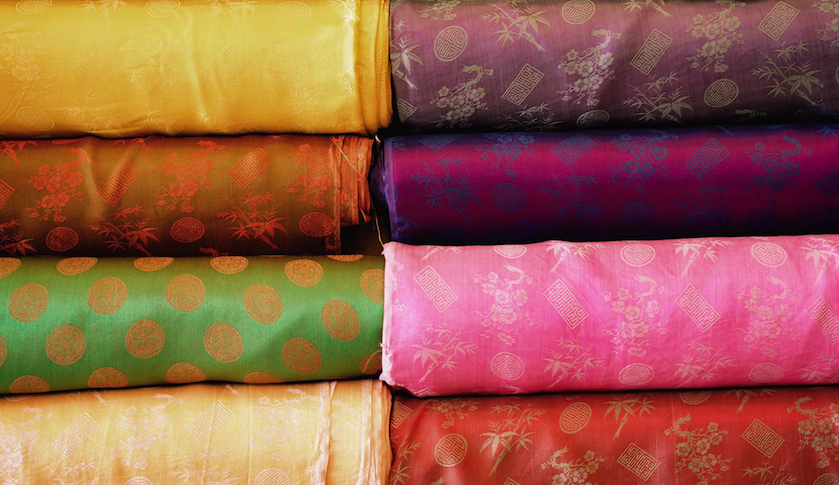
Shar Simantob and his Los Angeles-based textile company, United Fabric International, are used to following trends in the fashion industry. The company works as a middleman between mills and labels to develop fabrics and prints in line with what tastemakers say will be hot in the coming seasons.
Over the past few years, UFI and other textile companies based mostly in Los Angeles have managed to push themselves to the forefront of a new trend in the fashion industry: copyright infringement lawsuits. The complaints target print designs on garments, one of the few aspects of a garment eligible for copyright protection in the U.S.
Prints have received protection for more than 60 years, stemming from a 1954 Supreme Court case. But it was only about 10 years ago that one textile company, L.A. Printex, and its law firm, Doniger/Burroughs, attempted to engage the law full on and target companies they believed had stolen their prints—the florals, paisleys, geometric designs, animal skin patterns, and the like which so often appear on clothing.
According to figures sourced from Bloomberg Law, Doniger/Burroughs has filed more than 700 copyright infringement cases over the past five years, including more than 30 since August 1. Most of the complaints are filed in Southern California, which is now home to more than twice as many fashion, textile, and wholesale jobs as New York City, as well as $18 billion in revenue for fashion companies based in the region, according to a 2014 report sponsored by CIT Group for the California Fashion Association.
Because U.S. copyright law allows for copyright claims to target all parties involved in the production and sales process, from retailers to labels to textile manufacturers, misappropriated patterns could represent millions of dollars to a successful plaintiff—as happened in 2013 when a jury awarded $1.75 million to Doniger/Burroughs’s client, Advanced Visual Image Design.
“In fashion, as you go up the chain, the margins are greater,” says Staci Riordan, adjunct professor and executive director of the Fashion Law Project at Loyola Law School in L.A. and partner at Nixon Peabody LLP, as well as chairperson of its Fashion Practice Group.
Law partners Stephen Doniger and Scott Alan Burroughs have pioneered these lawsuits over the past decade. Their suits have targeted garments which feature designs they claim are purloined from their clients, who are mostly large textile converters and importers, such as L.A. Printex Industries, Star Fabrics, Unicolors, and UFI.
Lawyers familiar with Doniger/Burroughs’s work say their lawsuits follow a general formula, with settlements varying from case to case. And while some defendants have called it “copyright trolling,” the firm says it’s leveling the playing field by allowing its clients to pursue their claims, sometimes against the nation’s largest retailers and manufacturers, in an efficient manner.
“There has to be merit to the case, there has to be,” says Doniger. “Sure you can go ahead and sue people for $10,000 here and there, but you look at our record, we’ve got multiple six- and seven-figure verdicts.”
[fortune-brightcove videoid=4517982636001]
In order for a work, including a fashion print, to be copyrightable in the U.S., it must be created independently and possess a “modicum of creativity,” according to the Supreme Court. But many defendants and their lawyers say that’s just not so with the current spate of litigation. Doug Lipstone, a partner at Weinberg Gonser whose clients are targets of Doniger/Burroughs is skeptical, calling the prints in question “the most basic patterns imaginable.”
“This is not about copyright. This is about legalized extortion, it is shakedowns under the presumption of validity you can get from a copyright registration,” he says. “It is an absolute tax.”
Lipstone points out how easy it is to get a copyright registration, which would make the cost of entry very low for a company to hypothetically register a bevy of generic prints and then seek out other companies who might have used similar patterns due to a current trend.
“There are only so may ways you can make a floral design,” says Mark Brutzkus, founding partner at Ezra Brutzkus Gubner LLP, whose clients are also targets of Doniger/Burroughs.
Perhaps the most outspoken critic of these cases is Charles Colman, NYU Law Professor and author of the blog Law of Fashion, as well as author of the forthcoming book Patents and Perverts: The Hidden Moral Agenda of American Design Law.
“One by one these textile companies realized the potential benefits that could accrue from bringing lawsuits that were easy to multiply because of economies of scale and expensive to defend because they are often factually intensive and ultimately often low stakes,” he says. “In the real world, the economics of litigation are such that the true account of what happened and how a defendant came to be in possession of a print often never comes out.”
Another factor working in favor of the plaintiff is the way the U.S. legal system is structured.
“There is this gap that puts all citizens at a disadvantage. Anybody can sue anybody over anything. You are out of pocket and inconvenienced until you get back attorney fees. That is one of the prices you pay for living in a society under the rule of law,” says Paul Goldstein, a Stanford University law professor and expert on intellectual property (IP) law.
[fortune-brightcove videoid=4390532556001]
In conversations with some of the manufacturers and retailers that have been sued by UFI, L.A. Printex, and other companies, it is clear that the suits have had an impact on the industry.
Most of the recent changes among retailers and manufacturers come in the form of copious tracking systems for all designs, indemnity agreements from their suppliers, and additional training for their designers.
“We see people trying to make a business out of alleged copyright infringement and it’s so costly for us to defend some of these things,” says Jill Shea, chief marketing officer for Vanity Shops, a young women’s clothing and accessories chain based in Fargo, N.D. with stores in 25 states. “It’s definitely always at the top of your mind because it can be very damaging to your organization. It takes you off focus.”
In New York City, an owner of an established clothing company who has been sued multiple times and has agreed to settlements, talked about the experience in exchange for anonymity due to privacy concerns.
“We are more conscious of it, to make sure we are not copying anything, like a print. A retailer would say, ‘We like this print, make something like it for us,’ but we are respecting that copyright thing,” he says. Despite his vigilance, however, he’s still confused over the law.
“It’s almost impossible to separate some of this, though. A thing is in, that has become hot, and you’ll see it from all the best people. What’s that called? It’s more of a trend than IP or design. What separates something IP vs. a trend that should be open to everybody?”
To Doniger/Burroughs, though, this is not a philosophical question—and one that could be avoided entirely, according to Burroughs, if companies simply hired their own designers or purchased prints from sources who do.
The partners believe they are making a dent in the industry in this regard. “We have certainly seen a lot of companies in the apparel industry clean up their practice and change the way they do business,” says Doniger.
And what about the claims that these legal actions amount to a tax on the industry? “The response is that the tax obviously is not high enough,” says Burroughs. “The record is that we have gone to trial nine times and we have won all of these cases.”