• Home
  • Latest
  • Fortune 500
  • Finance
  • Tech
  • Leadership
  • Lifestyle
  • Rankings
  • Multimedia
Techbrain science

Research shows a path to reading each other’s minds

By
Derrick Harris
Derrick Harris
Down Arrow Button Icon
By
Derrick Harris
Derrick Harris
Down Arrow Button Icon
September 23, 2015, 8:49 PM ET
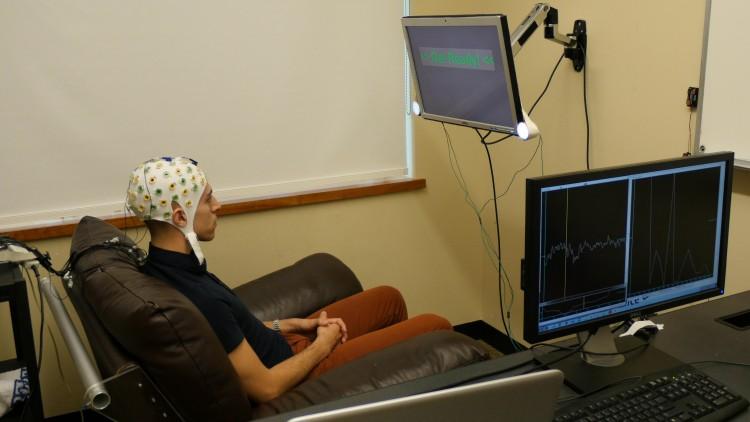
Courtesy of University of Washington

You know the TV-show trope where someone is able to read other people’s minds just by touching them? Well, scientists have devised a way to let people actually read minds—in a sense—and they can do it even when they’re nowhere near each other.

Research out of the University of Washington, and published Wednesday in the journal PLOS ONE, shows how people sitting nearly a mile apart were able to participate in a question-answering game using only their minds. While the study is not proof that people will soon be carrying on long, non-verbal conversations with each other, its underlying technology could potentially be very valuable in burgeoning fields such as virtual reality and real-time language translation, or even helping tackle diseases such as ADHD.

The way it works, essentially, is that each person is wearing caps that read their brain waves, which are measured by an electroencephalography, or EEG, machine. One person asks the other a yes or no question, via computer, which the other answers by focusing on the “yes” or “no” sections on his computer monitor. The answer is delivered to the questioner via magnetic stimulation, with an answer of “yes” delivering a signal strong enough to stimulate the visual cortex and make the recipient see a flash of light.

In this case, the questions and answers were pretty limited. The person asking the questions was shown a list of eight objects, one of which was shown on screen in front of the person answering. After asking three questions from a predetermined list and receiving (or not receiving) the stimuli, the questioner had to guess what the answer was. They were able to do so 72% of the time, although the paper notes that the actual number would have been above 90% had people answering questions not answered incorrectly sometimes, and had those asking not occasionally misinterpreted the stimuli they received.

A diagram of how the experiment was set up.Courtesy of PLOS ONE / University of Washington
Courtesy of PLOS ONE / University of Washington

While any controlled experiment has factors that limit real-world viability—in this case, for example, the physical setup (specialized caps, EEG machines and stimulus servers on each end) and the limited yes-no interactions—it’s not too difficult to envision some powerful applications for this type of technology in situations where mere words wouldn’t work. The PLOS ONE paper suggests improved communications for people who cannot speak, or between people who don’t speak the same language.

In a University of Washington news story on the experiment, one of the researchers, Chantel Prat, suggests this type of technology could transmit brain states from person to person. For example, she said, a student without ADHD might be able to help a student with ADHD concentrate by sending signals that stimulate the proper areas of his brain. That sort of capability might also apply to a broad range of disorders that we would like to get under control in certain situations.

However, pulling off these ideas at any significant scale would likely require some major investments in both the gear involved (everything would probably have to fit in a small, comfortable package, for example) and in the methods for actually sending the proper signals between devices. So maybe a realistic first application would be something like virtual reality, where companies such as Facebook (FB) and Microsoft (MSFT) are already investing a lot of money, including on headset technology that’s both functional and feasible to wear.

The prospect of letting headset-wearers read each other’s minds might be the kind of game-changing technology that convinces these companies to fund its development across the finish line.

About the Author
By Derrick Harris
See full bioRight Arrow Button Icon

Latest in Tech

CryptoYouTube
Exclusive: YouTube launches option for U.S. creators to receive stablecoin payouts through PayPal
By Ben WeissDecember 11, 2025
59 minutes ago
Five panelists seated; two women and five men.
AIBrainstorm AI
The race to deploy an AI workforce faces one important trust gap: What happens when an agent goes rogue?
By Amanda GerutDecember 11, 2025
4 hours ago
Stephanie Zhan, Partner Sequoia Capital speaking on stage at Fortune Brainstorm AI San Francisco 2025.
AIEye on AI
Highlights from Fortune Brainstorm AI San Francisco
By Jeremy KahnDecember 11, 2025
5 hours ago
Sam Altman
Arts & EntertainmentMedia
‘We’re not just going to want to be fed AI slop for 16 hours a day’: Analyst sees Disney/OpenAI deal as a dividing line in entertainment history
By Nick LichtenbergDecember 11, 2025
5 hours ago
InnovationBrainstorm AI
Backflips are easy, stairs are hard: Robots still struggle with simple human movements, experts say
By Nicholas GordonDecember 11, 2025
5 hours ago
Iger
AIDisney
‘Creativity is the new productivity’: Bob Iger on why Disney chose to be ‘aggressive,’ adding OpenAI as a $1 billion partner
By Nick LichtenbergDecember 11, 2025
7 hours ago

Most Popular

placeholder alt text
Success
At 18, doctors gave him three hours to live. He played video games from his hospital bed—and now, he’s built a $10 million-a-year video game studio
By Preston ForeDecember 10, 2025
2 days ago
placeholder alt text
Investing
Baby boomers have now 'gobbled up' nearly one-third of America's wealth share, and they're leaving Gen Z and millennials behind
By Sasha RogelbergDecember 8, 2025
3 days ago
placeholder alt text
Economy
‘Be careful what you wish for’: Top economist warns any additional interest rate cuts after today would signal the economy is slipping into danger
By Eva RoytburgDecember 10, 2025
1 day ago
placeholder alt text
Politics
Exclusive: U.S. businesses are getting throttled by the drop in tourism from Canada: ‘I can count the number of Canadian visitors on one hand’
By Dave SmithDecember 10, 2025
2 days ago
placeholder alt text
Economy
‘We have not seen this rosy picture’: ADP’s chief economist warns the real economy is pretty different from Wall Street’s bullish outlook
By Eleanor PringleDecember 11, 2025
16 hours ago
placeholder alt text
Success
Netflix–Paramount bidding wars are pushing Warner Bros CEO David Zaslav toward billionaire status—he has one rule for success: ‘Never be outworked’
By Preston ForeDecember 10, 2025
1 day ago
Rankings
  • 100 Best Companies
  • Fortune 500
  • Global 500
  • Fortune 500 Europe
  • Most Powerful Women
  • Future 50
  • World’s Most Admired Companies
  • See All Rankings
Sections
  • Finance
  • Leadership
  • Success
  • Tech
  • Asia
  • Europe
  • Environment
  • Fortune Crypto
  • Health
  • Retail
  • Lifestyle
  • Politics
  • Newsletters
  • Magazine
  • Features
  • Commentary
  • Mpw
  • CEO Initiative
  • Conferences
  • Personal Finance
  • Education
Customer Support
  • Frequently Asked Questions
  • Customer Service Portal
  • Privacy Policy
  • Terms Of Use
  • Single Issues For Purchase
  • International Print
Commercial Services
  • Advertising
  • Fortune Brand Studio
  • Fortune Analytics
  • Fortune Conferences
  • Business Development
About Us
  • About Us
  • Editorial Calendar
  • Press Center
  • Work At Fortune
  • Diversity And Inclusion
  • Terms And Conditions
  • Site Map

© 2025 Fortune Media IP Limited. All Rights Reserved. Use of this site constitutes acceptance of our Terms of Use and Privacy Policy | CA Notice at Collection and Privacy Notice | Do Not Sell/Share My Personal Information
FORTUNE is a trademark of Fortune Media IP Limited, registered in the U.S. and other countries. FORTUNE may receive compensation for some links to products and services on this website. Offers may be subject to change without notice.