• Home
  • News
  • Fortune 500
  • Tech
  • Finance
  • Leadership
  • Lifestyle
  • Rankings
  • Multimedia
Techbrain science

Research shows a path to reading each other’s minds

By
Derrick Harris
Derrick Harris
Down Arrow Button Icon
By
Derrick Harris
Derrick Harris
Down Arrow Button Icon
September 23, 2015, 8:49 PM ET
Courtesy of University of Washington

You know the TV-show trope where someone is able to read other people’s minds just by touching them? Well, scientists have devised a way to let people actually read minds—in a sense—and they can do it even when they’re nowhere near each other.

Research out of the University of Washington, and published Wednesday in the journal PLOS ONE, shows how people sitting nearly a mile apart were able to participate in a question-answering game using only their minds. While the study is not proof that people will soon be carrying on long, non-verbal conversations with each other, its underlying technology could potentially be very valuable in burgeoning fields such as virtual reality and real-time language translation, or even helping tackle diseases such as ADHD.

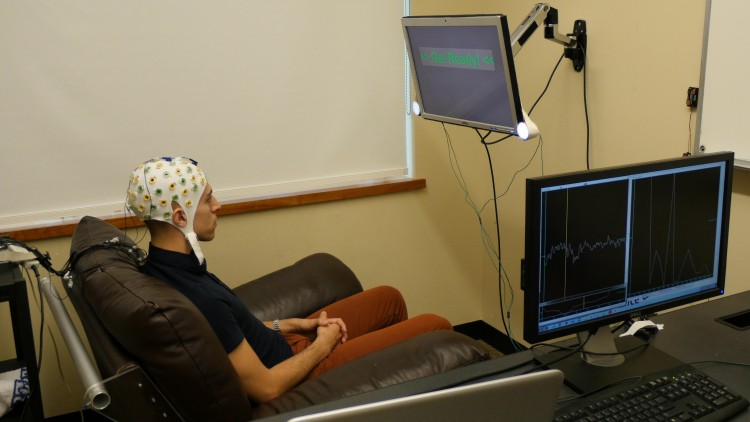
The way it works, essentially, is that each person is wearing caps that read their brain waves, which are measured by an electroencephalography, or EEG, machine. One person asks the other a yes or no question, via computer, which the other answers by focusing on the “yes” or “no” sections on his computer monitor. The answer is delivered to the questioner via magnetic stimulation, with an answer of “yes” delivering a signal strong enough to stimulate the visual cortex and make the recipient see a flash of light.

In this case, the questions and answers were pretty limited. The person asking the questions was shown a list of eight objects, one of which was shown on screen in front of the person answering. After asking three questions from a predetermined list and receiving (or not receiving) the stimuli, the questioner had to guess what the answer was. They were able to do so 72% of the time, although the paper notes that the actual number would have been above 90% had people answering questions not answered incorrectly sometimes, and had those asking not occasionally misinterpreted the stimuli they received.

A diagram of how the experiment was set up.Courtesy of PLOS ONE / University of Washington
Courtesy of PLOS ONE / University of Washington

While any controlled experiment has factors that limit real-world viability—in this case, for example, the physical setup (specialized caps, EEG machines and stimulus servers on each end) and the limited yes-no interactions—it’s not too difficult to envision some powerful applications for this type of technology in situations where mere words wouldn’t work. The PLOS ONE paper suggests improved communications for people who cannot speak, or between people who don’t speak the same language.

In a University of Washington news story on the experiment, one of the researchers, Chantel Prat, suggests this type of technology could transmit brain states from person to person. For example, she said, a student without ADHD might be able to help a student with ADHD concentrate by sending signals that stimulate the proper areas of his brain. That sort of capability might also apply to a broad range of disorders that we would like to get under control in certain situations.

However, pulling off these ideas at any significant scale would likely require some major investments in both the gear involved (everything would probably have to fit in a small, comfortable package, for example) and in the methods for actually sending the proper signals between devices. So maybe a realistic first application would be something like virtual reality, where companies such as Facebook (FB) and Microsoft (MSFT) are already investing a lot of money, including on headset technology that’s both functional and feasible to wear.

The prospect of letting headset-wearers read each other’s minds might be the kind of game-changing technology that convinces these companies to fund its development across the finish line.


About the Author
By Derrick Harris
See full bioRight Arrow Button Icon

Latest in Tech

InnovationBrainstorm Design
Video games can teach designers deeper lessons than ‘high score streaks’ and gamification
By Angelica AngDecember 3, 2025
39 minutes ago
LawInternet
A Supreme Court decision could put your internet access at risk. Here’s who could be affected
By Dave Lozo and Morning BrewDecember 2, 2025
10 hours ago
AITikTok
China’s ByteDance could be forced to sell TikTok U.S., but its quiet lead in AI will help it survive—and maybe even thrive
By Nicholas GordonDecember 2, 2025
10 hours ago
United Nations
AIUnited Nations
UN warns about AI becoming another ‘Great Divergence’ between rich and poor countries like the Industrial Revolution
By Elaine Kurtenbach and The Associated PressDecember 2, 2025
12 hours ago
Anthropic cofounder and CEO Dario Amodei
AIEye on AI
How Anthropic’s safety first approach won over big business—and how its own engineers are using its Claude AI
By Jeremy KahnDecember 2, 2025
12 hours ago
Nvidia founder and CEO Jensen Huang reacts during a press conference at the Asia-Pacific Economic Cooperation (APEC) CEO Summit in Gyeongju on October 31, 2025.
AINvidia
Nvidia CFO admits the $100 billion OpenAI megadeal ‘still’ isn’t signed—two months after it helped fuel an AI rally
By Eva RoytburgDecember 2, 2025
14 hours ago

Most Popular

placeholder alt text
Economy
Ford workers told their CEO 'none of the young people want to work here.' So Jim Farley took a page out of the founder's playbook
By Sasha RogelbergNovember 28, 2025
5 days ago
placeholder alt text
Success
Warren Buffett used to give his family $10,000 each at Christmas—but when he saw how fast they were spending it, he started buying them shares instead
By Eleanor PringleDecember 2, 2025
20 hours ago
placeholder alt text
Economy
Elon Musk says he warned Trump against tariffs, which U.S. manufacturers blame for a turn to more offshoring and diminishing American factory jobs
By Sasha RogelbergDecember 2, 2025
14 hours ago
placeholder alt text
C-Suite
MacKenzie Scott's $19 billion donations have turned philanthropy on its head—why her style of giving actually works
By Sydney LakeDecember 2, 2025
21 hours ago
placeholder alt text
North America
Jeff Bezos and Lauren Sánchez Bezos commit $102.5 million to organizations combating homelessness across the U.S.: ‘This is just the beginning’
By Sydney LakeDecember 2, 2025
16 hours ago
placeholder alt text
AI
More than 1,000 Amazon employees sign open letter warning the company's AI 'will do staggering damage to democracy, our jobs, and the earth’
By Nino PaoliDecember 2, 2025
22 hours ago
Rankings
  • 100 Best Companies
  • Fortune 500
  • Global 500
  • Fortune 500 Europe
  • Most Powerful Women
  • Future 50
  • World’s Most Admired Companies
  • See All Rankings
Sections
  • Finance
  • Leadership
  • Success
  • Tech
  • Asia
  • Europe
  • Environment
  • Fortune Crypto
  • Health
  • Retail
  • Lifestyle
  • Politics
  • Newsletters
  • Magazine
  • Features
  • Commentary
  • Mpw
  • CEO Initiative
  • Conferences
  • Personal Finance
  • Education
Customer Support
  • Frequently Asked Questions
  • Customer Service Portal
  • Privacy Policy
  • Terms Of Use
  • Single Issues For Purchase
  • International Print
Commercial Services
  • Advertising
  • Fortune Brand Studio
  • Fortune Analytics
  • Fortune Conferences
  • Business Development
About Us
  • About Us
  • Editorial Calendar
  • Press Center
  • Work At Fortune
  • Diversity And Inclusion
  • Terms And Conditions
  • Site Map

© 2025 Fortune Media IP Limited. All Rights Reserved. Use of this site constitutes acceptance of our Terms of Use and Privacy Policy | CA Notice at Collection and Privacy Notice | Do Not Sell/Share My Personal Information
FORTUNE is a trademark of Fortune Media IP Limited, registered in the U.S. and other countries. FORTUNE may receive compensation for some links to products and services on this website. Offers may be subject to change without notice.