• Home
  • Latest
  • Fortune 500
  • Finance
  • Tech
  • Leadership
  • Lifestyle
  • Rankings
  • Multimedia
LeadershipFuture of Work

Free agent or full-timer? How to hire the right fit

By
John W. Boudreau
John W. Boudreau
,
Ravin Jesuthasan
Ravin Jesuthasan
and
David Creelman
David Creelman
Down Arrow Button Icon
By
John W. Boudreau
John W. Boudreau
,
Ravin Jesuthasan
Ravin Jesuthasan
and
David Creelman
David Creelman
Down Arrow Button Icon
August 13, 2015, 11:09 AM ET

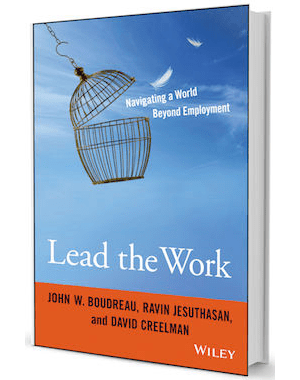
In this excerpt from Lead the Work: Navigating a World Beyond Employment, authors John W. Boudreau, Ravin Jesuthasan, and David Creelman examine how permeable your staffing boundaries should be.

A look around a typical office won’t show you whether work and workers reside inside a relatively sealed organization boundary or flow freely across it. A familiar example is when you discover that someone working in your office is not a coworker at all, but actually a consultant on an extended contract. That’s an example of a worker flowing into the organization without an employment relationship. Do some employees stay only a couple of years, to bolster their resume and then move on? That’s an example of workers flowing out across the boundary. Do employees leave for a few years, gain valuable experience, and then return? That’s an example of workers flowing both outward and then inward through the boundary.

We tend to think of the organization as a place where there’s clear inside and outside, and the way to cross it is to become an employee or to terminate employment. In the world beyond employment, work and workers flow through the organization quite freely, and often without an employment relationship.

As a leader, you decide how much of this inflow and outflow fits your mission—how much to allow your organization boundary to be permeable.

The better we get at deconstructing assignments, the more we disperse them, and the more they are detached from regular full-time employment, the more permeable the boundary can become, and the more important it becomes for leaders to choose carefully where they fall on the permeability dimension. The same is true for the workers themselves. There is a range of emerging relationships you can have with workers, from regular employees to consultants on secondment to using employees from another firm (perhaps an outsourcer or alliance), and the work they do can flow through your boundary or be contained within it.


For example, a large company valued its HR consultant because he was the only person who had been around long enough to know how and why certain decisions had been made. Many regular full-time employees in HR had come and gone, leaving no one else to match the consultant’s long-term connection and institutional knowledge of the company. In this case, the relationship between the work and the worker—the job of continuity in the HR department—had unintentionally been moved outside the firm and into the consulting firm that employed the consultant. Continuity is important, but if we see the organization as permeable, there may be ways to achieve it without relying on employees embedded inside the firm. Leaving such choices to chance, without a framework to guide them, may be risky in the new world of work.

Leading the work means using the flow of talent, work, and workers to sustain and achieve your mission. Making a sharp distinction between how you manage contractors and how you manage employees feels increasingly odd when people and work flow so freely in and out of the company, even if the distinction is important from a legal perspective. Thinking of free agents providing their work from distant locations as “outsiders” seems odd when the regular employees themselves are rarely in the office, and the work of both employees and free agents is intermingled as it flows in and out across the boundary of the organization.

There will be differences in how you treat people who are working for and with you. Some will be in the inner circle and some will be completely anonymous. Some will merit investment to cement a long-term relationship; others will do a microtask and disappear. The point is that increasingly the work they do flows across the boundary called your “organization,” that is demarcated by a regular full-time employment relationship. Your key people and your closest advisors need not be employees “inside” the boundary. You may shield trade secrets from employees who are inside yet share them with a trusted contractor who is outside. You may work hard to retain the work of uniquely skilled free agents yet accept the fact that less-uniquely skilled employees may leave. Leading the work means focusing more on how the work and workers flow through the boundary than on whether or not it is done by regular full-time employees sitting inside that (increasingly) imaginary boundary.

[fortune-brightcove videoid=4406513587001]


How much should you allow work and workers to permeate your organizational boundary? Dialing this dimension to zero means that no work will be done unless it can be done by regular full-time employees residing inside the boundary. Dialing permeability a bit higher might involve encouraging some employees to become onsite independent contractors, or offsite free agents working through a talent platform, or to form a microbusiness to which you outsource the work. That’s letting the work and workers flow out. Conversely, you could offer a talented free agent the opportunity to become a regular full-time employee, so they build more enduring ties with your organization. That’s what happens with the most talented coders on competitive freelance hub Topcoder; they are frequently offered regular full-time employment with companies like Google, Twitter, and Amazon.

Take, for example, the owner of a small company who hired what turned out to be a very talented software coder. The owner wanted to keep this talented employee but could not compete with Topcoder’s variety of projects, high pay, and visibility for talented coders. If you think of work as happening only inside the employment boundary, the inevitable result is that the programmer will leave forcing the small company to hire someone else. The owner was more creative. He encouraged his young programmer to work for Topcoder on the side. The employee was so pleased with this arrangement that he actually turned down a lucrative offer to work for a high-tech firm, to stay with his current employer. Seeing the organization boundary as permeable means that the owner could allow work to flow through the boundary, even when it flowed outward to the Topcoder platform, as long as the coder’s work for the small company was still useful. Dial up permeability a bit, and nonobvious solutions emerge for keeping top programming talent happy and close at hand.

The idea is to dial permeability up and down optimally. An organization boundary, with “insiders” that are regular full-time employees and “outsiders” that are not, matters less now; and leading the work means being more savvy about how freely work flows through the boundary.

Excerpted and adapted with permission of the publisher, Wiley, from Lead the Work: Navigating a World Beyond Employment by John W. Boudreau, Ravin Jesuthasan, David Creelman. Copyright (c) 2015 by John W. Boudreau, Ravin Jesuthasan, David Creelman.


About the Authors
By John W. Boudreau
See full bioRight Arrow Button Icon
By Ravin Jesuthasan
See full bioRight Arrow Button Icon
By David Creelman
See full bioRight Arrow Button Icon

Latest in Leadership

Finance
Lorem ipsum dolor sit amet, consectetur adipiscing elit, sed do eiusmod tempor incididunt ut labore et dolore magna aliqua. Ut enim ad minim veniam
By Fortune Editors
October 20, 2025
Finance
Lorem ipsum dolor sit amet, consectetur adipiscing elit, sed do eiusmod tempor incididunt ut labore et dolore magna aliqua. Ut enim ad minim veniam
By Fortune Editors
October 20, 2025
Finance
Lorem ipsum dolor sit amet, consectetur adipiscing elit, sed do eiusmod tempor incididunt ut labore et dolore magna aliqua. Ut enim ad minim veniam
By Fortune Editors
October 20, 2025
Finance
Lorem ipsum dolor sit amet, consectetur adipiscing elit, sed do eiusmod tempor incididunt ut labore et dolore magna aliqua. Ut enim ad minim veniam
By Fortune Editors
October 20, 2025
Finance
Lorem ipsum dolor sit amet, consectetur adipiscing elit, sed do eiusmod tempor incididunt ut labore et dolore magna aliqua. Ut enim ad minim veniam
By Fortune Editors
October 20, 2025
Finance
Lorem ipsum dolor sit amet, consectetur adipiscing elit, sed do eiusmod tempor incididunt ut labore et dolore magna aliqua. Ut enim ad minim veniam
By Fortune Editors
October 20, 2025

Most Popular

Finance
Lorem ipsum dolor sit amet, consectetur adipiscing elit, sed do eiusmod tempor incididunt ut labore et dolore magna aliqua. Ut enim ad minim veniam
By Fortune Editors
October 20, 2025
Finance
Lorem ipsum dolor sit amet, consectetur adipiscing elit, sed do eiusmod tempor incididunt ut labore et dolore magna aliqua. Ut enim ad minim veniam
By Fortune Editors
October 20, 2025
Finance
Lorem ipsum dolor sit amet, consectetur adipiscing elit, sed do eiusmod tempor incididunt ut labore et dolore magna aliqua. Ut enim ad minim veniam
By Fortune Editors
October 20, 2025
Finance
Lorem ipsum dolor sit amet, consectetur adipiscing elit, sed do eiusmod tempor incididunt ut labore et dolore magna aliqua. Ut enim ad minim veniam
By Fortune Editors
October 20, 2025
Finance
Lorem ipsum dolor sit amet, consectetur adipiscing elit, sed do eiusmod tempor incididunt ut labore et dolore magna aliqua. Ut enim ad minim veniam
By Fortune Editors
October 20, 2025
Finance
Lorem ipsum dolor sit amet, consectetur adipiscing elit, sed do eiusmod tempor incididunt ut labore et dolore magna aliqua. Ut enim ad minim veniam
By Fortune Editors
October 20, 2025
Rankings
  • 100 Best Companies
  • Fortune 500
  • Global 500
  • Fortune 500 Europe
  • Most Powerful Women
  • Future 50
  • World’s Most Admired Companies
  • See All Rankings
Sections
  • Finance
  • Leadership
  • Success
  • Tech
  • Asia
  • Europe
  • Environment
  • Fortune Crypto
  • Health
  • Retail
  • Lifestyle
  • Politics
  • Newsletters
  • Magazine
  • Features
  • Commentary
  • Mpw
  • CEO Initiative
  • Conferences
  • Personal Finance
  • Education
Customer Support
  • Frequently Asked Questions
  • Customer Service Portal
  • Privacy Policy
  • Terms Of Use
  • Single Issues For Purchase
  • International Print
Commercial Services
  • Advertising
  • Fortune Brand Studio
  • Fortune Analytics
  • Fortune Conferences
  • Business Development
About Us
  • About Us
  • Editorial Calendar
  • Press Center
  • Work At Fortune
  • Diversity And Inclusion
  • Terms And Conditions
  • Site Map
  • Facebook icon
  • Twitter icon
  • LinkedIn icon
  • Instagram icon
  • Pinterest icon

Latest in Leadership

kande
C-SuiteConsulting
PwC’s global chairman says most leaders have forgotten ‘the basics’ as 56% are still getting ‘nothing’ out of AI adoption
By Diane Brady and Nick LichtenbergJanuary 19, 2026
22 hours ago
Elon Musk, wearing a suit, looks to the side and frowns.
AIElon Musk
Elon Musk says that in 10 to 20 years, work will be optional and money will be irrelevant thanks to AI and robotics
By Sasha RogelbergJanuary 19, 2026
1 day ago
Woman packing her stuff as an AI worker types on a computer
SuccessCareers
Microsoft researchers have revealed the 40 jobs most exposed to AI—and even teachers make the list
By Preston ForeJanuary 19, 2026
1 day ago
mohamad ali
CommentaryConsulting
I lead IBM Consulting, here’s how AI-first companies must redesign work for growth
By Mohamad AliJanuary 19, 2026
1 day ago
SuccessThe Promotion Playbook
Barry’s cofounder meets with ‘random’ young people who send him cold emails and LinkedIn DMs—it’s how he hired the current CEO
By Orianna Rosa RoyleJanuary 19, 2026
1 day ago
NewslettersCEO Daily
Trump and his Greenland threats are set to dominate a high-stakes World Economic Forum in Davos
By Diane Brady and Claire ZillmanJanuary 19, 2026
1 day ago

Most Popular

placeholder alt text
AI
Elon Musk says that in 10 to 20 years, work will be optional and money will be irrelevant thanks to AI and robotics
By Sasha RogelbergJanuary 19, 2026
1 day ago
placeholder alt text
Politics
Army readies 1,500 paratroopers specializing in arctic operations for possible deployment to Minnesota if Trump invokes Insurrection Act
By Konstantin Toropin and The Associated PressJanuary 18, 2026
2 days ago
placeholder alt text
Investing
Stocks sell off globally as traders digest Trump message saying he wants Greenland because ‘your Country decided not to give me the Nobel’ 
By Jim EdwardsJanuary 19, 2026
1 day ago
placeholder alt text
Politics
The U.S. Supreme Court could throw a wrench into Trump’s plan to take Greenland as soon as Tuesday
By Jim EdwardsJanuary 19, 2026
1 day ago
placeholder alt text
Success
Despite his $2.6 billion net worth, MrBeast says he’s having to borrow cash and doesn’t even have enough money in his bank account to buy McDonald’s
By Emma BurleighJanuary 13, 2026
7 days ago
placeholder alt text
Commentary
I oversee a lab where engineers try to destroy my life’s work. It's the only way to prepare for quantum threats
By Bernard VianJanuary 18, 2026
2 days ago

© 2025 Fortune Media IP Limited. All Rights Reserved. Use of this site constitutes acceptance of our Terms of Use and Privacy Policy | CA Notice at Collection and Privacy Notice | Do Not Sell/Share My Personal Information
FORTUNE is a trademark of Fortune Media IP Limited, registered in the U.S. and other countries. FORTUNE may receive compensation for some links to products and services on this website. Offers may be subject to change without notice.