• Home
  • Latest
  • Fortune 500
  • Finance
  • Tech
  • Leadership
  • Lifestyle
  • Rankings
  • Multimedia
LeadershipEntrepreneurs

TechShop gives the Maker Movement a big boost

By
Rick Wartzman
Rick Wartzman
and
Tom Ziegler
Tom Ziegler
Down Arrow Button Icon
By
Rick Wartzman
Rick Wartzman
and
Tom Ziegler
Tom Ziegler
Down Arrow Button Icon
June 11, 2015, 7:55 AM ET
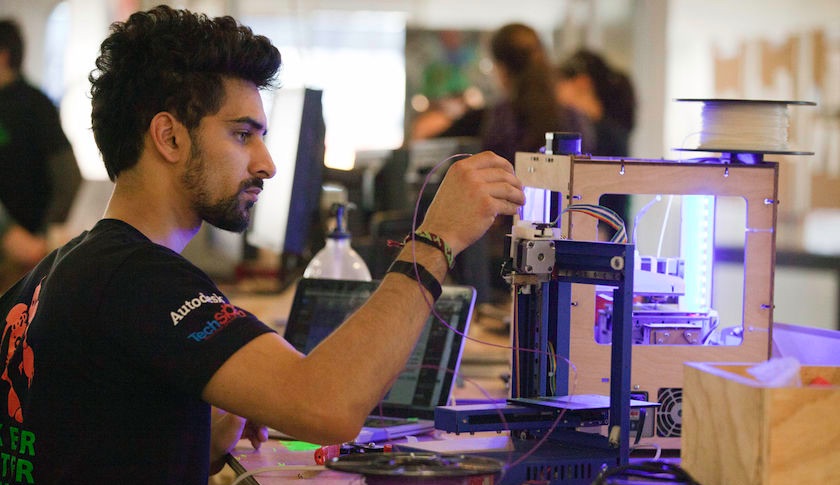
TechShop’s fabrication studio in downtown San Francisco
TechShop’s fabrication studio in downtown San FranciscoCourtesy TechShop

One of the first things you notice when you walk into TechShop’s 17,000-square-foot flagship fabrication studio in downtown San Francisco is the noise—the constant buzz and occasional bang of heavy machines biting and slicing into all manner of material: steel, aluminum, acrylic, wood.

It’s the sound of the Maker Movement, a phenomenon that is helping to fuel entrepreneurism and, for a growing group, changing the future of work.

The din promises to get only louder from here. On Friday, at a White House event, TechShop will announce that it’s aiming to teach others how to launch 1,000 smaller “maker spaces” across the country within the next two years.

For $4,500, TechShop will provide guidance on how to design these independent places, buy and maintain the industrial equipment inside, and educate users via a standardized curriculum. “It’s the nuts and bolts of how you actually run one of these,” says TechShop CEO Mark Hatch, who describes his nine-year-old company as “Kinko’s for geeks.”

By creating and certifying mini versions of itself through its Makerspace Academy, TechShop hopes to help midwife thousands of small businesses (some of which will become large businesses).

It also wants to generate income. In addition to collecting tuition at its academy, TechShop will share in any fees charged by the spaces it spawns. Hatch also believes that some of those who join one of these 1,000- to 3,000-square-foot operations will eventually want to move on to a full-fledged TechShop.

The company, which charges $150 a month for access to more than $1 million worth of professional tools (like laser cutters and 3-D printers), has eight locations around the nation serving some 7,000 members. It will soon open two more.

TechShop also offers hundreds of classes that, thanks to how easy it has become to use its array of contraptions, can turn a novice into a craftsman in a matter of days.

“Software really does lower the barrier of entry,” says Jesse Harrington Au, the “maker advocate” at Autodesk, which is a major investor in TechShop and has also donated all the computer-aided design and computer-aided manufacturing programs used at TechShop’s facilities. Tasks that five or 10 years ago required advanced training and many months to complete, Au notes, can now be accomplished in a few hours.


“This is a revolution,” says Hatch. “If you can imagine it, you can make it. And that’s new to the world.” TechShop’s logo carries this same sentiment: “Build your dreams here.”

America could use more dreamers. Although Silicon Valley has projected an image that the U.S. is fertile ground for startups, the rate at which new companies are being formed has been declining steadily for more than 30 years.

TechShop is a laboratory for those determined to defy this trend. Most of its members aren’t hobbyists, Hatch says, but are actively pursuing some kind of vocation. They typically fall into one of two camps.

The first includes people who come to TechShop to put together a prototype. The founders of Square built their first credit-card reader there. Scores of others have done the same, including those behind Lightning Motorcycles, the lamp maker Lumio, and BioLite, a social enterprise that makes consumer energy products for emerging markets.

For businesses like these, the advantages of TechShop are obvious: It saves them a ton of money and time because they don’t have to buy expensive equipment or hire a contract manufacturer out of the gate.

But as many discover, there’s another benefit as well: being around other entrepreneurs from a wide variety of fields. “I got a lot of advice from people at TechShop who started a little ahead of us,” says Anton Willis, the co-founder of Oru Kayak, which makes watercraft that you take out of a small storage box and unfold, origami-like, in just a few minutes.

Eventually, many successful businesses get too big for TechShop and fill their own offices and factories. “At some point, you grow out of it,” says Kendrick Coburn, an engineer at prosthetics maker LIM Innovations, another TechShop progeny.

But those in the second camp—artisans churning out all kinds of crafts—often stick around, using TechShop as their production line. Some of these folks have day jobs and use TechShop to make money on the side. Others have made it their full-time occupation. In either case, they are all tapping into the increasing demand for locally made goods.

Some at TechShop have bankrolled their ventures through crowdfunding sites like Kickstarter, while many of the artists sell their wares through online marketplaces such as Etsy. “None of these things even existed a decade ago,” Hatch points out.

Hatch and his colleagues delight in telling the stories of those who’ve turned their lives around at TechShop, like the unemployed advertising copywriter who now has a thriving jewelry business. “What we’re really selling is personal transformations,” says Andrew Calvo, a senior manager at TechShop in San Francisco.

For many, of course, it’s not so simple. Starting any business is hard, and most fail. And for all the excitement of being an entrepreneur, it’s difficult to figure out how the individual craftspeople, in particular, will ever have decent pensions or other forms of security associated with more traditional employment.

Still, TechShop is clearly onto something. The company recently went to a 24/7 schedule at all of its locations after the staff found they were kicking out lots of members at midnight.

Rick Wartzman is the executive director of the Drucker Institute at Claremont Graduate University. The author or editor of five books, he is currently writing a narrative history of how the social contract between employer and employee in America has changed since the end of World War II.


 

About the Authors
By Rick Wartzman
See full bioRight Arrow Button Icon
By Tom Ziegler
See full bioRight Arrow Button Icon

Latest in Leadership

Finance
Lorem ipsum dolor sit amet, consectetur adipiscing elit, sed do eiusmod tempor incididunt ut labore et dolore magna aliqua. Ut enim ad minim veniam
By Fortune Editors
October 20, 2025
Finance
Lorem ipsum dolor sit amet, consectetur adipiscing elit, sed do eiusmod tempor incididunt ut labore et dolore magna aliqua. Ut enim ad minim veniam
By Fortune Editors
October 20, 2025
Finance
Lorem ipsum dolor sit amet, consectetur adipiscing elit, sed do eiusmod tempor incididunt ut labore et dolore magna aliqua. Ut enim ad minim veniam
By Fortune Editors
October 20, 2025
Finance
Lorem ipsum dolor sit amet, consectetur adipiscing elit, sed do eiusmod tempor incididunt ut labore et dolore magna aliqua. Ut enim ad minim veniam
By Fortune Editors
October 20, 2025
Finance
Lorem ipsum dolor sit amet, consectetur adipiscing elit, sed do eiusmod tempor incididunt ut labore et dolore magna aliqua. Ut enim ad minim veniam
By Fortune Editors
October 20, 2025
Finance
Lorem ipsum dolor sit amet, consectetur adipiscing elit, sed do eiusmod tempor incididunt ut labore et dolore magna aliqua. Ut enim ad minim veniam
By Fortune Editors
October 20, 2025

Most Popular

Finance
Lorem ipsum dolor sit amet, consectetur adipiscing elit, sed do eiusmod tempor incididunt ut labore et dolore magna aliqua. Ut enim ad minim veniam
By Fortune Editors
October 20, 2025
Finance
Lorem ipsum dolor sit amet, consectetur adipiscing elit, sed do eiusmod tempor incididunt ut labore et dolore magna aliqua. Ut enim ad minim veniam
By Fortune Editors
October 20, 2025
Finance
Lorem ipsum dolor sit amet, consectetur adipiscing elit, sed do eiusmod tempor incididunt ut labore et dolore magna aliqua. Ut enim ad minim veniam
By Fortune Editors
October 20, 2025
Finance
Lorem ipsum dolor sit amet, consectetur adipiscing elit, sed do eiusmod tempor incididunt ut labore et dolore magna aliqua. Ut enim ad minim veniam
By Fortune Editors
October 20, 2025
Finance
Lorem ipsum dolor sit amet, consectetur adipiscing elit, sed do eiusmod tempor incididunt ut labore et dolore magna aliqua. Ut enim ad minim veniam
By Fortune Editors
October 20, 2025
Finance
Lorem ipsum dolor sit amet, consectetur adipiscing elit, sed do eiusmod tempor incididunt ut labore et dolore magna aliqua. Ut enim ad minim veniam
By Fortune Editors
October 20, 2025
Fortune Secondary Logo
Rankings
  • 100 Best Companies
  • Fortune 500
  • Global 500
  • Fortune 500 Europe
  • Most Powerful Women
  • Future 50
  • World’s Most Admired Companies
  • See All Rankings
Sections
  • Finance
  • Fortune Crypto
  • Features
  • Leadership
  • Health
  • Commentary
  • Success
  • Retail
  • Mpw
  • Tech
  • Lifestyle
  • CEO Initiative
  • Asia
  • Politics
  • Conferences
  • Europe
  • Newsletters
  • Personal Finance
  • Environment
  • Magazine
  • Education
Customer Support
  • Frequently Asked Questions
  • Customer Service Portal
  • Privacy Policy
  • Terms Of Use
  • Single Issues For Purchase
  • International Print
Commercial Services
  • Advertising
  • Fortune Brand Studio
  • Fortune Analytics
  • Fortune Conferences
  • Business Development
  • Group Subscriptions
About Us
  • About Us
  • Editorial Calendar
  • Press Center
  • Work At Fortune
  • Diversity And Inclusion
  • Terms And Conditions
  • Site Map
  • About Us
  • Editorial Calendar
  • Press Center
  • Work At Fortune
  • Diversity And Inclusion
  • Terms And Conditions
  • Site Map
  • Facebook icon
  • Twitter icon
  • LinkedIn icon
  • Instagram icon
  • Pinterest icon

Latest in Leadership

erewhon
EconomyFood and drink
Americans hate the economy so much, they’re buying $22 smoothies
By Yuanyuan (Gina) Cui, Patrick Van Esch and The ConversationApril 9, 2026
12 hours ago
Mark Cuban admits he made a mistake letting go of the Mavericks: ‘I don’t regret selling. I regret who I sold to’
InvestingMark Cuban
Mark Cuban admits he made a mistake letting go of the Mavericks: ‘I don’t regret selling. I regret who I sold to’
By Sydney LakeApril 9, 2026
13 hours ago
You’re looking at the AI revolution all wrong, top economist says: 40% unemployment and a 3-day work week are the same thing
AIdisruption
You’re looking at the AI revolution all wrong, top economist says: 40% unemployment and a 3-day work week are the same thing
By Nick LichtenbergApril 9, 2026
13 hours ago
Jamie Dimon, the CEO of JPMorgan Chase
SuccessCareer Advice
JPMorgan CEO Jamie Dimon says he’s ‘learned and relearned’ to not make big decisions when he’s tired on Fridays
By Emma BurleighApril 9, 2026
14 hours ago
Zoom CEO Eric Yuan
Successthe future of work
‘I hate working 5 days’: Zoom CEO says traditional work schedules are becoming obsolete—and predicts a 3-day workweek by 2031
By Preston ForeApril 9, 2026
14 hours ago
trump
PoliticsIran
Trump’s journey from ‘annihilation’ to ‘PEACE’ in one day rested on realization of a long-term battle to control Strait of Hormuz
By Aamer Madhani, Will Weissert, Josh Boak, Farnoush Amiri and The Associated PressApril 9, 2026
17 hours ago

Most Popular

The U.S. government is spending $88 billion a month in interest on national debt—equal to spending on defense and education combined
Economy
The U.S. government is spending $88 billion a month in interest on national debt—equal to spending on defense and education combined
By Fortune EditorsApril 9, 2026
18 hours ago
Gen Z doesn't want your full-time job. They want several part-time roles, and it's reshaping the entire workforce
Success
Gen Z doesn't want your full-time job. They want several part-time roles, and it's reshaping the entire workforce
By Fortune EditorsApril 9, 2026
21 hours ago
A Meta employee created a dashboard so coworkers can compete to be the company's No. 1 AI token user—and Zuckerberg doesn't even rank in the top 250
AI
A Meta employee created a dashboard so coworkers can compete to be the company's No. 1 AI token user—and Zuckerberg doesn't even rank in the top 250
By Fortune EditorsApril 9, 2026
20 hours ago
2 years ago, Saudi Arabia quietly canceled the ‘petrodollar’ deal with America that wired the world economy for 50 years. Then war broke out in Iran
Energy
2 years ago, Saudi Arabia quietly canceled the ‘petrodollar’ deal with America that wired the world economy for 50 years. Then war broke out in Iran
By Fortune EditorsApril 7, 2026
2 days ago
White-collar workers are quietly rebelling against AI as 80% outright refuse adoption mandates
AI
White-collar workers are quietly rebelling against AI as 80% outright refuse adoption mandates
By Fortune EditorsApril 9, 2026
19 hours ago
Gen Z workers are so fearful AI will take their job they’re intentionally sabotaging their company’s AI rollout
AI
Gen Z workers are so fearful AI will take their job they’re intentionally sabotaging their company’s AI rollout
By Fortune EditorsApril 8, 2026
2 days ago

© 2026 Fortune Media IP Limited. All Rights Reserved. Use of this site constitutes acceptance of our Terms of Use and Privacy Policy | CA Notice at Collection and Privacy Notice | Do Not Sell/Share My Personal Information
FORTUNE is a trademark of Fortune Media IP Limited, registered in the U.S. and other countries. FORTUNE may receive compensation for some links to products and services on this website. Offers may be subject to change without notice.