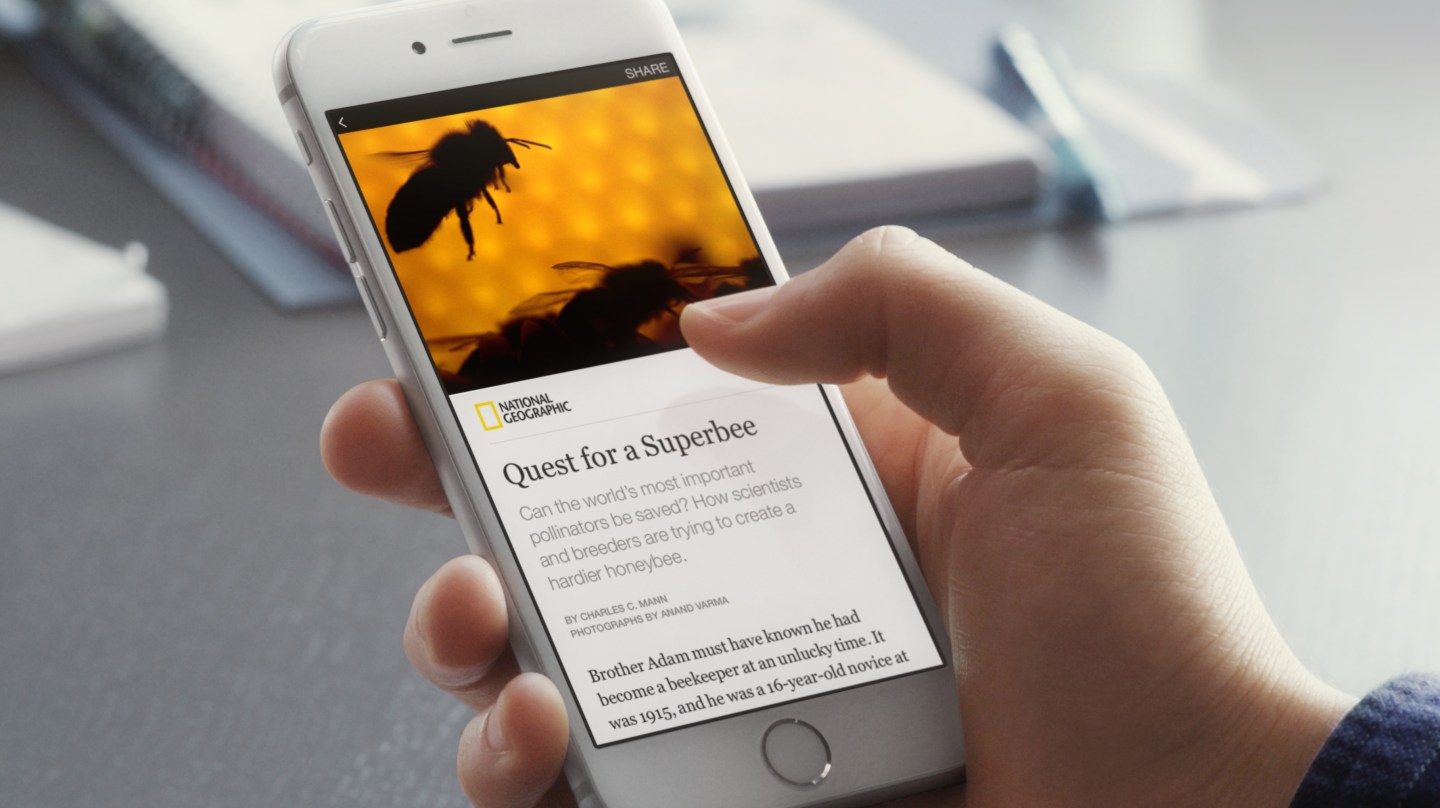
As has been rumored for some time, Facebook launched a trial project called “Instant Articles” on Wednesday morning—a partnership with nine news organizations, including The New York Times, The Guardian, BuzzFeed, and National Geographic. Under the terms of the deal, entire news stories from those partners will appear inside Facebook’s mobile app and be able to be read there, as opposed to the traditional practice of news publishers posting an excerpt and a link to their website.
At first blush, this sounds like a pretty straightforward exchange of value. Facebook (FB) gets what will hopefully be engaging content for its 1.4 billion or so users, and publishers get the reach that the social network provides—plus keep any revenue from advertising that they sell around that content. (if Facebook sells the ads, then publishers reportedly get to keep 70% of the proceeds.) So everybody wins, right?
That’s certainly the way Facebook is trying to sell the partnership: as a mutual exchange of goods, driven by the company’s desire to help publishers make their articles look as good as possible and reach more readers. But whenever you have an entity with the size and power of Facebook, even the simplest of arrangements becomes fraught with peril, and this is no exception. Why? Because a single player holds all of the cards in this particular game.
And that player is Facebook, as Columbia University’s Emily Bell noted on Twitter:
Main problem for publishers + FB remains theoretical: can you both be journalistic + be part of a commercial power structure?
— emily bell (@emilybell) May 13, 2015
The main reason why publishers like the Times have entered into this partnership in the first place is that they are falling behind when it comes to mobile. As technology analyst Ben Thompson points out, Facebook is quite right when it says that most news sites load too slowly and look terrible, rendering the ads on those pages largely useless. Facebook, however, understands mobile like no one else: everything loads faster, looks nicer and is more appealing to advertisers, in part because Facebook can do the kind of targeting that newspapers aren’t equipped to do.
This is what makes the social behemoth’s offer so appealing. Plus, publishers get to keep some or all of the ad revenue, and they also get data about what users are doing with their content, which is always useful.
The part of this deal that makes it a classic Faustian bargain is that Facebook arguably gets more from the arrangement than publishers do. How could that be, when it is giving away all the revenue? Because Facebook doesn’t really care about the revenue from ads around news content (although I expect most partners will take the 70% deal, if not now then later, because Facebook is better at selling ads). What Facebook wants is to deepen and strengthen its hold on users.

In that sense, news content is just a means to an end. And the risk is that if it stops being an effective means to that end, then Facebook will lose interest in promoting it. But in the meantime, Facebook will have solidified its status as the default place where millions or possibly even billions of people go to get their news. In other words, it will still own the land, and who farms which specific patch of that land is irrelevant.
One big reason why there is trepidation in news-publishing circles—New York magazine said there was “palpable anxiety” in the Times newsroom about the deal—is that we already know what happens when Facebook loses interest in something: it withers and dies. That’s what happened with the social games that companies like Zynga (ZNGA) developed and promoted through Facebook, a multibillion-dollar business until it suddenly wasn’t. It’s also what happened with the “social reader” apps that publishers like The Guardian and The Washington Post came up with in 2012 at Facebook’s behest.
The similarities between those apps and the current “instant articles” arrangement are many. The apps allowed users to read entire articles inside an app within Facebook, and millions of readers signed up to do so. But then Facebook changed its algorithm so that these articles and apps didn’t show up as frequently, and readership plummeted overnight.
The risk isn’t that an evil Facebook suddenly tries to destroy or pervert the causes of journalism, or goes to war against media entities (although the network’s relationship with news is troubled, as my colleague Erin Griffith points out, and censorship is not uncommon). The big risk is that Facebook plunders the relationship that news companies have—or should have—with their readers, and then destroys their business model almost accidentally, while it is in pursuit of other things. That’s the kind of thing that concerns Facebook-watchers like veteran journalist Dan Gillmor:
Facebook “instant articles” will be good for a few media orgs in the short run. But journalism will be far worse off as a whole.
— Dan Gillmor (@dangillmor) May 13, 2015
Thompson and others are right when they say that news companies don’t really have any choice but to play ball with Facebook, which is why this is actually much worse than the classic Faustian bargain. As a result of their own incompetence and/or inflexibility, combined with the shifting sands of the digital-media market, they have lost their grip on the audience that both they and advertisers are trying to reach.
That’s why all the cards are in Facebook’s hands. It has the platform, it has the reach, it has the users and it has something to offer to advertisers that most news companies can’t hope to replicate. Publishers like The New York Times have websites that users spend less than 20 minutes on in the average month, apps that no one wants to pay for, and paywalls whose growth is flattening sharply. What does the future hold for them?
What the social network has to offer is unquestionably going to help any of those publishers who sign up (and that in turn will create an incentive for others to do so). The risk is that it will wind up helping Facebook more, and that eventually Facebook—a for-profit company that has shown no evidence that it actually understands or cares about “journalism” per se—will become the trusted source of news for millions of users, rather than the publications that produce content.
Do news consumers ultimately benefit from this deal? Clearly they do, or at least the ones who use Facebook do. And perhaps we shouldn’t shed too many tears for slow, lumbering, inefficient news providers who have failed to adapt. But what does a world in which Facebook essentially controls access to the news look like? We are about to find out.