These days, it’s difficult to find an organization that isn’t investing in a mobile initiative. Most businesses currently support an average of three to five projects, but the number of enterprise applications optimized for on-the-go access could quadruple by 2016, according to some market projections.
What’s more, within two years, at least 25% of corporate software development budgets will be dedicated to mobility. This despite the dearth of on-staff mobile experts one is apt to find within many Fortune 500 companies.
“Many organizations still struggle with their mobile strategies because there isn’t an environment that fosters strong collaboration between business leaders and developer teams,” said Steve Lokam, senior principal with OpenLogix, an IBM technology partner that specializes in mobile development. “This divide not only slows down development and increases backlogs but can also lead to poor quality apps that aren’t delivering on the needs of the user.”
Lokam’s comments refer specifically to IBM’s new partnership with Ionic, which is focused on supporting mobile apps development. IBM employs more than 6,000 mobile specialists; the Ionic relationship helps with rapid prototyping of mobile apps, so businesses can figure out quickly whether something is worth a larger investment. Or not.
A larger debate centers on how to prioritize development resources. Consumer-facing apps continue to get most of the attention. Consider the widely used Starbucks loyalty one or the Cartwheel shopping coupon service from Target.
The busy Miami Children’s Hospital, for example, plays off that familiarity with a series of “concierge” apps for parents. These range from medication reminders to a videoconferencing system to a room-service ordering system (so relatives don’t need to a patient’s bedside to eat). The goal was to streamline certain operational functions while making it simpler for families to cope. These apps are, at their heart, a sort of relationship management tool.
“We realized that virtually everyone had smartphones but not everyone had access to computers,” the hospital’s CIO Ed Martinez told Fortune. He added: “The board now recognizes this as a business function, they’ve even requested specific projects.”
A survey published this week by software company Canvas, which makes mobile app development tools used by the likes of Red Bull, Pepsi and Tyco, suggests an increasingly number of businesses are investing in mobile software to reengineer internal workflows.
The motivation: costs reductions, spanning from $1,000 to $100,000 annually. (The majority of companies are saving up to $25,000, according to the Canvas study.) Two of the most widely used applications among survey respondents were signature capture (for electronic contracts) and image capture (often to help with things such as insurance claims or property valuations).
Mind you, Canvas specializes in mobile forms software, so this revelation isn’t that surprising for what amounts to sponsored research. But a separate study from mobile device management company Good Technology underscores this thesis. Insurance companies are particularly heavy proponents of using mobile apps to rethink business processes, the data suggests.
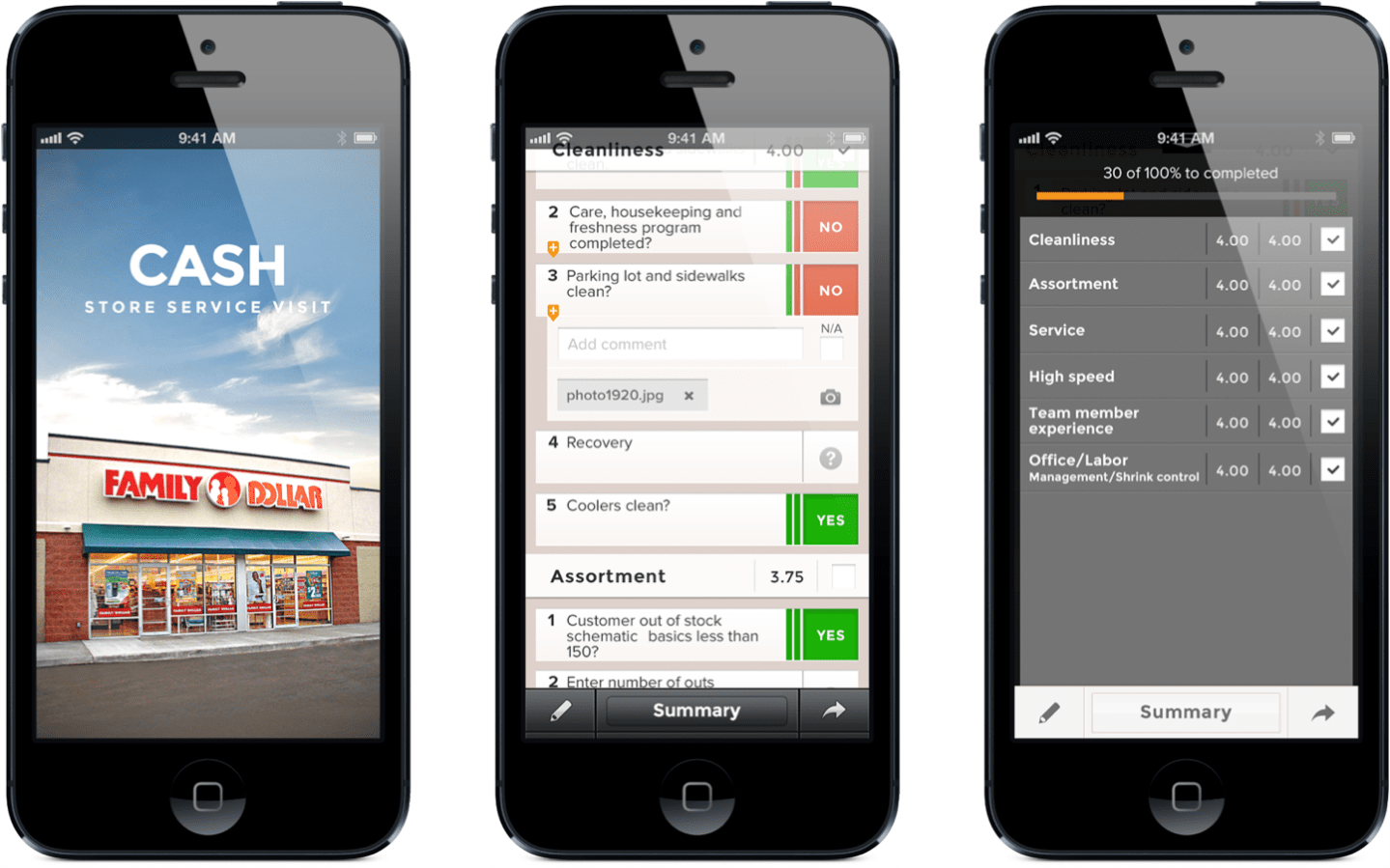
One big retailer that you might expect to put shopping software first, discount chain Family Dollar Stores, likewise is putting mobile apps for employees ahead of ones for customers. The company’s “Cash App” was developed to help district managers keep tabs on metrics that might affect in-store performance such as how shelves are organized, average prices compared with the competition, and how employees meet certain customer satisfaction measures.
The managers were using notebook computers to gather this information, but the iPad replacement saves “hours” on what used to be a very manual process,” said Family Dollar CIO Josh Jewett.
His team also created a mobile portal that make it far easier for managers to evaluate a series of store reports generated every Monday morning. “This paradigm really opens up the opportunity for more peer-to-peer collaboration,” Jewett said. The notebooks are being reclaimed and reallocated to other departments.
Regardless whether an app is meant for employees or customers, experts caution against simply slapping a mobile interface onto existing software. “Mobile is a great opportunity to rethink a process or workflow,” said Jeff Haynie, CEO and co-founder of Appcelerator, which had a hand in the Family Dollar project. Other clients include Avis, Farmers Insurance, and Zipcar. “Technology is meant to drive improvement, drive out cost or make someone more productive. You need to define what success means.”
Why require an employee to gather location information, for example, when the location services in a mobile device can gather that data automatically, Haynie asked. To require that extra step is annoying to someone in the field. “You need to consider the task, and remember that someone isn’t going to sit through 15 screens of instructions or questions,” he said.
Sign up for Data Sheet, our daily newsletter about the business of technology.