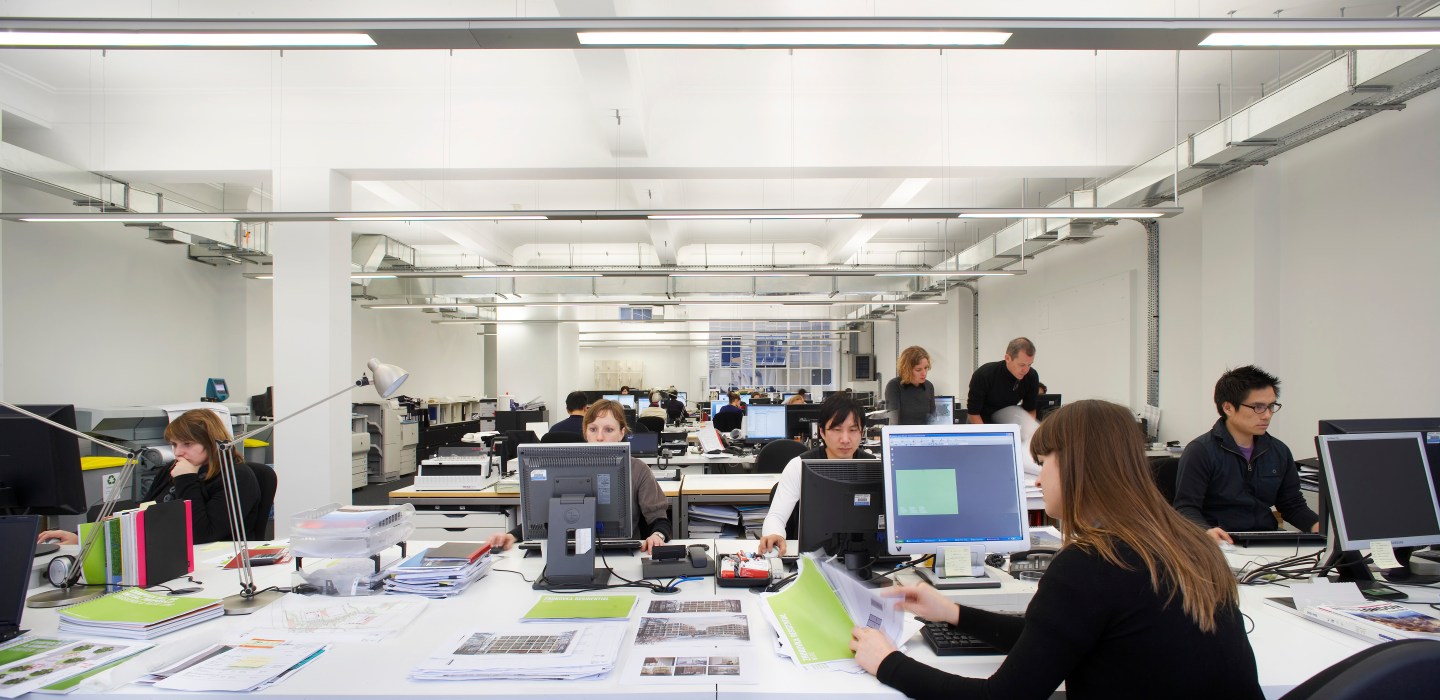
Answer by Michael O. Church on Quora
The cons of open-plan offices are obvious: they’re unhealthy, needlessly stress-inducing, hostile to productivity and creativity, and communicate low social status through the lack of privacy. They’re a “Little Brother” state, and even for those who “ought to” have nothing to hide, a surveillance state is an anxiety state.
The main “pro” is that they’re cheaper. They don’t foster collaboration because they make people more irritable and aggressive. Nor are they “egalitarian” because the invasive, violating degree of visibility to which the worker is subjected actually increases status-related anxiety and steepens disparities in power. Open-plan isn’t as oppressive to the CEO, who can leave that environment without explaining himself. In general, open-plan offices are terrible. That said, they’re cheaper than anything else. Of course, you get what you pay for.
A second advantage is that they handle rapid changes in personnel number. If you’re expecting 150% year-on-year growth in headcount, open plan offices give you more of a “crumple zone” than traditional layouts, where you’re limited by the number of individual rooms in the space. At some point, you have to choose between going to multiple floors (or buildings) or choose open-plan offices. There are cultural changes that occur once you’re on two floors, but I think that most businesspeople overestimate the negatives of being multi-floor and underestimate those of bullpen offices, which are murderous for any job that requires creativity or concentration. (That said, multi-building is a major step. A typical parking lot is equivalent to 1000 miles of desert; people will call or Skype but no one will walk across it.) With open-plan layouts, you can pack people in at a prison-like 40 SF per worker, if needed, and procrastinate decisions about how to divide the company into two or more floors. That said, there are probably no more than a hundred companies of size (50+ people) in existence at any time that are growing so fast (100-200 percent per year) that they actually need open-plan offices, and even in them, open-plan ought to be regarded as a temporary evil rather than a permanent arrangement.
Thirdly, open-plan offices are slightly better than cubicle layouts. Open-plan sucks, but cubicles are shitty too. If the worker is visible from behind, the cubicle walls make the arrangement more cramped, uglier, and do little good against noise or stress levels. At that point, you’re trading off agoraphobia vs. claustrophobia. Really, if you want someone to perform creative or intellectually intense work, you have to give that person privacy. That said, open-plan offices are no more invasive than three-wall cubicle offices, and a lot less ugly.
Fourth, open-plan offices are more photogenic because they look busy, even if less is being accomplished in them than would be achieved with a legitimate office setup. That’s right, it’s the marketing aspect. Startups need to communicate the image of ruthless efficiency and aggressive, around-the-clock diligence and open-plan offices take the right pictures, whether for magazine photos or venture capitalists.
There’s a fifth, evil, “pro” of the open-plan office: age discrimination. This is probably not a major factor right now, because while VCs are age discriminating in terms of who they fund, older programmers are essential if a startup wants to scale. In boom times like 1999 or 2015, you see open-plan offices because of rapid growth, not age discrimination. But what happens in a bust (like 2002)? Companies go into retreat and have to cut costs, and you don’t really need the best (generally older, and more expensive) programmers, when you’re just planning to run in maintenance mode for the next 3 years. It’s well known that older workers are the first to leave when office layouts deteriorate. When you’re growing rapidly, that’s an undesirable side effect. When you’re cutting costs everywhere you can, and you don’t really need experienced engineers, it’s an added bonus to what you’d probably do (decrease office-space expenditures) in the first place.
I don’t actually think that most companies using open-plan offices (nearly all of them, sadly) have age discrimination as a motive. I think it has more to do with marketing and the price, and the fact that the negatives of these office spaces are under-reported, because people are afraid of appearing weak (like they “can’t handle” the stress of a “demanding” work environment). Most companies don’t view open-plan offices as discriminatory and aren’t trying to do anything evil, but the ones who really trumpet the supposed “values” of these plans, I think, do have such exclusionary intentions toward older programmers and women. The open-plan fetishism (see: Facebook’s new 2800-engineer open-plan office) coming out of many Silicon Valley leaders carries that message quite clearly: “Get Out, Geezers”. (“Geezer” means “28 and up”). Of course, you want “geezers” (and private, reflective time for your workers) if you’re building something of quality, but open-plan offices are just another correlate of a general favoritism, in the current Silicon Valley culture, for quick flashiness over lasting quality.
This question originally appeared on Quora: What are the pros and cons open-office plans.