• Home
  • Latest
  • Fortune 500
  • Finance
  • Tech
  • Leadership
  • Lifestyle
  • Rankings
  • Multimedia
Greece

Why Greece caved, in two simple charts

By
Geoffrey Smith
Geoffrey Smith
Down Arrow Button Icon
By
Geoffrey Smith
Geoffrey Smith
Down Arrow Button Icon
February 26, 2015, 9:24 AM ET

Anyone still wondering why the new Greek government went into negotiations with the Eurozone like Vin Diesel and came out like PeeWee Herman?

Or why the European Central Bank has effectively shut Greek banks out of its regular lending operations?

This chart kind of makes things clear: in January alone, Greeks pulled over €12 billion, or 7.6% of all their deposits, out of local banks. Bear in mind that Syriza only took office on the 26th, that its brinkmanship carried on for a full two weeks after the cut-off date for this chart, and that outflows probably picked up as the news flow intensified.
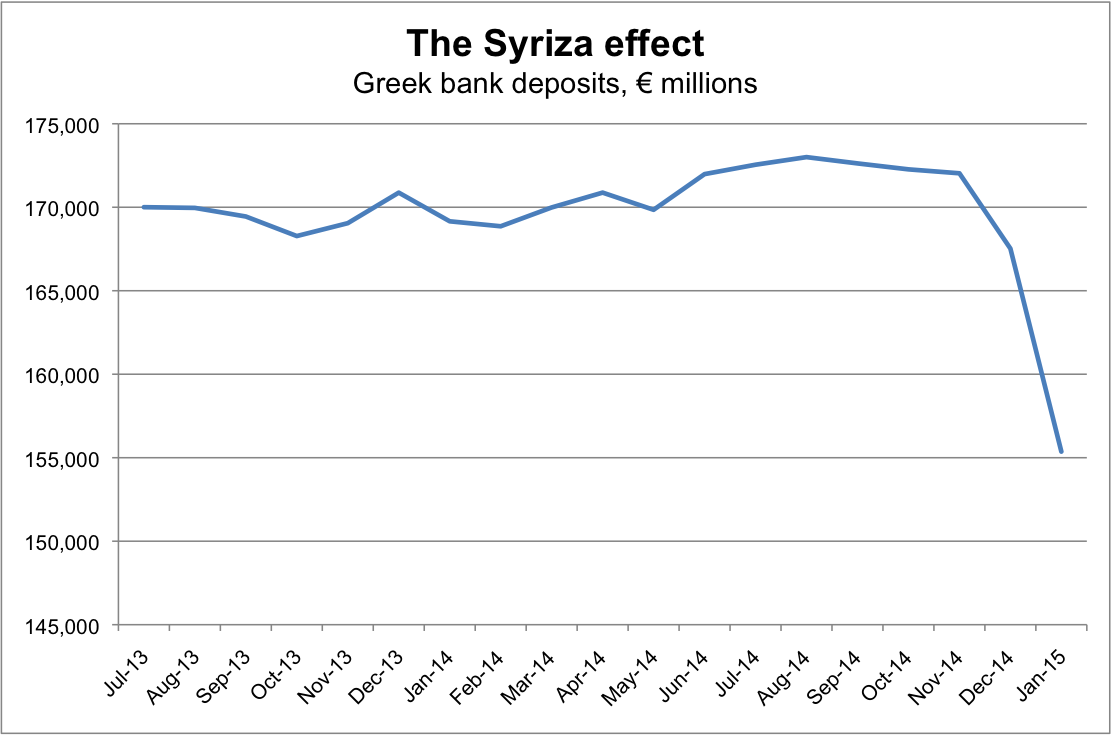
We’ll trust you with our government, just not with our money. Source: ECB

We’ll never know exactly where they bottomed. Finance Minister Yanis Varoufakis told Bloomberg Wednesday that they had already started to reverse after last week’s deal (€700 million on Tuesday alone, he reckons), so the February data, as of month-end won’t show the full horror of how things stood on Monday.

The moral is clear. Greeks may have voted for a party that promised them they could keep the euro but ditch the bailout, but even that doesn’t mean they believe their own wish-dreams.

Here’s another chart that shows the flip side of that liquidity coin. When other banks and bond market investors won’t lend to you, and when your depositors are running away, the only thing you can do is borrow from the central bank.

As the deposits flow out, Greek banks are borrowing more and more from the ECB (via the Bank of Greece)Source: Bank of Greece
Source: Bank of Greece

The thing to bear in mind here is that the ECB has capped at €68.3 billion the amount that it’s willing to lend against debt issued or guaranteed by the Greek government. As the chart shows, they were already borrowing over €87 billion by the end of January. It seems a fair guess that most of the Greek banking system’s remaining assets, down to the contents of the janitors’ cupboards, have already been pledged as collateral too.

So the system is already facing a massive two-way squeeze and the government is only a few bad headlines away from financial collapse. It’s quite possible that some of Greece’s banks would have had to limit withdrawals, or even keep their doors closed, on Tuesday if the Eurozone hadn’t accepted Finance Minister Yanis Varoufakis’ list of proposed reforms and kept the safety net of the loan agreement in place.

That means that Greece can ill afford the kind of inflammatory comments that it indulged in Wednesday. If the rhetoric dies down in the next few days, we’ll know that the point is finally being understood.

On your marks, get set…

About the Author
By Geoffrey Smith
See full bioRight Arrow Button Icon
0

Most Popular

placeholder alt text
Economy
Tariffs are taxes and they were used to finance the federal government until the 1913 income tax. A top economist breaks it down
By Kent JonesDecember 12, 2025
1 day ago
placeholder alt text
Success
Apple cofounder Ronald Wayne sold his 10% stake for $800 in 1976—today it’d be worth up to $400 billion
By Preston ForeDecember 12, 2025
23 hours ago
placeholder alt text
Success
40% of Stanford undergrads receive disability accommodations—but it’s become a college-wide phenomenon as Gen Z try to succeed in the current climate
By Preston ForeDecember 12, 2025
22 hours ago
placeholder alt text
Economy
For the first time since Trump’s tariff rollout, import tax revenue has fallen, threatening his lofty plans to slash the $38 trillion national debt
By Sasha RogelbergDecember 12, 2025
18 hours ago
placeholder alt text
Economy
The Fed just ‘Trump-proofed’ itself with a unanimous move to preempt a potential leadership shake-up
By Jason MaDecember 12, 2025
16 hours ago
placeholder alt text
Success
At 18, doctors gave him three hours to live. He played video games from his hospital bed—and now, he’s built a $10 million-a-year video game studio
By Preston ForeDecember 10, 2025
3 days ago
Rankings
  • 100 Best Companies
  • Fortune 500
  • Global 500
  • Fortune 500 Europe
  • Most Powerful Women
  • Future 50
  • World’s Most Admired Companies
  • See All Rankings
Sections
  • Finance
  • Leadership
  • Success
  • Tech
  • Asia
  • Europe
  • Environment
  • Fortune Crypto
  • Health
  • Retail
  • Lifestyle
  • Politics
  • Newsletters
  • Magazine
  • Features
  • Commentary
  • Mpw
  • CEO Initiative
  • Conferences
  • Personal Finance
  • Education
Customer Support
  • Frequently Asked Questions
  • Customer Service Portal
  • Privacy Policy
  • Terms Of Use
  • Single Issues For Purchase
  • International Print
Commercial Services
  • Advertising
  • Fortune Brand Studio
  • Fortune Analytics
  • Fortune Conferences
  • Business Development
About Us
  • About Us
  • Editorial Calendar
  • Press Center
  • Work At Fortune
  • Diversity And Inclusion
  • Terms And Conditions
  • Site Map

© 2025 Fortune Media IP Limited. All Rights Reserved. Use of this site constitutes acceptance of our Terms of Use and Privacy Policy | CA Notice at Collection and Privacy Notice | Do Not Sell/Share My Personal Information
FORTUNE is a trademark of Fortune Media IP Limited, registered in the U.S. and other countries. FORTUNE may receive compensation for some links to products and services on this website. Offers may be subject to change without notice.