• Home
  • Latest
  • Fortune 500
  • Finance
  • Tech
  • Leadership
  • Lifestyle
  • Rankings
  • Multimedia
Finance

Jamie Dimon calls regulation un-American, once again

By
Stephen Gandel
Stephen Gandel
Down Arrow Button Icon
By
Stephen Gandel
Stephen Gandel
Down Arrow Button Icon
January 14, 2015, 12:20 PM ET
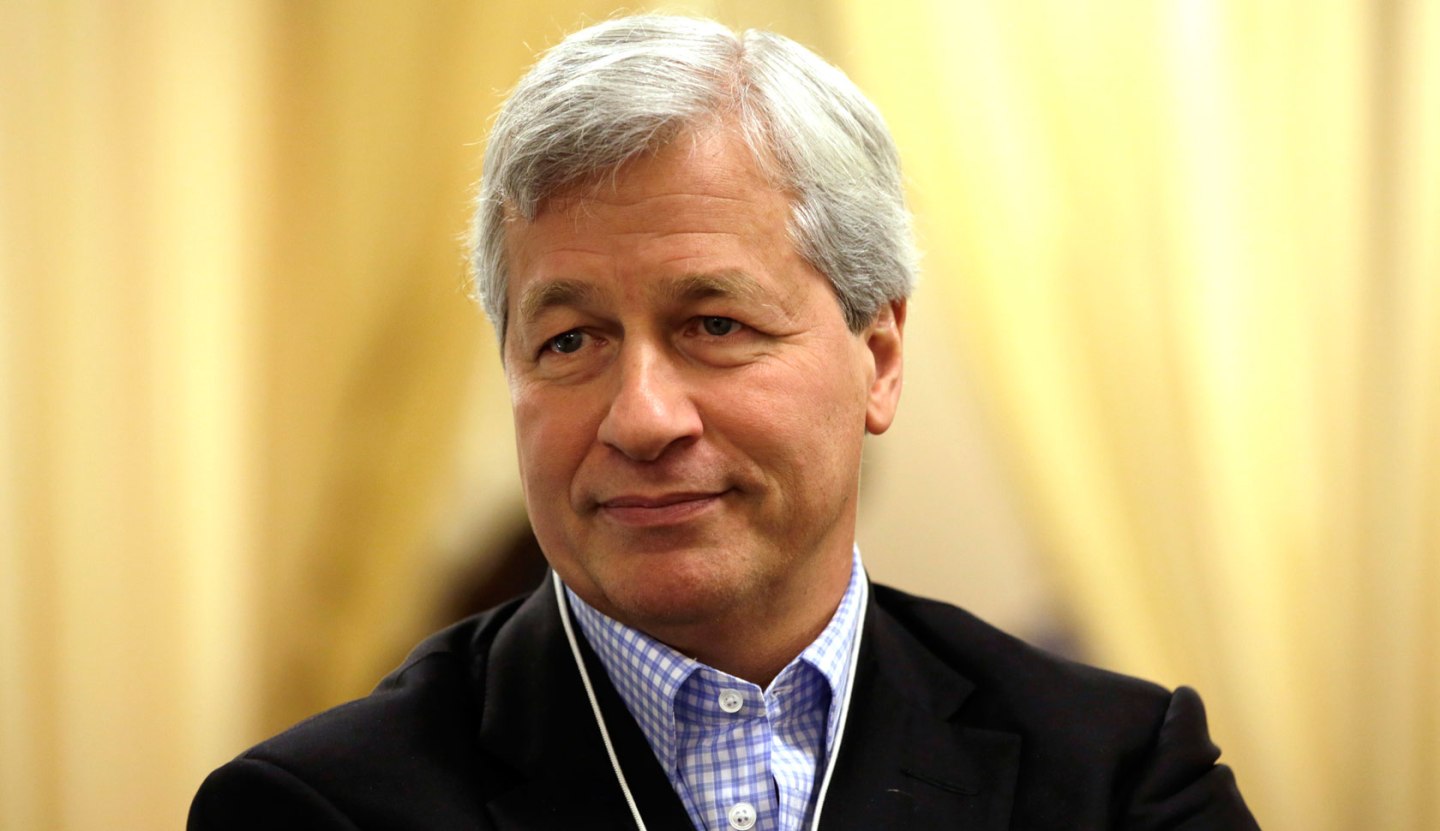
The Davos World Economic Forum 2014
Jamie DimonPhotograph by Jason Alden — Bloomberg/Getty Images

JPMorgan Chase CEO Jamie Dimon still thinks the way banks are treated these days is un-American.

On a conference call on Wednesday morning in which the bank reported that last year it had earned $22 billion, or roughly 240,000 times what’s in the average American’s retirement account, Jamie Dimon said that JPMorgan (JPM) was “under assault,” and questioned whether the increased scrutiny by regulators of banks since the financial crisis has gone too far.

“In the old days, you dealt with one regulator. Now it’s five or six,” Dimon said, referring to instances when multiple regulators have sought to punish JPMorgan for the same issue. “You all should ask the question, how American that is.”

It’s not the first time Dimon has questioned the American as apple pie-ness of banking regulation. In 2011, Dimon called an earlier version of capital rules contemplated by international bank regulators in Switzerland un-American. “I’m very close to thinking the United States shouldn’t be in Basel any more. I would not have agreed to rules that are blatantly anti-American,” Dimon told the Financial Times at the time. “Our regulators should go there and say, ‘If it’s not in the interests of the United States, we’re not doing it.’”

Back then, Dimon seemed to be arguing that his bank had come through the financial crisis better than others. So, why should it be penalized?

Dimon’s Wednesday comments came in response to a question about a new proposal from the Federal Reserve that would require JPMorgan, the biggest bank in America, to hold more capital in reserve to protect against losses, even compared to its other mega-bank rivals. The Fed has said the new proposal adjusts capital rules to account for the fact that risks at some banks are more complex than others, and maybe harder to detect. But Dimon effectively said the proposal shows that regulators still don’t get his bank.

“It’s just because we’re big,” said Dimon.

But regulators aren’t the only ones questioning JPMorgan’s size. Last week, rival Goldman Sachs released a report that said JPMorgan should be broken up. When asked by Fortune on Wednesday’s call whether he thought Goldman should be broken up, Dimon laughed and then offered, “No comment.”

Like he has in the past, Dimon defended JPMorgan’s size. He said it makes the bank more diverse and safer, not the opposite. He also noted that many of the aspects of JPMorgan that have raised concern among regulators, like the bank’s $300 billion portfolio of so-called available for sale securities, make it safer, not riskier or more complex. “Our AFS portfolio adds to liquidity,” said Dimon.

The bank’s size also seems to attract the attention of more regulators, something that Dimon thinks is unfair. But it has been a very long time since a big bank like JPMorgan would have had to deal with only one federal regulator, long before Dimon’s career began. According to bank historian John Gordan Steele, the Federal Reserve got its mandate to oversee the nation’s largest banks in 1913 (the same year that the actual J.P. Morgan died), making it the second federal regulator besides the Comptroller of the Currency. Banks also had to answer to state regulators.

Regulation doesn’t seem to be holding JPMorgan back that much. The bank reported a nearly $1 billion charge in the last three months of 2014 for increased legal expenses. But even with that, JPMorgan said that its per-share profit in 2014 was the highest in its history.

Recently, Bloomberg reported that Jamie Dimon was a key player in an industry-wide effort to roll back a provision of the Dodd-Frank financial reform bill that would have required banks to split their derivative trading units from the rest of the bank. JPMorgan would have been among the banks most affected by the rule, which has been dropped.
About the Author
By Stephen Gandel
See full bioRight Arrow Button Icon

Latest in Finance

Musk
Big TechElon Musk
Elon Musk admits DOGE was only ‘somewhat successful’ and he should have ‘worked on my companies’ instead
By Bill Barrow and The Associated PressDecember 11, 2025
10 seconds ago
Dresser
AIOpenAI
Slack CEO leaves Salesforce to become OpenAI’s first revenue chief, tackle multibillion-dollar losses
By The Associated PressDecember 11, 2025
6 minutes ago
netflix
Big TechNetflix
Netflix looks to become Debtflix again to fund Warner Bros. acquisition
By Emily Graffeo, Nick Lichtenberg and BloombergDecember 11, 2025
28 minutes ago
senate
EconomyCongress
Senate fails to save millions from skyrocketing ACA premiums in new year, with Republicans never meaningfully engaging
By Mary Clare Jalonick and The Associated PressDecember 11, 2025
29 minutes ago
Trump
Economyaffordability
Less than a third of Americans approve of Trump’s handling of the economy, lowest in either term
By Linley Sanders, Will Weissert and The Associated PressDecember 11, 2025
33 minutes ago
AsiaSingapore
ComfortDelGro joins Singapore’s race for autonomous vehicles with new shuttle trials and public rides by 2026
By Angelica AngDecember 11, 2025
50 minutes ago

Most Popular

placeholder alt text
Success
At 18, doctors gave him three hours to live. He played video games from his hospital bed—and now, he’s built a $10 million-a-year video game studio
By Preston ForeDecember 10, 2025
1 day ago
placeholder alt text
Politics
Exclusive: U.S. businesses are getting throttled by the drop in tourism from Canada: ‘I can count the number of Canadian visitors on one hand’
By Dave SmithDecember 10, 2025
1 day ago
placeholder alt text
Economy
‘Be careful what you wish for’: Top economist warns any additional interest rate cuts after today would signal the economy is slipping into danger
By Eva RoytburgDecember 10, 2025
19 hours ago
placeholder alt text
Economy
‘Fodder for a recession’: Top economist Mark Zandi warns about so many Americans ‘already living on the financial edge’ in a K-shaped economy 
By Eva RoytburgDecember 9, 2025
2 days ago
placeholder alt text
Uncategorized
Transforming customer support through intelligent AI operations
By Lauren ChomiukNovember 26, 2025
15 days ago
placeholder alt text
Success
Netflix–Paramount bidding wars are pushing Warner Bros CEO David Zaslav toward billionaire status—he has one rule for success: ‘Never be outworked’
By Preston ForeDecember 10, 2025
21 hours ago
Rankings
  • 100 Best Companies
  • Fortune 500
  • Global 500
  • Fortune 500 Europe
  • Most Powerful Women
  • Future 50
  • World’s Most Admired Companies
  • See All Rankings
Sections
  • Finance
  • Leadership
  • Success
  • Tech
  • Asia
  • Europe
  • Environment
  • Fortune Crypto
  • Health
  • Retail
  • Lifestyle
  • Politics
  • Newsletters
  • Magazine
  • Features
  • Commentary
  • Mpw
  • CEO Initiative
  • Conferences
  • Personal Finance
  • Education
Customer Support
  • Frequently Asked Questions
  • Customer Service Portal
  • Privacy Policy
  • Terms Of Use
  • Single Issues For Purchase
  • International Print
Commercial Services
  • Advertising
  • Fortune Brand Studio
  • Fortune Analytics
  • Fortune Conferences
  • Business Development
About Us
  • About Us
  • Editorial Calendar
  • Press Center
  • Work At Fortune
  • Diversity And Inclusion
  • Terms And Conditions
  • Site Map

© 2025 Fortune Media IP Limited. All Rights Reserved. Use of this site constitutes acceptance of our Terms of Use and Privacy Policy | CA Notice at Collection and Privacy Notice | Do Not Sell/Share My Personal Information
FORTUNE is a trademark of Fortune Media IP Limited, registered in the U.S. and other countries. FORTUNE may receive compensation for some links to products and services on this website. Offers may be subject to change without notice.