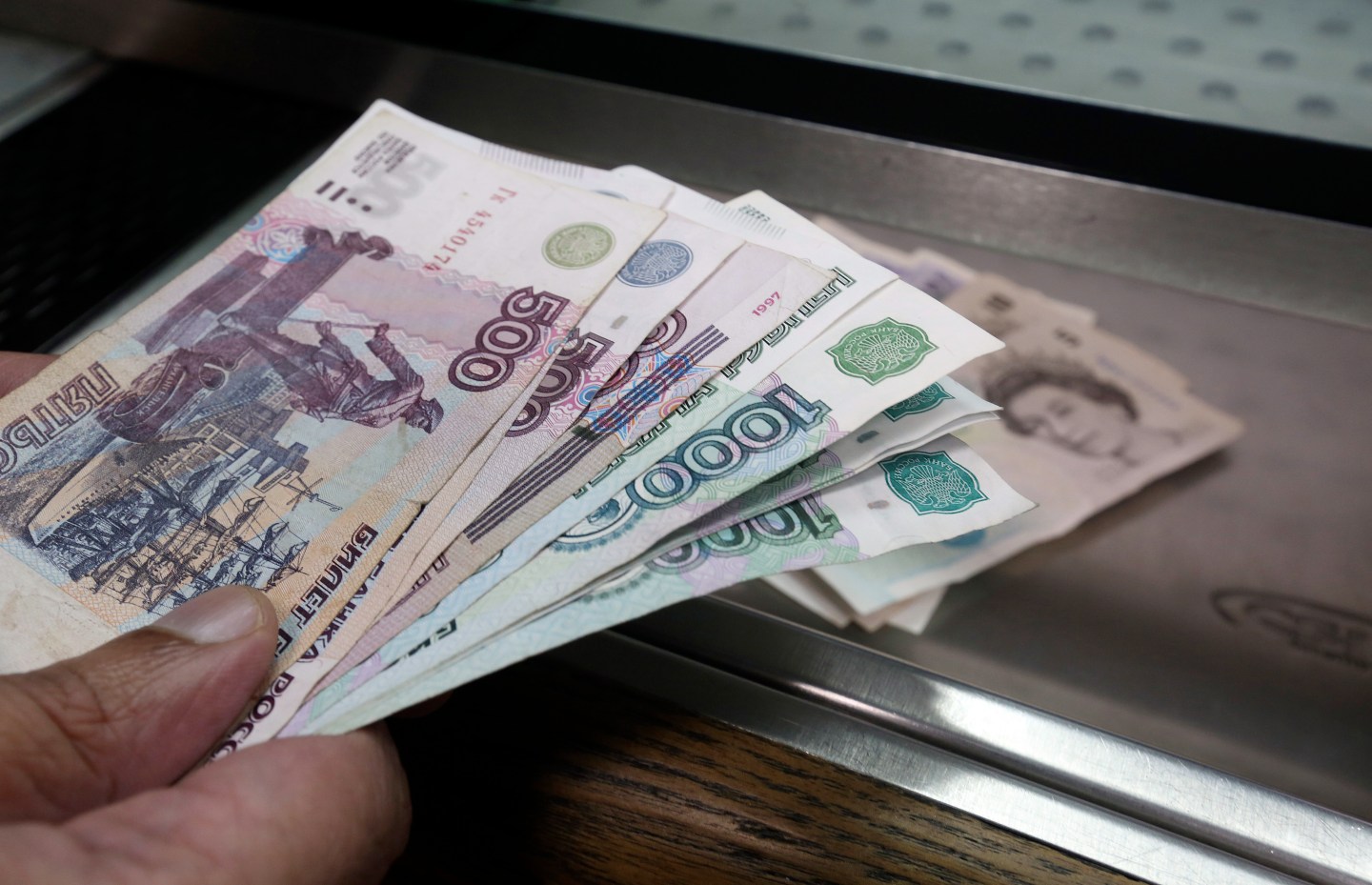
Russia’s ruble may have strengthened sharply Wednesday, but it’s plunge in recent days has encouraged plenty of talk about the country’s catastrophe, with some even proclaiming that the new Russia is about to go the way of the old USSR.
Don’t believe it. Russia is not the United States, and the effects of a rapidly declining currency over there are much less dramatic than they would be in the U.S.
One important thing to remember is that the fall of the ruble has accompanied a precipitous decline in the per barrel price of oil. But the two are not as intimately connected as might be supposed. Yes, Russia has a resource-based economy that is hurt by oil weakness. However, oil is traded nearly everywhere in U.S. dollars, which are presently enjoying considerable strength.
This means that Russian oil producers can sell their product in these strong dollars but pay their expenses in devalued rubles. Thus, they can make capital improvements, invest in new capacity, or do further explorations for less than it would have cost before the ruble’s value was halved against the dollar. The sector remains healthy, and able to continue contributing the lion’s share of governmental tax revenues.
Nor is ruble volatility going to affect the ability of most Russian companies to service their debt. Most of the dollar-denominated corporate debt that has to be rolled over in the coming months was borrowed by state companies, which have a steady stream of foreign currency revenues from oil and gas exports.
Russian consumers will be hurt, of course, due to the higher costs of imported goods, as well as the squeeze inflation puts on their incomes. But, by the same token, exports become much more attractive to foreign buyers. A cheaper ruble boosts the profit outlook for all Russian companies involved in international trade. Additionally, when the present currency weakness is added to the ban on food imports from the European Union, the two could eventually lead to an import-substitution boom in Russia.
In any event, don’t expect any deprivations to inspire riots in the streets of Moscow. Russian President Vladimir Putin’s popularity has soared since the beginning of the Ukraine crisis. The people trust him. They’ll tighten their belts and there will be no widespread revolt against his policies.
Further, the high price of oil during the commodity supercycle, coupled with a high real exchange rate, led to a serious decline in the Russia’s manufacturing and agricultural sectors over the past 15 years. This correlation—termed by economists “Dutch disease”—lowered the Russian manufacturing sector’s share of its economy to 8% from 21% in 2000.
The longer the ruble remains weak, however, the less Dutch disease will rule the day. A lower currency means investment in Russian manufacturing and agriculture will make good economic sense again. Both should be given a real fillip.
Low oil prices are also good for Russia’s big customers, especially China, with which Putin has been forging ever-stronger ties. If, as expected, Russia and China agree to transactions in rubles and/or yuan, that will push them even closer together and further undermine the dollar’s worldwide hegemony. Putin always thinks decades ahead, and any short-term loss of energy revenues will be far offset by the long-term gains of his economic alliances.
In the most recent development, the Russian central bank has reacted by raising interest rates to 17%. On the one hand, this is meant to curb inflation. On the other, it’s an direct response to the short selling speculators who’ve been attacking the ruble. They now have to pay additional premiums, so the risk/reward ratio has gone up. Speculators are going to be much warier going forward.
[fortune-brightcove videoid=3948171982001]
The rise in interest rates mirrors how former U.S. Fed Chair Paul Volcker fought inflation in the U.S. in the early ‘80s. It worked for Volcker, as the U.S. stock market embarked on a historic bull run. The Russians — whose market has been beaten down during the oil/currency crisis — are expecting a similar result.
Not that the Russian market is anywhere near as important to that country’s economy as the US’s is to its. Russians don’t play the market like Americans do. There is no Jim Kramerovsky’s Mad Money in Russia.
Russia is not some Zimbabwe-to-be. It’s sitting on a surplus of foreign assets and very healthy foreign exchange reserves of around $375 billion. Moreover, it has a strong debt-to-GDP ratio of just 13% and a large (and steadily growing) stockpile of gold. Why Russia will arrest the ruble’s slide and keep pumping oil
And there is Russia’s energy relationship with the EU, particularly Germany. Putin showed his clout when he axed the South Stream pipeline and announced that he would run a pipeline through Turkey instead. The cancellation barely lasted long enough to speak it before the EU caved and offered Putin what he needed to get South Stream back on line. Germany is never going to let Turkey be a gatekeeper of European energy security. With winter arriving, the EU’s dependence on Russian oil and gas will take center stage, and the union will become a stabilizing influence on Russia once again.
In short, while the current situation is not working in Russia’s favor, the country is far from down for the count. It will arrest the ruble’s slide and keep pumping oil. Its economy will contract but not crumble. The harsh reality is that American shale fields have much more to fear from plummeting oil prices than the Russians (or the Saudis), since their costs of production are much higher. Many US shale wells will become uneconomic if oil falls much further. And it they start shutting down, it’ll be disastrous for the American economy, since the growth of the shale industry has underpinned 100% of US economic growth for the past several years.
Those waving their arms about the ruble might do better to look at countries facing real currency crises, like oil-dependent Venezuela and Nigeria, as well as Ukraine. That’s where the serious trouble is going to come.
Marin Katusa is the author of the New York Times bestseller, The Colder War: How the Global Energy Trade Slipped from America’s Grasp