
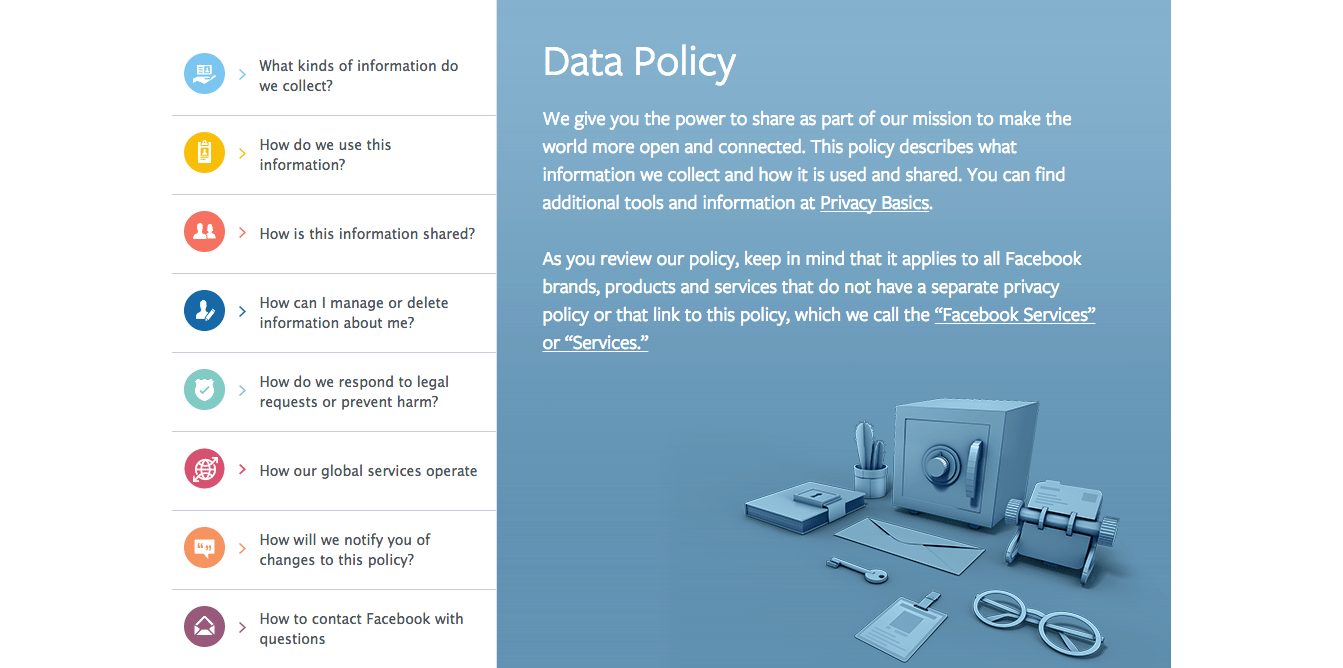
On Thursday, Facebook unveiled a slimmed-down and reformatted privacy policy intended to make the screed easier for people to understand. The new version is less than two-thirds the length of its unwieldy predecessor, chopping to 2,700 words from 9,000. (Yes, it is now finally shorter than the U.S. Constitution.)
Although the rewritten and redesigned text (plus an accompanying “Privacy Basics” tutorial) has made the social network’s policy more readable and navigable, the update has little effect on the actual substance of those policies. A blog post accompanying the release makes clear that, regarding your information and advertising, “nothing is changing with these updates” and that “Your settings on Facebook are not changing.” (The company is inviting comments and feedback on its policy starting this week through Nov. 20 that it will take into consideration.)
“We’re working hard to make sure people feel in control of their information on Facebook,” Facebook’s chief privacy officer Erin Egan, author of the announcement, told Fortune in an e-mail. “Privacy Basics and our updated data policy are all about making sure people can create an experience that’s right for them.”
The redesign follows a change of tack in the company’s strategy to be much more than just a web-based social network. In recent months Facebook (FB) has been on a tear building its portfolio of applications and services. It has acquired companies like Oculus VR, WhatsApp, Onavo, and Moves. It has been experimenting with new features, such as its location-based service called Nearby Friends, which when activated allows Facebook friends to see when you’re close, and the incorporation of a “buy” button.
The differences in how the network presents privacy information are evident. Previously, information regarding the company’s stance on payment information appeared at the very bottom of the policy statement under a vague bucket of miscellanea titled: “VI. Some other things you need to know.” Now it’s first mention appears at the very top—without jargon.
The revised policy also reads much more clearly, using plainspoken English and assuming a direct tone. It also includes a color-coded Frequently Asked Questions framework and has enough whitespace to be easy on eyes.
Here’s an excerpt from the old version:
Service Providers
We give your information to the people and companies that help us provide, understand and improve the services we offer. For example, we may use outside vendors to help host our website, serve photos and videos, process payments, analyze data, conduct and publish research, measure the effectiveness of ads, or provide search results. In some cases we provide the service jointly with another company, such as the Facebook Marketplace. In all of these cases our partners must agree to only use your information consistent with the agreement we enter into with them, as well as this Data Use Policy.
And one from the new version:
Information about payments.
If you use our Services for purchases or financial transactions (like when you buy something on Facebook, make a purchase in a game, or make a donation), we collect information about the purchase or transaction. This includes your payment information, such as your credit or debit card number and other card information, and other account and authentication information, as well as billing, shipping and contact details.
Despite these improvements, Rob Shavell, CEO of Boston-based privacy company Abine, believes the simplified policy is more a distraction than actual progress. Consider the tabs under Privacy Basics tutorial. Facebook’s language tends to frame the privacy question as what you share with others, not what you share with Facebook. Sure, there is “What Others See About You,” “How Others Interact With You,” and “What You See,” but where is the tab that goes over what Facebook sees about you?
“The funny thing about the Facebook privacy policy is that not a single one of the settings actually stops Facebook from collecting one less byte of information or data about you. It’s all completely focused on what people in the network can see or can’t see,” Shavell says. “Facebook has taken the concept of privacy setting features and twisted it in such a way that nobody is really thinking about Facebook having control of your data.”
“It’s an example of Facebook being an expert at consumer psychology,” he adds.
The company has received criticism for its practices and lack of clarity around privacy before. (Did you know that Facebook collects info about your device’s battery and signal strength, for instance?) In 2011, the Federal Trade Commission won a settlement from Facebook after charging the company with breaking promises and deceiving its users about privacy safeguards.
Rather than dote on the redesign of Facebook’s privacy policy, Shavell says Facebook users should take a critical look at the company’s growth strategy. This year Facebook has taken three major strides toward repositioning itself as more of an ad platform than a website for social networking, he says. In February, Facebook acquired WhatsApp, giving it access to more than 450 million active users whose data it can access (and eventually monetize). Four months later, the company announced it would begin using data collected on sites outside Facebook.com—for example, through widgets like its Like button. And two months ago, Facebook announced its Atlas ad network, which would help create fuller profiles of its users by tracking their activity across mobile and desktop.
“In my opinion, what they’re doing is sacrificing long-term potential value for what they could create with Facebook to deliver more and more services and more and more data to advertisers,” Shavell says.
Though Egan’s blog post announcing the company’s privacy policy redesign states its goal as “Helping you get more out of Facebook,” people like Shavell wonder whether it’s just Facebook getting more out of you.