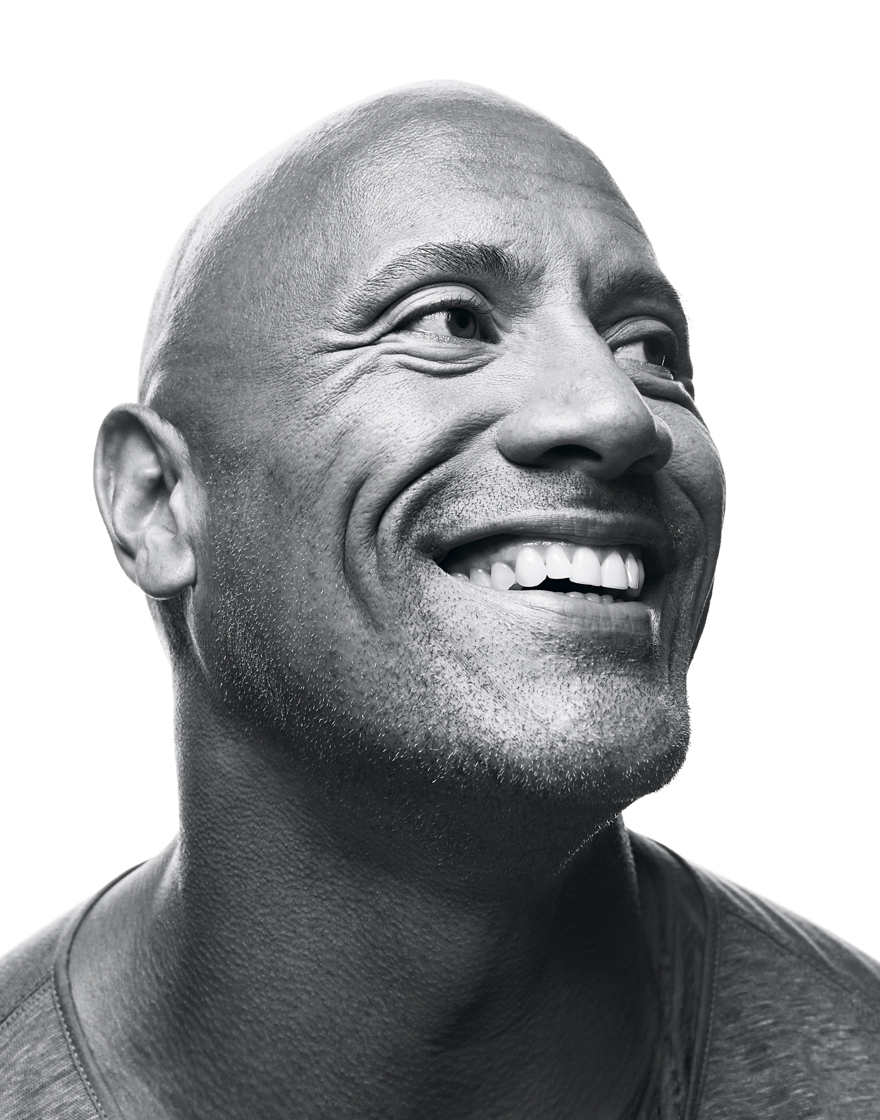
It was 110 degrees in the Sahara Desert, and Dwayne Johnson was freezing.
He was in Morocco in 2001 shooting his first film role, as the Scorpion King in The Mummy Returns, and he was sick as a dog. He had only one line (a shout, “Haku machente!”), but two big scenes. Between takes, he slumped in a chair with blankets over his head. “I get a call from my agent, and he says, ‘Hey, they’re watching the dailies of what they’re shooting, and they want to make a movie just off your character.’ And I said, ‘Great,’ as I leaned over to vomit more.”
It’s a story that reflects how hard Johnson works. Hollywood teems with hardworking actors, of course, but Johnson, 42, goes further than most. He’s not done when the cameras stop rolling. He takes each movie’s promotion into his own hands, pushing it to his 56 million fans across social media, a platform that film insiders say is more valuable to a Dwayne Johnson flick than any ad campaign.
You may know Johnson as “The Rock,” but then again, you might not. For years he was an actor with an asterisk: former wrestler. But these days the asterisk is gone. Johnson has become bona fide box-office gold without abandoning the venue that made him famous. Now he’s turning his attention to the production company he created with his manager, who is also his ex-wife. Earning respect beyond acting, as a businessman, will be a serious challenge, but The Rock likes his odds.
Johnson went from being so poor as a kid that he and his mother were evicted from their home, to Division I college football, to World Wrestling Entertainment, to Hollywood, to being the highest-grossing actor of 2013. How he did it is a case study in determination—and in getting some great advice.
“Here’s why one day I’ll have to see a therapist,” Johnson tells Fortune, sitting on a windowsill in the sparkling new Fort Lauderdale offices of his ex-wife, Dany Garcia. Then he recounts the story of getting evicted in Hawaii. It’s one he has told many times, and tells well.
The only child of a Canadian father and a Samoan mother, Johnson grew up like an Army brat, living everywhere from California to New Zealand to Texas, because his father, Rocky Johnson, was a professional wrestler and traveled the circuit. At age 15, Dwayne and his mother were living in a small studio in Honolulu when they came home to an eviction notice and a lock on the door. Their rent, at $180 a week, was too much for his mother, who cleaned hotel rooms. “It broke my heart,” he says. The pair had no choice but to move to Nashville, where his dad was wrestling at the time. “I remember saying to myself, ‘I will do anything and everything I possibly can to make sure we never get evicted again.’ But what does that mean—what does it mean to be successful? Well, the successful men I admired all built their bodies.”

Those men were Sylvester Stallone, Clint Eastwood, and Arnold Schwarzenegger. Johnson began boxing and lifting weights after school. The training gave him focus, which he needed at the time. Back in Hawaii he had been arrested for crimes including theft, check fraud, vandalism, and assault. But although he was poor, he had connections there: One of his uncles was a former chief of police in Honolulu. And many of his relatives were minor local celebrities: His grandfather Peter Maivia was a professional wrestler, as were two uncles, nicknamed the “Wild Samoans,” and five cousins. His grandmother was a wrestling promoter. “They were all well-known in Hawaii, so I never went to juvie,” he says. “It was like Boardwalk Empire out there.”
Because of his father’s job, Johnson ended up at Freedom High School in Bethlehem, Pa., for his junior year. He quickly emerged as a star defensive tackle and got recruited to the University of Miami. There he met his future wife, Garcia—she rowed crew, and they locked eyes in the weight room—and won a national championship in 1991. He figured he was on a straight path to the NFL until a back injury sidelined him in his senior year. (His replacement was future Hall of Famer Warren Sapp.) His dream dashed, he took a consolation prize, joining the Calgary Stampeders of the Canadian Football League. That didn’t work out either; he was cut after two months. Broke, jobless, and embarrassed, he flew from Canada to Miami and called his father to drive from Tampa to get him. On the ride home, he emptied his pockets and found just seven dollars (hence his company’s name: 7 Bucks Productions).
Johnson had never planned on going into the family business, and his father initially forbade it. But once he moved back in with his parents, and after weeks of depression, it seemed the obvious move. Rocky told Dwayne he had nothing to offer the sport; Dwayne, hurt, felt differently. “Looking back,” he says, “I understand that he was thinking, ‘Man, I wrestled for 40 years, and this is what I have to show for it: a tiny apartment in Tampa. I don’t want this for you.’”
It turned out that Johnson had a lot to offer the sport. He began wrestling in small-time matches as Flex Kavana, made it to the WWE in 1996 and took the name Rocky Maivia, and went on, as The Rock, to become the biggest superstar televised wrestling has ever seen. Fans of the “sport”—which is part verbal performance, part dance, and all theater—loved his charisma and family backstory.
In wrestling, at last, Johnson found financial stability. (As a kid, he had dreamed of owning a Rolex, and even wore a fake one to remember his goal; in his second year in the WWE, he finally bought one, for $35,000. It got smashed in the ring a week later, and he realized he didn’t care and never replaced it.) Then, in 2000, he was invited to host Saturday Night Live. “When the SNL ask came,” Dany Garcia recalls, “he was like, ‘Bring it on! I get to wear a dress and do comedy? Sure, easy.’” The show went well, and Americans who didn’t care a whit about pro wrestling took notice of him. Hollywood came calling.
Johnson kept wrestling, even through a series of leading roles in movies from The Scorpion King (for which he earned $5.5 million, believed to be the highest price tag then for a first-time star) to the action comedy The Rundown in 2003 to the grittier crime movie Walking Tall in 2004. Debating whether to leave the WWE and abandon (as they saw it) the fans who had made him was perhaps his first true internal struggle. But that’s what he did in 2004, to give acting his full attention.
You could argue that Johnson fully emerged as an actor with Be Cool in 2005, in which he played a gay bodyguard with an Afro. It was the first time he acted opposite A-list stars (Uma Thurman and John Travolta) and, more significantly, it helped establish that his groove was in action comedy.
For the 2006 football film Gridiron Gang he used the stage name Dwayne “The Rock” Johnson. By 2008, for the Steve Carell movie Get Smart, he was credited simply as Dwayne Johnson. That simple move had a real struggle behind it—Johnson didn’t think he needed to drop “The Rock,” but he felt pulled into a certain mold by his agents at Creative Artists Agency.
Johnson was getting advice that didn’t feel right to him. “The management I had around me was adamant about shedding the moniker of ‘The Rock,’” he says, “and I bought into it. In their defense, it made sense, because I was attempting to do something that nobody had done.” In 2011 he switched from CAA to WME and its famous wheeler-dealer chief, Ari Emanuel. Right away Johnson felt Emanuel was on the same page. (The agent even beats him out of bed. Johnson, who gets up every day at 4 a.m. to hit the gym, complains that Emanuel is up 15 minutes earlier.) “If I want to be called ‘The Rock,’ I’ll be called ‘The Rock.’ If I want to go back to wrestling, I’ll go back to wrestling,” he says. “It’s all the same guy. Ari gets it.”
He did, in fact, go back to wrestling. In 2011 he signed on to fight in a number of big WWE events for three years. After he pulled off the feat of transitioning out of sports, getting back in the ring was a risk. (You wouldn’t expect, say, Jimmy Fallon to go back to SNL for a season.) Johnson didn’t need the money, but he wanted to show that he could boost the WWE’s business. “We set pay-per-view buy-rate records and attendance records each time,” he says proudly. “So: boom!”
It was also a way to win back fans who had jeered when he first retired. “I think fans realized, ‘Wow, you’re back, and you committed for three years, and you don’t have to be here.’ I had the balls to be authentic.” That authenticity comes through in his social media posts, where he gives a personal view into his life. It’s why fans adore him. (In person he comes across as instantly likable, unassuming, and exuberantly profane.)
In 2013 his movies made some $1.3 billion worldwide—more than any other actor’s movies that year, period. (It helped that he was in four.) Johnson has a tendency to pick up existing franchises and make them his. The second G.I. Joe film took in $376 million worldwide; the first, without Johnson, made $74 million less. Journey 2 grossed almost $100 million more than its predecessor. In the Fast and Furious franchise, Fast Five, which introduced his character, Hobbs, earned nearly twice what the previous movie made.
It’s as though he doubles as a promotional tool. You can imagine his name as a line on a studio’s marketing budget: billboard in Times Square, TV advertising, Dwayne’s Twitter account. “I’ve been in meetings where certain actors’ names come up and there’s a hesitation to cast them, because they don’t ‘work for the movie,’” says the producer Toby Emmerich. “They’ll show up at the press junket, but they don’t put in the effort after it films. Given the choice of two actors equally right for the part, the studio places the value on someone who will go out and tease the film.” Johnson does a lot more than tease. He shares videoclips on his Facebook page, where he has 42 million followers. He posts on-set selfies to Instagram, where they receive hundreds of comments, most of them not in English.

Johnson’s global fame can even rescue a film that disappoints at the U.S. box office. When director Brett Ratner was preparing to make a Hercules movie, Johnson met with him to discuss the part. “He was just coming off Pain and Gain, which I thought he was brilliant in, and he was huge, like the biggest I’ve ever seen him,” says Ratner. “The muscles on his shoulders were up to his ears. And at the end of the meeting he says to me, ‘I’m going to work really hard to get into shape for this.’ I didn’t know what to say.” The film had only a decent U.S. opening of $29.8 million. (Keith Simanton, managing editor of IMDb, says Johnson’s performance wasn’t the problem: “That poor guy probably acts against greenscreen more than any other person in the world.”) Abroad it was a different story. “The great saving grace is China,” says Ratner. “We could be disappointed in the final number, but China tips it over the top. He has such a huge fan base there.” Thus far Hercules has made roughly 70% of its total gross overseas.
Johnson wasn’t done when Hercules premiered in the U.S. in July. He attended the premieres in Moscow, Tokyo, Toronto, Beijing, and Mexico City. He rode into the Berlin premiere on a horse. “I always used to say the most committed actor I ever worked with was Jackie Chan,” says Ratner. “But Dwayne—this guy has worked out and eaten twice before he gets to the set. When I’m still dreaming, he’s up transforming his body.”

Indeed, Johnson’s body is the stuff of CGI fantasy. At 6-foot-5, 250 pounds, with biceps the size of your skull, he looks even bigger than when he wrestled. “Training is my anchor,” he says. “Being on a regimented schedule, setting a goal, failing at a goal. It’s the philosophies of being an athlete that carry me today.” He’s so shredded and veiny in photos from the gym that critics in online forums accuse him of using steroids. Johnson has said he hasn’t touched them since he was 18, when he tried them before college. “Sure, you get a lot of people out there who will suspect, and say shit,” he says. “They want to negate the hard work you put in.” Judging by his diet, it’s hard to think he cuts corners. He chugs protein shakes (he calls them “liquid crack”) and eats five or six meals a day, each protein, fat, and carbohydrate tallied.
The best advice that The Rock ever got was something the director of Gridiron Gang, Phil Joanou, said to him on set in 2005: Protect the thing that allows you to do what you do. Johnson rephrases it: “Around every corner always protect the engine that powers you.”
Johnson’s engine is his unusual support team. He and Garcia, who have a 13-year-old daughter, divorced in 2007 and then in 2012 co-founded 7 Bucks Productions. Johnson now lives with his girlfriend of seven years, Lauren Hashian. Garcia remarried this year, to Dave Rienzi, who is now Johnson’s strength and conditioning coach. It’s enough to raise The Rock’s eyebrow, he acknowledges. “Life is amazing. Life is fucking messy. Life is what you make of it,” he says. “I’m happy to say we’re all together working nicely, but it took a lot of work. With Dany, it was going through the sludge of divorce and then having the clarity to say, ‘We’re still friends, we respect each other, let’s do business. And let’s do big business.’”
The big business moving forward is in producing television. Johnson and Garcia, through 7 Bucks Productions, have eight projects in the works, many of which won’t star Johnson. One is an anti-bullying show with mixed-martial-arts champion Ronda Rousey (the working title is Comeback Kids). Another is a comedic show with a host (not Johnson) who discusses how to survive social events like a bachelor party. Yet another show, a partnership with 44 Blue, which produces the MSNBC program Lockup, will send Johnson to a Miami detention center to mentor at-risk youths.
“The thought was always, ‘How can we put a corporate structure around this beast called Dwayne Johnson?’” says Garcia. “What can we set up so that this man, when he no longer wants to be in front of the camera, can have a lot to offer?” In pitch meetings Garcia stresses her partner’s global appeal. She estimates that his social media efforts add $15 million to $20 million in marketing value to a film or TV project.
The first producing credit for 7 Bucks was on TNT’s The Hero, Johnson’s initial foray into reality TV, in which he put people through physical and mental challenges. TNT ended it after one season but wanted to keep working with him. Garcia had an idea to do something similar to Extreme Home Makeover, with struggling families. The result is Wake Up Call, which premieres this fall. It’s what you might call a reality advice show. Each episode begins with Johnson running a surprise intervention, then guiding the subject—a dad spending his family’s money on trying to become a rapper, a football coach whose obesity has gotten out of control—to self-betterment. “No competition, no cash prize, America doesn’t vote on anything,” says Johnson. “It’s just me and the audience.”
MORE: The Rock’s best advice for success
Meanwhile, he has two new movies coming in 2015: another Fast and Furious flick and the earthquake drama San Andreas, which paid him $13 million. Further down the road he will play the antihero Black Adam in the film adaptation of the cult comic book Shazam—a role smack in the center of his sweet spot—and will star in a movie version of the campy show Baywatch.
Perhaps most notably, he will star in the HBO series Ballers, which he and Garcia are executive-producing with Mark Wahlberg. He plays a former football player trying to become a superagent. Unlike Hercules, which Johnson admits was “all about the body,” Ballers is about the performance. “You won’t see him with his shirt off in every scene, if at all,” says his WME agent, Brad Slater. “He’ll be in expensive suits.”
That really will take some acting—Johnson isn’t into flash. He owns two black Ford trucks and spends his free time fishing in the Everglades. Ten years after buying a home in Hollywood, he felt “done with L.A.,” sold the house, and moved to Florida full-time. (He had been living bi-coastally.) “Fortunately, business has grown so much, we’re able to have business down here,” he says.
The globalization of film is happening at the perfect time for Dwayne Johnson. In markets like China and Russia there are far fewer screens than in the States, but new ones are opening at a rapid pace. “Imagine when they have as many screens there as we have,” says Ratner, giddily. “There will be a time when a movie doesn’t even perform in the U.S. and can do $1 billion in the box office.” It will probably be a Brett Ratner–directed action comedy starring a certain large Samoan.
This story appears in the November 17, 2014 issue of Fortune.