• Home
  • Latest
  • Fortune 500
  • Finance
  • Tech
  • Leadership
  • Lifestyle
  • Rankings
  • Multimedia
FinanceEconomics

Nobel prize-winner Jean Tirole’s ideas could make your Internet cheaper

By
Chris Matthews
Chris Matthews
Down Arrow Button Icon
By
Chris Matthews
Chris Matthews
Down Arrow Button Icon
October 13, 2014, 4:43 PM ET
NOBEL-ECONOMICS-FRANCE-AWARD
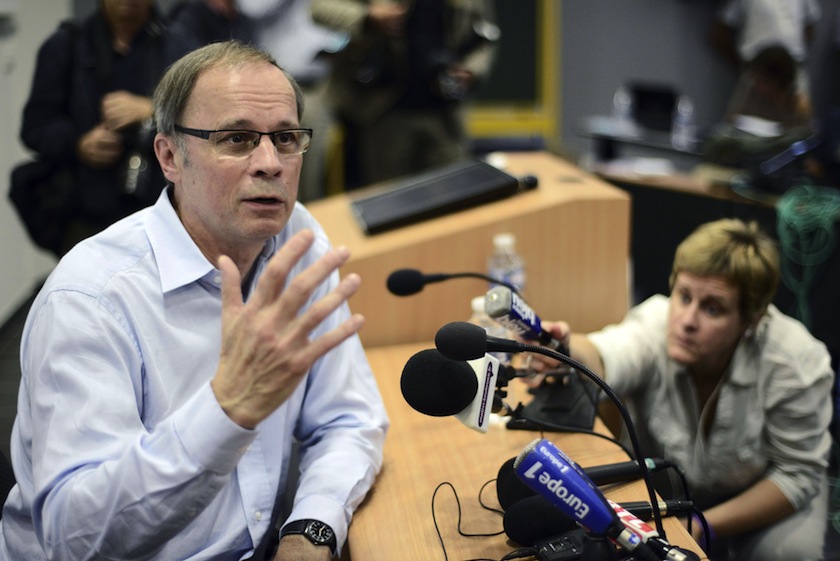
Laureate of the 2014 Nobel Prize in Economics, French economist Jean Tirole speaks during a press conference at the Toulouse School of Economics (TSE) on October 13, 2014 in Toulouse. Tirole is a master of game theory and industrial organisation, who added a Nobel prize to a gleaming heap of honours for his work. The 61-year-old was hailed by the Nobel jury as "one of the most influential economists of our time" for his analysis of big companies, market power and regulation. The professor at the Toulouse School of Economics has long been tipped as a potential winner of the Nobel Economics Prize, largely dominated by economists from the United States. AFP PHOTO / REMY GABALDA (Photo credit should read REMY GABALDA/AFP/Getty Images)Photograph by Remy Gabalda — AFP/Getty Images

Competition is at the very heart of capitalism: it drives firms to make better products at lower prices, and it gives customers the ability to choose a provider that best serves their needs.

But what about industries in which competition doesn’t result naturally? Take rail transport, for example. It wouldn’t pay for several companies to build competing networks of train tracks going to and from the same cities. The result: we have a government-owned monopoly, Amtrak, that provides commuter-rail service. Another way of handling so-called natural monopolies is to tightly regulate a private enterprise so that it doesn’t use its monopoly for ill. A good example of this might be your local power company.

But regulating these entities so that they are efficient, innovative, and charge fair prices is very difficult. Economists have studied this problem for decades. On Monday, French economist Jean Tirole was awarded the Nobel Prize in economics for his work in this very subject. As the Nobel Committee said Monday in its press release announcing the award:

Before Tirole, researchers and policymakers sought general principles for all industries. They advocated simple policy rules, such as capping prices for monopolists and prohibiting cooperation between competitors, while permitting cooperation between firms with different positions in the value chain. Tirole showed theoretically that such rules may work well in certain conditions, but do more harm than good in others. Price caps can provide dominant firms with strong motives to reduce costs—a good thing for society—but may also permit excessive profits—a bad thing for society. Cooperation on price setting within a market is usually harmful, but cooperation regarding patent pools can benefit everyone. The merger of a firm and its supplier may encourage innovation, but may also distort competition.

It is these insights that could help the U.S. regulate broadband service providers in a way that would bring down the prices that Americans pay for Internet, which are among the highest in the developed world, while still creating enough competition that companies would still have the incentive to innovate. The problem, according to Joshua Gans, a professor of strategic management at the University of Toronto, is that the federal government has not been regulating broadband Internet like a utility for many years. So, while Tirole’s theories have had a huge impact on the rest of the developed world, where broadband access is regulated as a utility, the effects of his ideas are less felt in the U.S. Says Gans:

The issue in telecoms arises with what is termed the last-mile problem. You only have one set of cables or copper coming into your house. The solution adopted around the world has been to say, okay, one firm owns this cable, but what they have to do is provide access to these cables. So If I want another firm to provide me with TV or Internet, they have to allow that firm to effectively rent the cable from the other firm.

Obviously you can’t just let a firm that’s a competitor rent a key input at any old price, so what Tirole did in a number of papers is say that this is quite a difficult problem, he worked out how regulators should balance the incentives, trying to create the competition, while a firm that creates a cable still has the incentives to connect up new homes and things like that.

This sort of competition has driven down the price of broadband around the world, while American customers tend to pay relatively high rates. In the meantime, Tirole’s ideas have been adopted by regulators in other industries. According to economist and Brookings Institute fellow Robert Litan, Tirole helped regulators force companies to be more efficient through what’s known as “incentive regulation.” Prior to the work of Tirole and others, regulators would simply allow utility companies to charge whatever price was warranted by calculating a rate of return on investment the regulator deemed fair. But this caused utilities to overinvest so that that they could charge more.

Tirole suggested that regulators offer a profit-sharing scheme in which any cost-saving cut or investment would be shared equally by the company and its customers. These techniques have been adopted by electric and water companies across the U.S.


About the Author
By Chris Matthews
See full bioRight Arrow Button Icon

Latest in Finance

EconomyFederal Reserve
Trump names Warsh, Hassett as top Fed contenders, WSJ says
By Jennifer A. Dlouhy and BloombergDecember 12, 2025
5 hours ago
EconomyFederal Reserve
The Fed just ‘Trump-proofed’ itself with a unanimous move to preempt a potential leadership shake-up
By Jason MaDecember 12, 2025
7 hours ago
robots
InnovationRobots
‘The question is really just how long it will take’: Over 2,000 gather at Humanoids Summit to meet the robots who may take their jobs someday
By Matt O'Brien and The Associated PressDecember 12, 2025
8 hours ago
Man about to go into police vehicle
CryptoCryptocurrency
Judge tells notorious crypto scammer ‘you have been bitten by the crypto bug’ in handing down 15 year sentence 
By Carlos GarciaDecember 12, 2025
9 hours ago
Donald Trump, sitting in the Roosevelt Room, looks forward and frowns.
EconomyTariffs and trade
For the first time since Trump’s tariff rollout, import tax revenue has fallen, threatening his lofty plans to slash the $38 trillion national debt
By Sasha RogelbergDecember 12, 2025
9 hours ago
Personal Financemortgages
7 best HELOC lenders in 2025: How to choose the best home equity line of credit for your situation
By Joseph HostetlerDecember 12, 2025
9 hours ago

Most Popular

placeholder alt text
Economy
Tariffs are taxes and they were used to finance the federal government until the 1913 income tax. A top economist breaks it down
By Kent JonesDecember 12, 2025
18 hours ago
placeholder alt text
Success
At 18, doctors gave him three hours to live. He played video games from his hospital bed—and now, he’s built a $10 million-a-year video game studio
By Preston ForeDecember 10, 2025
3 days ago
placeholder alt text
Success
Palantir cofounder calls elite college undergrads a ‘loser generation’ as data reveals rise in students seeking support for disabilities, like ADHD
By Preston ForeDecember 11, 2025
2 days ago
placeholder alt text
Success
Apple cofounder Ronald Wayne sold his 10% stake for $800 in 1976—today it’d be worth up to $400 billion
By Preston ForeDecember 12, 2025
14 hours ago
placeholder alt text
Success
40% of Stanford undergrads receive disability accommodations—but it’s become a college-wide phenomenon as Gen Z try to succeed in the current climate
By Preston ForeDecember 12, 2025
13 hours ago
placeholder alt text
Arts & Entertainment
'We're not just going to want to be fed AI slop for 16 hours a day': Analyst sees Disney/OpenAI deal as a dividing line in entertainment history
By Nick LichtenbergDecember 11, 2025
1 day ago
Rankings
  • 100 Best Companies
  • Fortune 500
  • Global 500
  • Fortune 500 Europe
  • Most Powerful Women
  • Future 50
  • World’s Most Admired Companies
  • See All Rankings
Sections
  • Finance
  • Leadership
  • Success
  • Tech
  • Asia
  • Europe
  • Environment
  • Fortune Crypto
  • Health
  • Retail
  • Lifestyle
  • Politics
  • Newsletters
  • Magazine
  • Features
  • Commentary
  • Mpw
  • CEO Initiative
  • Conferences
  • Personal Finance
  • Education
Customer Support
  • Frequently Asked Questions
  • Customer Service Portal
  • Privacy Policy
  • Terms Of Use
  • Single Issues For Purchase
  • International Print
Commercial Services
  • Advertising
  • Fortune Brand Studio
  • Fortune Analytics
  • Fortune Conferences
  • Business Development
About Us
  • About Us
  • Editorial Calendar
  • Press Center
  • Work At Fortune
  • Diversity And Inclusion
  • Terms And Conditions
  • Site Map

© 2025 Fortune Media IP Limited. All Rights Reserved. Use of this site constitutes acceptance of our Terms of Use and Privacy Policy | CA Notice at Collection and Privacy Notice | Do Not Sell/Share My Personal Information
FORTUNE is a trademark of Fortune Media IP Limited, registered in the U.S. and other countries. FORTUNE may receive compensation for some links to products and services on this website. Offers may be subject to change without notice.