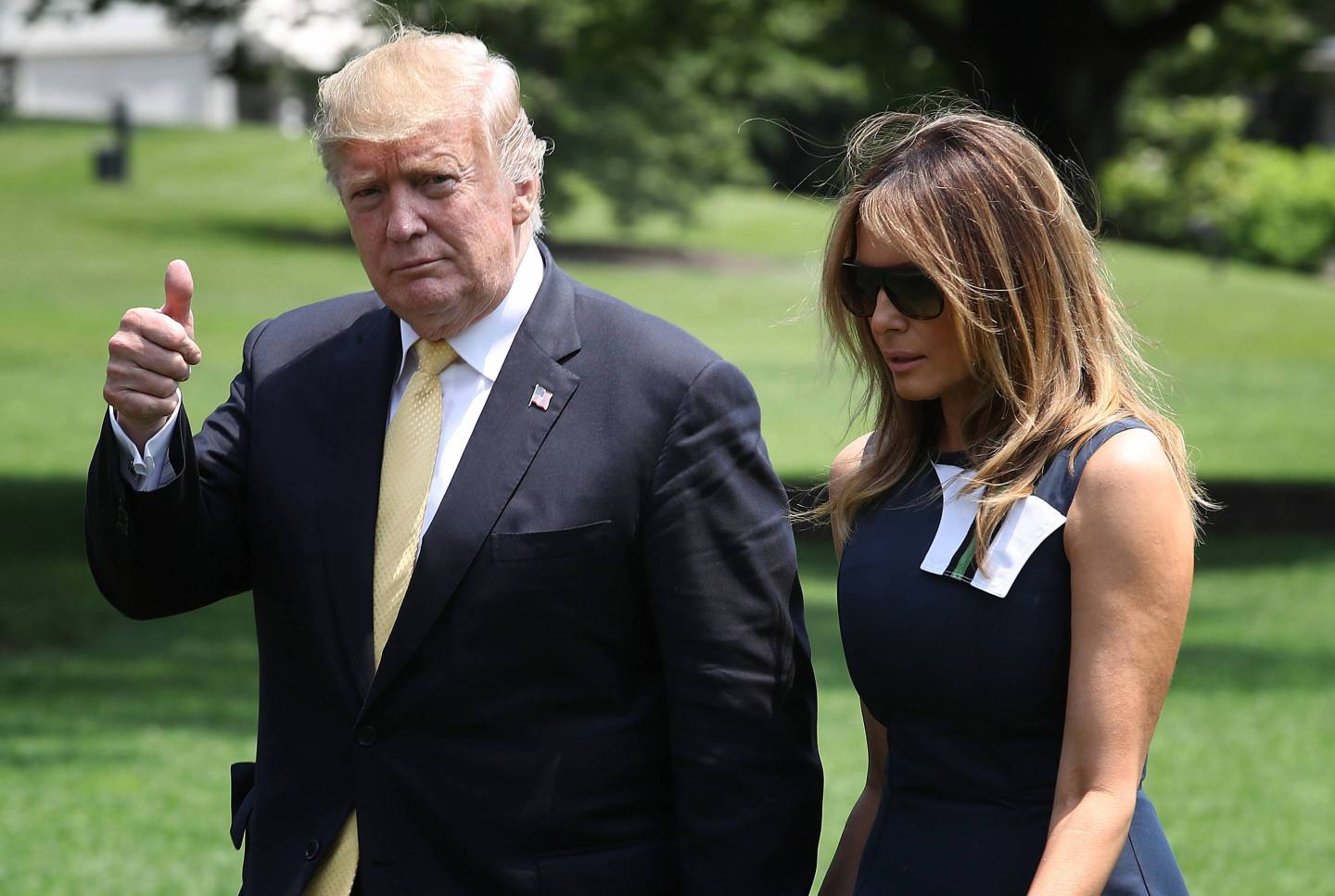
More than two years after U.S. President Donald Trump walked away from a regional Asia-Pacific trade agreement, the U.S. and Japan — the world’s largest and third-largest economies — are negotiating a deal of their own. Both sides insist they want a “win-win” outcome, but as evidenced by the Trump administration’s tariff battles with China and the European Union, there’s potential for serious economic damage if things go bad.
1. What are the two sides after?
Trump abhors trade deficits and is determined to reduce the one the U.S. has with Japan, particularly by gaining more access for exports by American farmers and automakers. Japan, under Prime Minister Shinzo Abe, wants to head off Trump’s threatened penalties on autos and auto parts, which could tip it into recession, as well as any “currency clause” directed at the Japanese yen.
2. Why are these talks happening?
After Trump pulled the U.S. out of the Trans-Pacific Partnership, the 11 other members (including Japan) went ahead without the U.S. That deal, which entered into force Dec. 30, and another that Abe struck in 2018 with the EU have left U.S. farmers at risk of losing market share to rivals with lower tariffs. (American growers accounted for about a quarter of Japan’s agricultural imports in 2017.) Abe dragged his heels in the hope that the U.S. would rejoin the TPP, but agreed to direct talks in September after Trump hit Japan’s steel and aluminum exports with tariffs and threatened to do the same on all imported cars, including those made in Japan.
3. How are they going?
Both sides have said they want to move quickly but as with most trade talks, the end date is murky. U.S. Trade Representative Robert Lighthizer and Japan’s Economy Minister Toshimitsu Motegi were said to have agreed on the broad scope, but Motegi has repeatedly said that any deal will have to be comprehensive, signaling that Japan won’t agree to anything piecemeal. The two sides also are to hold discussions on digital trade, but other types of services are off the table, at least for now. Japan has elections set for July and Trump has acknowledged nothing will be finalized before that.
4. What about the ‘currency clause’?
U.S. Treasury Secretary Steven Mnuchin has said the U.S. wants any trade deal with Japan to include language that would prevent competitive devaluations — currency moves designed specifically to boost exports. The U.S. made sure similar language was included in its revised trade deal with Mexico and Canada, and that prohibition is expected to be part of any U.S.-China deal. Japan, though, wants to avoid any clause that might tie the Bank of Japan’s hands. It has argued that currency moves and export volumes no longer correlate. Motegi has said that any discussion on currency is between Japan’s Finance Ministry and the U.S. Treasury Department, under an agreement reached in February 2017.
5. How big is the U.S. trade deficit with Japan?
In goods trade, it was 6.5 trillion yen ($59 billion) in 2018. That was down 8.1% compared with 2017, the result of weaker car exports from Japan and more imports of aircraft and oil, according to Japan’s Finance Ministry. Autos and auto parts make up the biggest portion of that deficit, and Trump’s trade policy is particularly focused on that sector. The U.S. actually has a trade surplus for services, which has slowly been increasing over the past decade.
6. What’s motivating Japan?
It wants to head off anything that would dent its already lackluster economy, which has been flirting with a technical recession even before a planned increase in the national sales tax in October. Goldman Sachs estimates that with new tariffs on auto exports of just 10% (Trump has threatened 25%), Japan’s gross domestic product could be cut by more than 0.2 percentage point. But it will be politically difficult for Abe to make any concessions, particularly on agriculture, ahead of the upper-house elections set for July.
7. What about the U.S.?
A deal with Japan became more urgent after its talks with China broke down in May and the tariff war escalated. Trump put off imposing tariffs on imported cars for six months, seeking to use that as leverage in talks with Japan. Already in March, Lighthizer told U.S. lawmakers that he’s aware of the precarious situation American farmers are in, and that winning greater market access for agriculture products in Japan is a high priority. Farm states were an important bloc of support for Trump in 2016, and with a presidential election in 2020, Trump will face questions on his achievements in rebalancing America’s trade relationships, a major campaign pledge. For now, the report card is full of incompletes: There’s resistance in the U.S. Congress to ratifying the United States-Mexico-Canada agreement. Talks with the EU haven’t gotten far. The trade war in China, meantime, has hurt both sides.
More must-read stories from Fortune:
—China’s running out of U.S. goods to tariff, but it has other trade war weapons to unleash
—How China’s top-down political system holds it back
—Too many companies are paying too much for stock buybacks
—How to invest during a trade war
—Listen to our new audio briefing, Fortune 500 Daily
Don’t miss the daily Term Sheet, Fortune‘s newsletter on deals and dealmakers.