• Home
  • Latest
  • Fortune 500
  • Finance
  • Tech
  • Leadership
  • Lifestyle
  • Rankings
  • Multimedia
CommentaryNorth Korea

How North Korea Could Start a War With America Right Now

By
Hannah Suh
Hannah Suh
Down Arrow Button Icon
By
Hannah Suh
Hannah Suh
Down Arrow Button Icon
July 17, 2017, 3:52 PM ET
STR/AFP/Getty Images

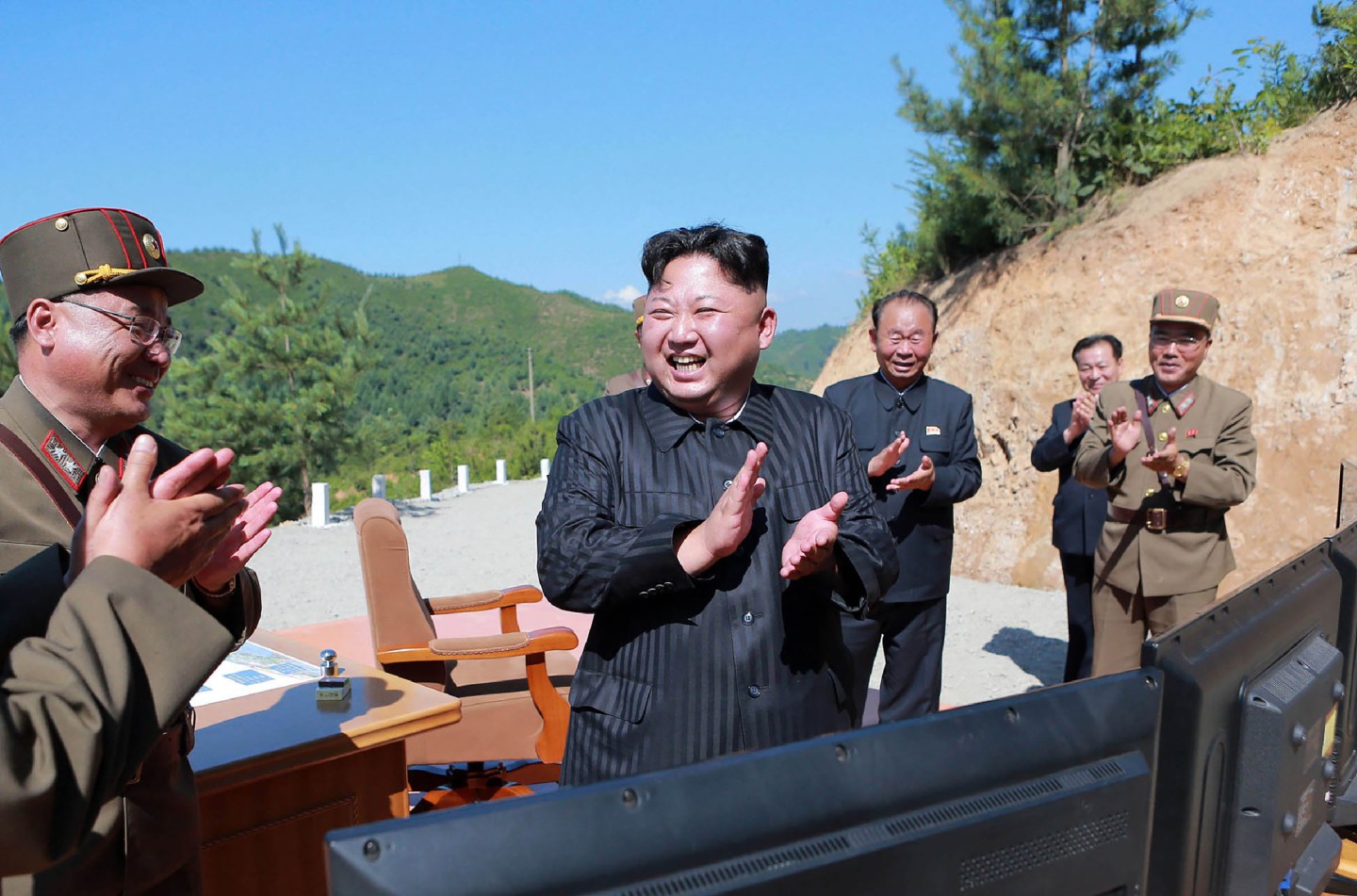
Earlier this month, North Korea launched an intercontinental ballistic missile (ICBM) test capable of reaching Alaska. Much ink has been spilled as to what this test means for the U.S., how policymakers should address North Korea nuclearization efforts, and the likelihood of war between the two nations.

However, North Korean leader Kim Jong-un has yet to display that his regime does indeed possess the technological knowledge needed to successfully fire a nuclear-tipped ICBM to hit the U.S. Miniaturizing a nuclear warhead to fit atop a ballistic missile is just one hurdle, and ensuring it does not tear apart upon atmospheric reentry (no small feat) is another. What is more urgently concerning is the fact that North Korea already has all of the technology it needs to start a damaging war with the U.S. via its short- and medium-range missiles. If America were to go to war with North Korea, it would most likely be in defense or aid of America’s East Asian allies.

The geographic proximity of Japan and South Korea to the hermit kingdom mean artillery or short- and medium-range missiles would suffice if Pyongyang were to conduct a damaging first strike. Unlike trying to hit the U.S. mainland, a target more than 5,000 miles away, Seoul and Tokyo, 121 miles and 798 miles respectively from the North Korean capital, present easier and similarly high-value targets, especially given both cities’ sizable populations.

Moreover, the strong defense alliance between the U.S. and both countries provides tempting targets with which North Korea could inflict pain. The U.S. military has a strong presence in both countries, with more than 60,000 troops stationed at various bases throughout Japan and South Korea. An attack on naval base Yokosuka outside of Tokyo or Yongsan Garrison on the outskirts of Seoul would result in a significant number of American lives lost in addition to the enormous loss of Japanese and South Korean lives. In Seoul, the sheer number of U.S. artillery shells and the positioning of artillery would make it difficult to adequately defend a North Korean nuclear attack. Although U.S. military installations in Tokyo do not have the same tactical conundrum, the short- and medium-range missiles capable of striking Tokyo would inflict a heavy human cost.

The cornerstones of America’s alliances with Japan and South Korea are their mutual defense treaties. If either Japan or South Korea were attacked, the U.S. would be obligated to come to their aid—and therefore into a war with North Korea. A war with North Korea on the Asian continent sparked over an attack on an American ally would incur the same grave costs of a direct conflict between Washington and Pyongyang, but with the added complexity of navigating potentially trilateral military interoperability and the political will and cost-benefit calculations of three democratic societies.

This growing threat of a conflict and North Korea’s increasing belligerence should serve to strengthen ties, bilaterally and trilaterally, between Washington, Tokyo, and Seoul. The deployment of the Terminal High Altitude Area Defense (THAAD) anti-ballistic missile system in South Korea and continued U.S.-Japan cooperation to ramp up efforts against the dictatorial Kim regime are steps in the right direction. Maintaining positive relations between the U.S. and its East Asian allies should be a top priority for the Trump administration to counter North Korea’s aggression.

As frightening as ICBMs sound, Pyongyang already possesses all the weapons it needs to draw America into a war. The question is whether the U.S. and its allies will continue to strengthen the tools required to deter such a conflict.

Hannah Suh is the program manager of the Asia-Pacific security program at the Center for a New American Security.


About the Author
By Hannah Suh
See full bioRight Arrow Button Icon

Latest in Commentary

student
CommentaryEducation
International students skipped campus this fall — and local economies lost $1 billion because of it
By Bjorn MarkesonDecember 10, 2025
21 hours ago
jobs
Commentaryprivate equity
There is a simple fix for America’s job-quality crisis: actually give workers a piece of the business 
By Pete StavrosDecember 9, 2025
2 days ago
Jon Rosemberg
CommentaryProductivity
The cult of productivity is killing us
By Jon RosembergDecember 9, 2025
2 days ago
Trump
CommentaryTariffs and trade
AI doctors will be good at science but bad at business, and big talk with little action means even higher drugs prices: 10 healthcare predictions for 2026 from top investors
By Bob Kocher, Bryan Roberts and Siobhan Nolan ManginiDecember 9, 2025
2 days ago
Google.org
CommentaryTech
Nonprofits are solving 21st century problems—they need 21st century tech
By Maggie Johnson and Shannon FarleyDecember 8, 2025
3 days ago
Will Dunham is President and Chief Executive Officer of the American Investment Council
CommentaryRetirement
Private equity is being villainized in the retirement debate — even as it provides diversification and outperforms public markets long-term
By Will DunhamDecember 8, 2025
3 days ago

Most Popular

placeholder alt text
Success
At 18, doctors gave him three hours to live. He played video games from his hospital bed—and now, he’s built a $10 million-a-year video game studio
By Preston ForeDecember 10, 2025
1 day ago
placeholder alt text
Politics
Exclusive: U.S. businesses are getting throttled by the drop in tourism from Canada: ‘I can count the number of Canadian visitors on one hand’
By Dave SmithDecember 10, 2025
23 hours ago
placeholder alt text
Economy
‘Be careful what you wish for’: Top economist warns any additional interest rate cuts after today would signal the economy is slipping into danger
By Eva RoytburgDecember 10, 2025
17 hours ago
placeholder alt text
Economy
‘Fodder for a recession’: Top economist Mark Zandi warns about so many Americans ‘already living on the financial edge’ in a K-shaped economy 
By Eva RoytburgDecember 9, 2025
2 days ago
placeholder alt text
Uncategorized
Transforming customer support through intelligent AI operations
By Lauren ChomiukNovember 26, 2025
15 days ago
placeholder alt text
Success
Netflix–Paramount bidding wars are pushing Warner Bros CEO David Zaslav toward billionaire status—he has one rule for success: ‘Never be outworked’
By Preston ForeDecember 10, 2025
19 hours ago
Rankings
  • 100 Best Companies
  • Fortune 500
  • Global 500
  • Fortune 500 Europe
  • Most Powerful Women
  • Future 50
  • World’s Most Admired Companies
  • See All Rankings
Sections
  • Finance
  • Leadership
  • Success
  • Tech
  • Asia
  • Europe
  • Environment
  • Fortune Crypto
  • Health
  • Retail
  • Lifestyle
  • Politics
  • Newsletters
  • Magazine
  • Features
  • Commentary
  • Mpw
  • CEO Initiative
  • Conferences
  • Personal Finance
  • Education
Customer Support
  • Frequently Asked Questions
  • Customer Service Portal
  • Privacy Policy
  • Terms Of Use
  • Single Issues For Purchase
  • International Print
Commercial Services
  • Advertising
  • Fortune Brand Studio
  • Fortune Analytics
  • Fortune Conferences
  • Business Development
About Us
  • About Us
  • Editorial Calendar
  • Press Center
  • Work At Fortune
  • Diversity And Inclusion
  • Terms And Conditions
  • Site Map

© 2025 Fortune Media IP Limited. All Rights Reserved. Use of this site constitutes acceptance of our Terms of Use and Privacy Policy | CA Notice at Collection and Privacy Notice | Do Not Sell/Share My Personal Information
FORTUNE is a trademark of Fortune Media IP Limited, registered in the U.S. and other countries. FORTUNE may receive compensation for some links to products and services on this website. Offers may be subject to change without notice.