• Home
  • Latest
  • Fortune 500
  • Finance
  • Tech
  • Leadership
  • Lifestyle
  • Rankings
  • Multimedia
CommentaryNorth Korea

How Trump Should View North Korea’s Nuclear Ambitions

By
Flynt Leverett
Flynt Leverett
Down Arrow Button Icon
By
Flynt Leverett
Flynt Leverett
Down Arrow Button Icon
April 23, 2017, 4:00 PM ET
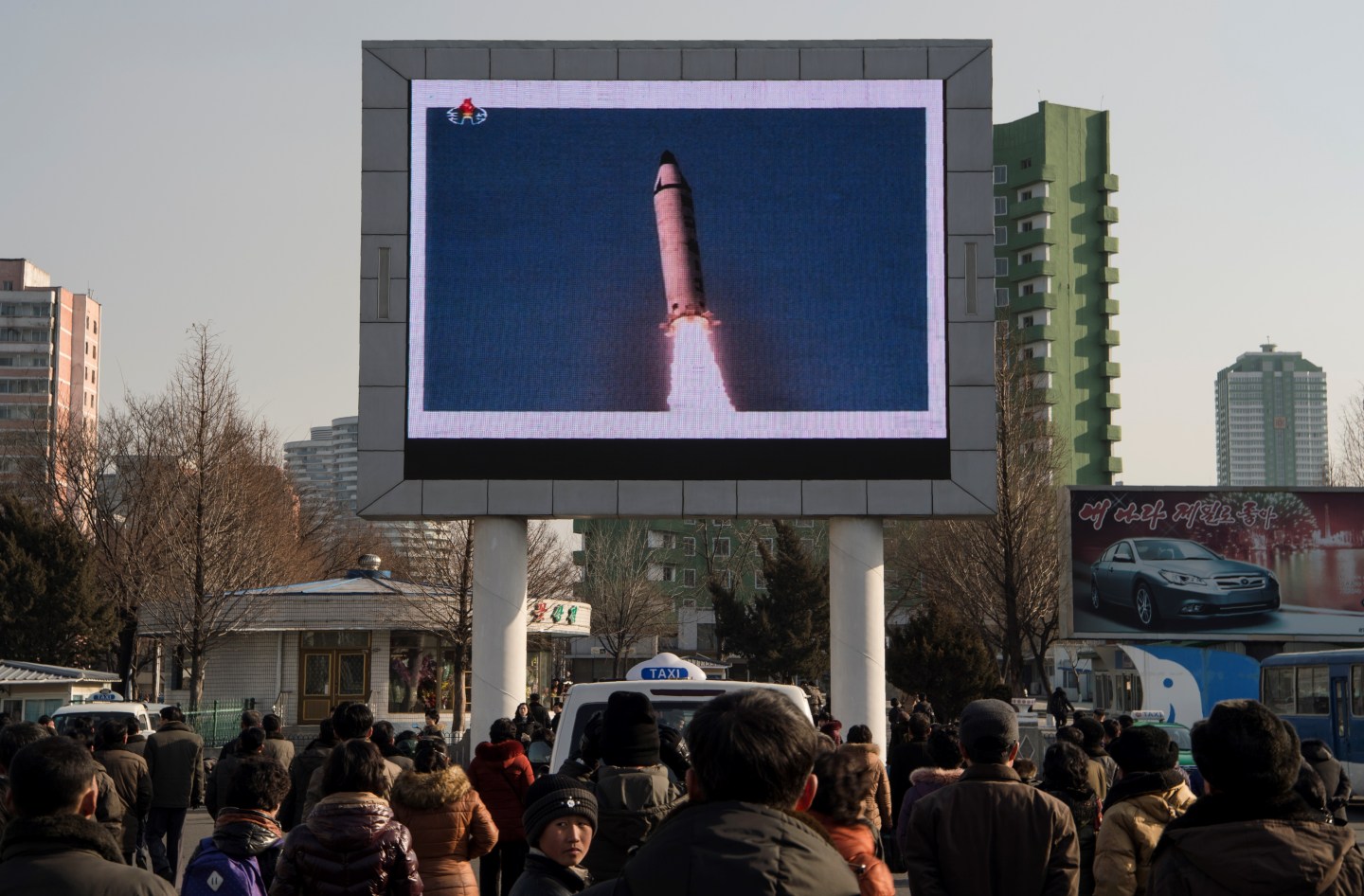
NKOREA-MILITARY-MISSILE-CONFLICTS
This photo taken on February 13, 2017 shows people in Pyongyang watching a public broadcast about the launch of a surface-to-surface medium long-range ballistic missile.Kim Won-Jin—AFP/Getty Images

The Trump administration last week warned again that if China does not extract North Korea’s surrender to U.S. demands that Pyongyang abandon its nuclear and missile activities, the administration will “solve” the North Korea problem on its own. But attacking Pyongyang’s nuclear and missile capabilities would almost certainly trigger Seoul’s destruction by North Korean conventional artillery. And targeting North Korea’s massive, heavily protected, and well-hidden artillery assets — even with bigger bombs than previously in the U.S. arsenal—will not destroy enough capability to produce an appreciably better strategic outcome.

Given these realities, the real challenge before the Trump administration is to treat the North Korean nuclear crisis as an opening to put the security of the world’s most economically vital region on a sturdier foundation.

Seizing this opportunity requires cultivating more stable relations among major Asian powers and key external players like the United States — relations that the parties themselves would see as less threatening to their respective core interests. The key to elaborating such relations is serious discussion and diplomacy with China, Japan, and North and South Korea about establishing a reunified Korean state that would be militarily denuclearized and strategically neutral.

Realizing this goal quickly is neither likely nor necessary; the process of shaping a new regional order would itself help stabilize relations among Asia’s major strategic actors. But an end goal of Korea’s reunification as a militarily denuclearized and strategically neutral state is key because of Korea’s historical centrality to Asian security and its rising standing as a regional and even global player.

For at least five centuries, geography has driven Asian powers to compete for influence over the Korean peninsula. From the 1500s, Japanese elites have seen a unified Korea controlled by China as unacceptably threatening to Japan’s security. Chinese elites (imperial, republican, and communist) have seen a unified Korea aligned with hostile powers — Japan or, more recently, the United States — as unacceptably threatening to China’s security.

In the modern era, competition for influence over the peninsula has repeatedly prompted contestation and conflict—e.g., the 1894-1895 Sino-Japanese War, Japan’s 1910-1945 occupation of Korea, the peninsula’s post-World War II division into two states, and the 1950-1953 Korean War. For the past quarter century, this competition has been an essential backdrop to the standoff over Pyongyang’s nuclear and missile programs.

Chronically concerned about security, North Korea is developing nuclear weapons and missile delivery systems that might deter America and its allies from attacking Pyongyang’s core interests. But Pyongyang’s search for deterrence also raises odds of conventional conflict on the peninsula — with growing risks that fighting could escalate to nuclear war. The only solution to this dilemma is negotiated arrangements ensuring Koreans living in the peninsula’s northern part that their strategic independence will not be compromised by outside powers.

South Korea faces its own security dilemma in trying to navigate an ever-shifting line between protecting itself and not provoking its northern neighbor. At the same time, South Korea has already demonstrated the potential of a reunified Korea to emerge as a major regional and even global player. In the late 1950s/early 1960s, South Korea’s per capita GDP was smaller than that of many African countries; today, South Korea is a manufacturing/technological powerhouse with the world’s 11th-largest economy. And even under sanctions and severe international isolation, North Korea has pursued technologically demanding nuclear and missile programs.

Korea’s reunification as a militarily denuclearized, strategically neutral state would let it realize even more of its economic potential. It would also position Korea to rise as a regional power in its own right, able to balance between America and its regional allies, on one side, and China, on the other, contributing to greater long-term regional stability.

China, for its part, faces increasingly acute dilemmas in managing relations with both Pyongyang and Seoul. Beijing has long seen North Korea as a critical buffer against U.S.-allied South Korea’s effective extension to China’s border — a scenario prospectively enabling U.S. troop deployments to that border. Thus, China has declined to squeeze Pyongyang in ways that would put North Korea at risk of collapse, no matter how much Washington wants it to. In recent years, China has also worked hard to build closer economic and political ties to South Korea. But North Korea’s weapons tests are now enabling Washington to expand U.S. military engagement in Northeast Asia (including in South Korea), threatening China’s own security.

To engage China more constructively in resolving the North Korea problem, it is vital to outline a diplomatic path mitigating Beijing’s Korean dilemmas. Seeking a reunified Korea that is militarily denuclearized and strategically neutral is the most promising way to do this. China has even offered a starting point for discussion: its proposal for a halt to North Korean weapons tests in exchange for a halt to U.S.-South Korean military exercises.

Flynt Leverett is professor of international affairs and Asian studies at Penn State and co-author of Going to Tehran: Why America Must Accept the Islamic Republic of Iran. He served in the U.S. government at the National Security Council, on the Secretary of State’s Policy Planning Staff, and as a CIA senior analyst.

Flynt Leverett is professor of international affairs and Asian studies at Penn State and co-author of Going to Tehran: Why America Must Accept the Islamic Republic of Iran. He served in the U.S. government at the National Security Council, on the Secretary of State’s Policy Planning Staff, and as a CIA senior analyst.

About the Author
By Flynt Leverett
See full bioRight Arrow Button Icon

Latest in Commentary

Finance
Lorem ipsum dolor sit amet, consectetur adipiscing elit, sed do eiusmod tempor incididunt ut labore et dolore magna aliqua. Ut enim ad minim veniam
By Fortune Editors
October 20, 2025
Finance
Lorem ipsum dolor sit amet, consectetur adipiscing elit, sed do eiusmod tempor incididunt ut labore et dolore magna aliqua. Ut enim ad minim veniam
By Fortune Editors
October 20, 2025
Finance
Lorem ipsum dolor sit amet, consectetur adipiscing elit, sed do eiusmod tempor incididunt ut labore et dolore magna aliqua. Ut enim ad minim veniam
By Fortune Editors
October 20, 2025
Finance
Lorem ipsum dolor sit amet, consectetur adipiscing elit, sed do eiusmod tempor incididunt ut labore et dolore magna aliqua. Ut enim ad minim veniam
By Fortune Editors
October 20, 2025
Finance
Lorem ipsum dolor sit amet, consectetur adipiscing elit, sed do eiusmod tempor incididunt ut labore et dolore magna aliqua. Ut enim ad minim veniam
By Fortune Editors
October 20, 2025
Finance
Lorem ipsum dolor sit amet, consectetur adipiscing elit, sed do eiusmod tempor incididunt ut labore et dolore magna aliqua. Ut enim ad minim veniam
By Fortune Editors
October 20, 2025

Most Popular

Finance
Lorem ipsum dolor sit amet, consectetur adipiscing elit, sed do eiusmod tempor incididunt ut labore et dolore magna aliqua. Ut enim ad minim veniam
By Fortune Editors
October 20, 2025
Finance
Lorem ipsum dolor sit amet, consectetur adipiscing elit, sed do eiusmod tempor incididunt ut labore et dolore magna aliqua. Ut enim ad minim veniam
By Fortune Editors
October 20, 2025
Finance
Lorem ipsum dolor sit amet, consectetur adipiscing elit, sed do eiusmod tempor incididunt ut labore et dolore magna aliqua. Ut enim ad minim veniam
By Fortune Editors
October 20, 2025
Finance
Lorem ipsum dolor sit amet, consectetur adipiscing elit, sed do eiusmod tempor incididunt ut labore et dolore magna aliqua. Ut enim ad minim veniam
By Fortune Editors
October 20, 2025
Finance
Lorem ipsum dolor sit amet, consectetur adipiscing elit, sed do eiusmod tempor incididunt ut labore et dolore magna aliqua. Ut enim ad minim veniam
By Fortune Editors
October 20, 2025
Finance
Lorem ipsum dolor sit amet, consectetur adipiscing elit, sed do eiusmod tempor incididunt ut labore et dolore magna aliqua. Ut enim ad minim veniam
By Fortune Editors
October 20, 2025
Fortune Secondary Logo
Rankings
  • 100 Best Companies
  • Fortune 500
  • Global 500
  • Fortune 500 Europe
  • Most Powerful Women
  • Future 50
  • World’s Most Admired Companies
  • See All Rankings
Sections
  • Finance
  • Fortune Crypto
  • Features
  • Leadership
  • Health
  • Commentary
  • Success
  • Retail
  • Mpw
  • Tech
  • Lifestyle
  • CEO Initiative
  • Asia
  • Politics
  • Conferences
  • Europe
  • Newsletters
  • Personal Finance
  • Environment
  • Magazine
  • Education
Customer Support
  • Frequently Asked Questions
  • Customer Service Portal
  • Privacy Policy
  • Terms Of Use
  • Single Issues For Purchase
  • International Print
Commercial Services
  • Advertising
  • Fortune Brand Studio
  • Fortune Analytics
  • Fortune Conferences
  • Business Development
About Us
  • About Us
  • Editorial Calendar
  • Press Center
  • Work At Fortune
  • Diversity And Inclusion
  • Terms And Conditions
  • Site Map
Fortune Secondary Logo
  • About Us
  • Editorial Calendar
  • Press Center
  • Work At Fortune
  • Diversity And Inclusion
  • Terms And Conditions
  • Site Map
  • Facebook icon
  • Twitter icon
  • LinkedIn icon
  • Instagram icon
  • Pinterest icon

Latest in Commentary

world's fair
CommentaryRobots
Something big is happening in AI, but panic is the wrong reaction
By Peter CappelliFebruary 28, 2026
11 hours ago
putin
CommentaryRussia
Exclusive analysis: we looked at the 400 western firms still in Russia. Their paltry size strips Putin’s bluff bare naked
By Jeffrey Sonnenfeld, Stephen Henriques, Jake Waldinger and Giuseppe ScottoFebruary 27, 2026
1 day ago
roth
CommentaryLeadership
The AI resource reallocation challenge: How can companies capture the value of time?
By Erik RothFebruary 27, 2026
1 day ago
will
CommentaryAdvertising
I’m one of America’s top pollsters and I’ve got a warning for the AI companies: customers aren’t sold on ads
By Will JohnsonFebruary 27, 2026
2 days ago
the pitt
CommentaryDEI
‘The Pitt’: a masterclass display of DEI in action 
By Robert RabenFebruary 26, 2026
2 days ago
david booth
CommentaryMarkets
3 lessons from investing’s ‘moneyball’ moment
By David BoothFebruary 25, 2026
3 days ago

Most Popular

placeholder alt text
Success
Japanese companies are paying older workers to sit by a window and do nothing—while Western CEOs demand super-AI productivity just to keep your job
By Orianna Rosa RoyleFebruary 27, 2026
1 day ago
placeholder alt text
Success
Walmart exec says U.S. workforces needs to take inspiration from China where ‘5 year-olds are learning DeepSeek’
By Preston ForeFebruary 27, 2026
2 days ago
placeholder alt text
Personal Finance
Current price of gold as of February 27, 2026
By Danny BakstFebruary 27, 2026
1 day ago
placeholder alt text
Law
China's government intervenes to show Michigan scientists were carrying worms, not biological materials
By Ed White and The Associated PressFebruary 26, 2026
2 days ago
placeholder alt text
AI
The week the AI scare turned real and America realized maybe it isn't ready for what's coming
By Nick LichtenbergFebruary 28, 2026
12 hours ago
placeholder alt text
Economy
Come 2030, the U.S. deficit will be worth 5.9% of GDP—more than spending on Social Security, and equal to major health programs
By Eleanor PringleFebruary 26, 2026
2 days ago

© 2026 Fortune Media IP Limited. All Rights Reserved. Use of this site constitutes acceptance of our Terms of Use and Privacy Policy | CA Notice at Collection and Privacy Notice | Do Not Sell/Share My Personal Information
FORTUNE is a trademark of Fortune Media IP Limited, registered in the U.S. and other countries. FORTUNE may receive compensation for some links to products and services on this website. Offers may be subject to change without notice.