• Home
  • Latest
  • Fortune 500
  • Finance
  • Tech
  • Leadership
  • Lifestyle
  • Rankings
  • Multimedia
CommentaryChina

Why China Should Work With The U.S. To Contain North Korea

By
Minxin Pei
Down Arrow Button Icon
By
Minxin Pei
Down Arrow Button Icon
March 13, 2017, 1:00 AM ET
NKOREA-POLITICS-KIM
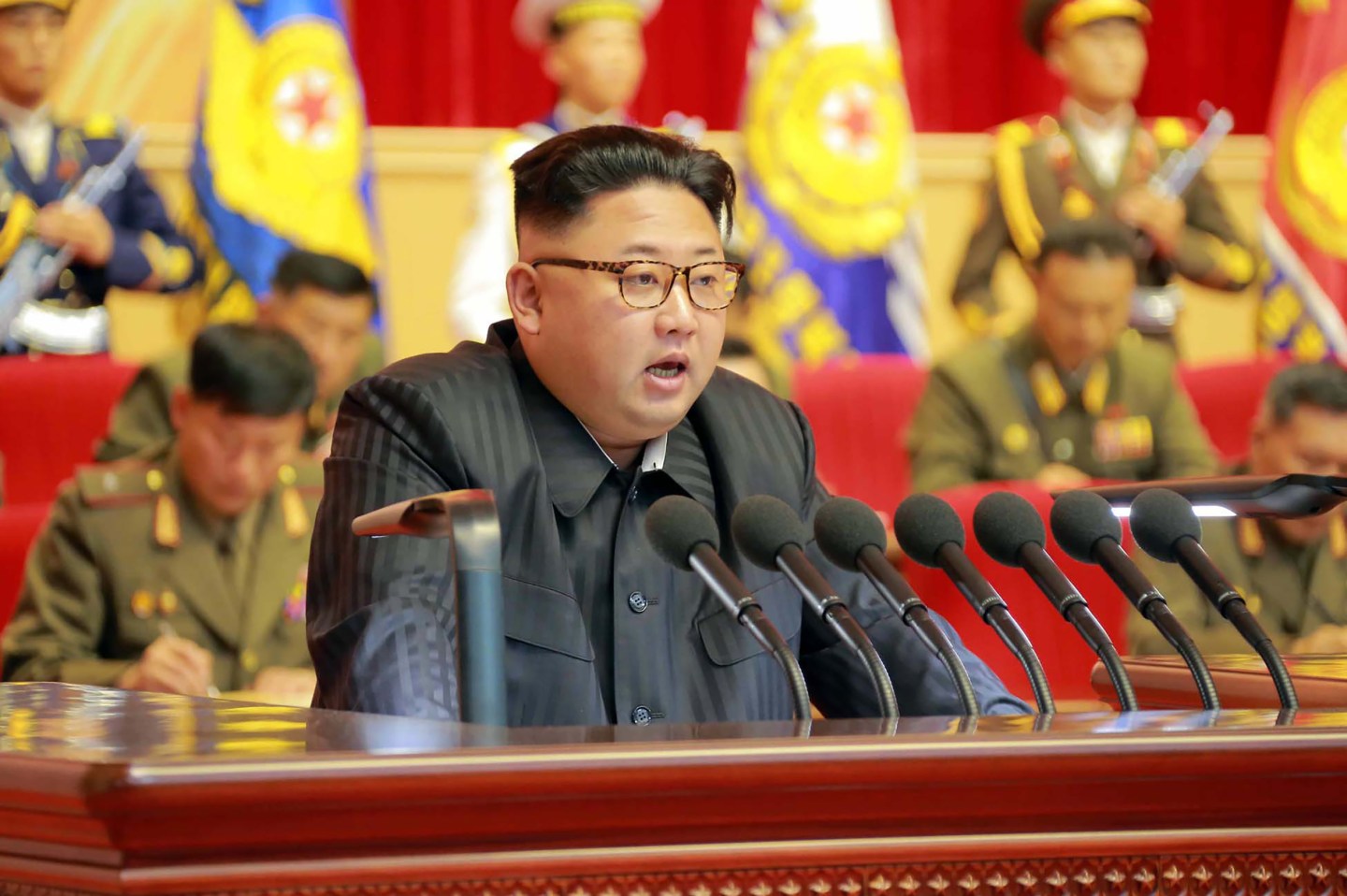
This undated picture released from North Korea's official Korean Central News Agency (KCNA) on August 4, 2016 shows North Korean leader Kim Jong-Un (C) delivering a speech at the 3rd Meeting of KPA Activists in O Jung Hup-led 7th Regiment Title Movement at the April 25 House of Culture in Pyongyang. / AFP / KCNA / KCNA Photograph by KCNA—AFP/Getty Images

Amidst rising tensions in Northeast Asia, U.S. Secretary of State Rex Tillerson’s upcoming visit to the region this week offers a glimmer of hope that diplomacy could avert a military conflict with North Korea.

For Tillerson, this will be the toughest test of his diplomatic skills. The odds that the secretary of state’s trip will cobble together a regional coalition to contain Pyongyang’s nuclear and missile ambitions do not appear good. South Korea has plunged into political chaos after the recent impeachment of President Park Geun-hye. Its political elites are deeply split over North Korea, which Tillerson is expected to visit on Friday. Japan, America’s staunch ally where Tillerson is expected to make his first stop Wednesday, will likely provide unreserved support. In China, Tillerson will almost certainly find his toughest interlocutors when he visits next weekend.

To Washington, Beijing’s response to Pyongyang’s brinksmanship has long been a source of frustration. As North Korea’s patron, only China has the means to pressure the Kim Jong-un regime to moderate its behavior. To be sure, in recent years Beijing has taken some modest measures trying to rein in Pyongyang. For example, China has supported sanctions against North Korea at the United Nations Security Council. Last month it also announced the suspension of coal imports from North Korea.

However, by and large, the Chinese government has refrained from imposing sanctions that could trigger a collapse of the North Korean economy and the Kim dynasty. In China’s strategic calculation, even a nuclear-armed North Korea bristling with missiles is preferable to a unified Korean peninsula allied with the United States.

It is this strategic logic that has led Beijing to adopt a policy that, instead of dialing up pressure on Pyongyang, ratchets up tensions with Washington and Seoul. Specifically, China has been incensed by America’s decision to deploy an advanced anti-missile system, known as Terminal High-Altitude Area Defense (Thaad), in South Korea because the Chinese military fears that the system could render China’s own nuclear deterrence more vulnerable.

Unable to force the more powerful U.S. to back down, China has concentrated its ire on South Korea. In the last two decades, South Korea has been playing a delicate balancing geopolitical game of relying on the U.S. for security protection and on China for trade. Now this game may be over because China is forcing South Korea to choose. In an effort to show Seoul the costs of hosting Thaad, Beijing has ordered a suspension of the sale of tour packages to South Korea and denied visas to Korean performers. On March 9, in a further escalation, Chinese authorities shut down half of the stores operated by Lotte, one of South Korea’s largest conglomerates.

On the surface, China seems to have a strong hand because it is South Korea’s largest trading partner. In 2016, Korea exported $124 billion worth of goods to China and ran a surplus of $37 billion. Additionally, 8 million Chinese tourists visited South Korea last year, spending $19 billion. In the eyes of Chinese leaders, sooner or later Seoul will have to capitulate because it cannot afford to lose its lucrative business with Beijing.

South Korea’s political upheaval has also created an opening for China. President Park has pursued a get-tough policy toward Kim Jong-un and agreed to the deployment of Thaad. Now that she is gone and the left-leaning opposition advocating a softer line may replace her, China could use its economic leverage to tip public support in favor of the opposition, which Chinese leaders hope to persuade to back out of the Thaad deal with the U.S.

However compelling this logic, China’s pressure tactics may not work. Even if the opposition should come to power, its leaders will likely stick with the Thaad agreement. If forced to choose, it is a safe bet that Seoul would pick Washington, not Beijing, for even more compelling security and economic reasons. In terms of security, China simply cannot replace the U.S. as a provider of security because it has not demonstrated its ability or willingness to deter North Korea. Economically, the U.S. remains South Korea’s second-largest export market (in 2016, Korean exports to the U.S. were about $70 billion). It is inconceivable that Seoul would risk losing access to the American market if it realigns with Beijing.

In all likelihood, Chinese efforts to pressure Seoul will backfire on several fronts. In terms of Chinese-Korean relations, China’s punitive measures will force Korean leaders to reassess — and reduce — their economic dependence on China. China’s Asian neighbors will also start rethinking the hidden costs of close economic ties with China because such dependence will make them strategically vulnerable.

Secretary of State Tillerson can take advantage of these dynamics to improve the chances of success of his trip to East Asia. Besides reassuring Seoul of Washington’s unwavering support, Tillerson needs to make it clear to his Chinese interlocutors that, instead of pushing a self-defeating strategy, China would be much better off working with the U.S., South Korea, and Japan to contain the most lethal threat to Chinese security – North Korea’s expanding nuclear and missile arsenals.

Minxin Pei is a professor of government at Claremont McKenna College and a non-resident senior fellow of the German Marshall Fund of the United States.


About the Author
By Minxin Pei
See full bioRight Arrow Button Icon

Latest in Commentary

Finance
Lorem ipsum dolor sit amet, consectetur adipiscing elit, sed do eiusmod tempor incididunt ut labore et dolore magna aliqua. Ut enim ad minim veniam
By Fortune Editors
October 20, 2025
Finance
Lorem ipsum dolor sit amet, consectetur adipiscing elit, sed do eiusmod tempor incididunt ut labore et dolore magna aliqua. Ut enim ad minim veniam
By Fortune Editors
October 20, 2025
Finance
Lorem ipsum dolor sit amet, consectetur adipiscing elit, sed do eiusmod tempor incididunt ut labore et dolore magna aliqua. Ut enim ad minim veniam
By Fortune Editors
October 20, 2025
Finance
Lorem ipsum dolor sit amet, consectetur adipiscing elit, sed do eiusmod tempor incididunt ut labore et dolore magna aliqua. Ut enim ad minim veniam
By Fortune Editors
October 20, 2025
Finance
Lorem ipsum dolor sit amet, consectetur adipiscing elit, sed do eiusmod tempor incididunt ut labore et dolore magna aliqua. Ut enim ad minim veniam
By Fortune Editors
October 20, 2025
Finance
Lorem ipsum dolor sit amet, consectetur adipiscing elit, sed do eiusmod tempor incididunt ut labore et dolore magna aliqua. Ut enim ad minim veniam
By Fortune Editors
October 20, 2025

Most Popular

Finance
Lorem ipsum dolor sit amet, consectetur adipiscing elit, sed do eiusmod tempor incididunt ut labore et dolore magna aliqua. Ut enim ad minim veniam
By Fortune Editors
October 20, 2025
Finance
Lorem ipsum dolor sit amet, consectetur adipiscing elit, sed do eiusmod tempor incididunt ut labore et dolore magna aliqua. Ut enim ad minim veniam
By Fortune Editors
October 20, 2025
Finance
Lorem ipsum dolor sit amet, consectetur adipiscing elit, sed do eiusmod tempor incididunt ut labore et dolore magna aliqua. Ut enim ad minim veniam
By Fortune Editors
October 20, 2025
Finance
Lorem ipsum dolor sit amet, consectetur adipiscing elit, sed do eiusmod tempor incididunt ut labore et dolore magna aliqua. Ut enim ad minim veniam
By Fortune Editors
October 20, 2025
Finance
Lorem ipsum dolor sit amet, consectetur adipiscing elit, sed do eiusmod tempor incididunt ut labore et dolore magna aliqua. Ut enim ad minim veniam
By Fortune Editors
October 20, 2025
Finance
Lorem ipsum dolor sit amet, consectetur adipiscing elit, sed do eiusmod tempor incididunt ut labore et dolore magna aliqua. Ut enim ad minim veniam
By Fortune Editors
October 20, 2025
Rankings
  • 100 Best Companies
  • Fortune 500
  • Global 500
  • Fortune 500 Europe
  • Most Powerful Women
  • Future 50
  • World’s Most Admired Companies
  • See All Rankings
Sections
  • Finance
  • Leadership
  • Success
  • Tech
  • Asia
  • Europe
  • Environment
  • Fortune Crypto
  • Health
  • Retail
  • Lifestyle
  • Politics
  • Newsletters
  • Magazine
  • Features
  • Commentary
  • Mpw
  • CEO Initiative
  • Conferences
  • Personal Finance
  • Education
Customer Support
  • Frequently Asked Questions
  • Customer Service Portal
  • Privacy Policy
  • Terms Of Use
  • Single Issues For Purchase
  • International Print
Commercial Services
  • Advertising
  • Fortune Brand Studio
  • Fortune Analytics
  • Fortune Conferences
  • Business Development
About Us
  • About Us
  • Editorial Calendar
  • Press Center
  • Work At Fortune
  • Diversity And Inclusion
  • Terms And Conditions
  • Site Map

© 2025 Fortune Media IP Limited. All Rights Reserved. Use of this site constitutes acceptance of our Terms of Use and Privacy Policy | CA Notice at Collection and Privacy Notice | Do Not Sell/Share My Personal Information
FORTUNE is a trademark of Fortune Media IP Limited, registered in the U.S. and other countries. FORTUNE may receive compensation for some links to products and services on this website. Offers may be subject to change without notice.


Most Popular

placeholder alt text
Personal Finance
Janet Yellen warns the $38 trillion national debt is testing a red line economists have feared for decades
By Eva RoytburgJanuary 5, 2026
1 day ago
placeholder alt text
AI
Experienced software developers assumed AI would save them a chunk of time. But in one experiment, their tasks took 20% longer
By Sasha RogelbergJanuary 5, 2026
2 days ago
placeholder alt text
Success
Blackstone exec says elite Ivy League degrees aren’t good enough—new analysts need to 'work harder' and be nice 
By Ashley LutzJanuary 5, 2026
2 days ago
placeholder alt text
Personal Finance
Current price of silver as of Monday, January 5, 2026
By Joseph HostetlerJanuary 5, 2026
2 days ago
placeholder alt text
Economy
Mark Cuban on the $38 trillion national debt and the absurdity of U.S. healthcare: we wouldn't pay for potato chips like this
By Nick LichtenbergJanuary 6, 2026
14 hours ago
placeholder alt text
Future of Work
Bank of America CEO says he hired 2,000 recent Gen Z grads from 200,000 applications, and many are scared about the future
By Ashley LutzJanuary 3, 2026
4 days ago

Latest in Commentary

CES
CommentaryRobots
Beyond the CES hype: why home robots need the self-driving car playbook
By Jason CorsoJanuary 6, 2026
18 hours ago
AsiaTariffs and trade
Countries must move beyond seeing AI as a race, where one side must beat the other
By Boris Babic and Brian WongJanuary 3, 2026
3 days ago
trump
CommentaryVenezuela
5 takeaways on Venezuela in the aftermath of Maduro: A memo to CEOs
By Jeffrey SonnenfeldJanuary 3, 2026
3 days ago
Bhargava
CommentaryPasswords
You probably use the same password for 30 different websites. It’s time for a passkey. 
By Rishi BhargavaJanuary 3, 2026
4 days ago
Sweden
CommentarySweden
Meet Sweden, the unicorn factory chasing America in the AI race
By Oscar TäckströmJanuary 3, 2026
4 days ago
Eric Simons
Commentarystart-ups
15 years after skipping college to launch 3 startups, I believe the taboo around questioning higher ed is holding an entire generation back
By Eric SimonsJanuary 2, 2026
5 days ago