• Home
  • Latest
  • Fortune 500
  • Finance
  • Tech
  • Leadership
  • Lifestyle
  • Rankings
  • Multimedia
Commentary

Republicans’ Health Care Bill Is America’s Best Chance to End Obamacare

By
Sally C. Pipes
Sally C. Pipes
and
Bethany Cianciolo
Bethany Cianciolo
Down Arrow Button Icon
By
Sally C. Pipes
Sally C. Pipes
and
Bethany Cianciolo
Bethany Cianciolo
Down Arrow Button Icon
March 8, 2017, 2:53 PM ET
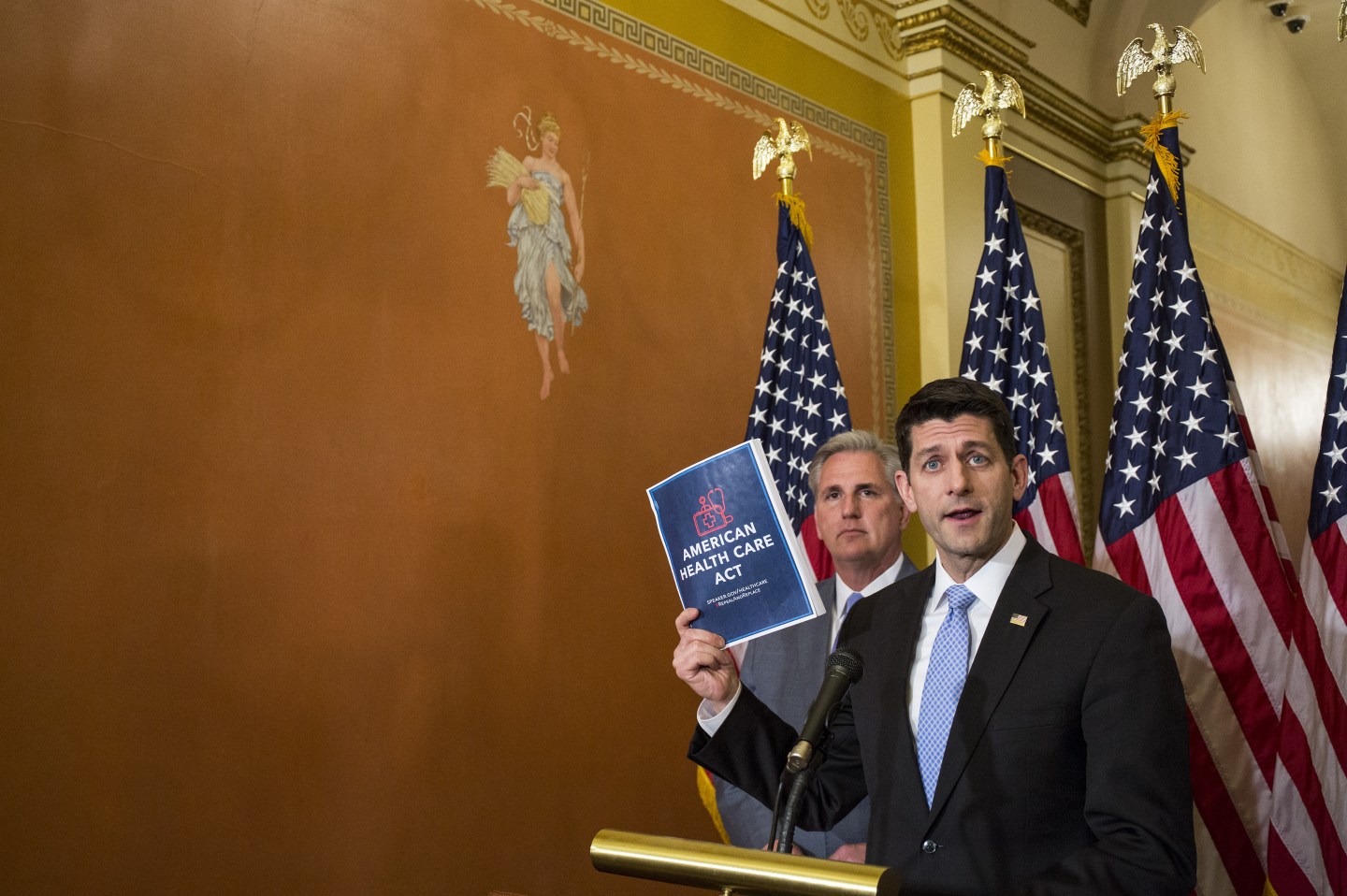
House Speaker Paul Ryan Holds News Conference On American Health Care Act
U.S. House Speaker Paul Ryan, a Republican from Wisconsin, center, holds up a copy of the American Health Care Act while speaking as House Majority Leader Kevin McCarthy, a Republican from California, left, listens during a news conference at the Capitol Building in Washington, D.C., U.S., on Tuesday, March 7, 2017. Ryan's new bill to replace Obamacare is being savaged by early bad reviews from a wide range of conservatives, with one Republican senator declaring it "dead on arrival" in the Senate -- if it can make it through the House. Photographer: Zach Gibson/Bloomberg via Getty ImagesPhotograph by Bloomberg via Getty Images

The most noteworthy thing about the House Republican leadership’s new American Health Care Act is that a lot of Republicans appear to be unhappy with it.

It leaves in place some of Obamacare’s most destructive provisions. For instance, the reform allows children to stay on their parents’ plans until 26, and requires private plans to cover certain essential benefits. But the bill also takes several steps toward creating a market-based health care system capable of expanding access to quality, affordable care.

Several parts of the American Health Care Act deserve applause. For instance, the bill would immediately end the individual mandate requiring Americans to purchase coverage or else pay a tax penalty of $695 or 2.5% of income—whichever is greater. It would also scrap the mandate requiring employers with 50 or more full-time workers to offer coverage.

By bolstering Health Savings Accounts, the measure would empower Americans to spend more of their health care dollars as they see fit. HSAs allow individuals to put aside money, tax-free, to cover out-of-pocket medical expenses. Starting next year, the act would increase the maximum individual HSA contribution from $3,400 to $6,550, and the top family contribution from $6,750 to $13,000.

The bill would also roll back Obamacare’s complex system of income-based insurance subsidies and replace them with more straightforward, age-based, refundable tax credits. An individual who does not get coverage through work or another public program would receive the credit once a month to help cover premiums for any health insurance policy he chooses—not just those available on Obamacare’s exchanges.

The new credits would increase by $500 for each decade of age—from $2,000 annually for Americans under 30, to $3,000 for those between 40 and 50, to $4,000 for those 60 and older. If a person selects a policy that costs less than his credit, he could deposit the remainder in an HSA.

The credits aren’t perfect. They’d decrease by $100 for every $1,000 of income above $75,000 for individuals and above $150,000 for families. Not only is this scheme overly complicated—it’ll require the IRS to verify people’s incomes in order to determine eligibility. That’s barely an improvement over the Obamacare status quo.

The GOP bill would help to drive down premiums and deductibles for the young by loosening its “community rating” rules. Obamacare prohibited insurers from charging older patients more than three times what they charged younger ones; the American Health Care Act would increase that ratio to 5:1.

In so doing, the bill would end an unfair arrangement that shifts insurance costs from older, sicker Americans to younger, healthier ones. Older Americans may see their premiums rise, but they’d also receive more generous tax credits than younger people. And by attracting more young people into the insurance pool, this reform would stabilize the adverse-selection “death spiral” plaguing Obamacare’s exchanges.

The act would further bring down premiums by repealing Obamacare’s many taxes, including its multibillion-dollar levies on health insurers, medical device manufacturers, and pharmaceuticals—which have been passed onto consumers for years.

However, the American Health Care Act is also a far cry from full-scale repeal and replacement of Obamacare. It would preserve many of Obamacare’s “essential health benefits,” like free coverage of preventive care and addiction treatment. Each of these mandates increases the cost of a policy. These mandates also undermine consumer choice; surely, some people would forego coverage of certain “essential” benefits in exchange for lower premiums.

The act also maintains the unlimited tax exclusion for employer-sponsored health plans. This tax break essentially subsidizes employer-based coverage by excluding the value of health benefits from employees’ taxable income.

Since those purchasing coverage in the individual market enjoy no such tax break, the policy has helped entrench a system in which coverage is tied to employment. And it’s contributed to the runaway growth of health costs. After all, a dollar of taxed wages is worth less than a dollar of untaxed health benefits. Americans have put those generous health benefits to use, driving up demand for health care and thus its price.

The GOP bill would also preserve Obamacare’s expansion of Medicaid to childless adults making up to 138% of the poverty level until the end of 2019. Thereafter, anyone who was in the program thanks to Obamacare’s expansion of eligibility could stay in.

The only saving grace for the bill’s treatment of Medicaid is that it begins to transform the program’s funding formula from an open-ended federal commitment into a “per capita allotment” system, wherein states receive a set amount of federal funding for each Medicaid enrollee.


This reform would put significant pressure on states to rein in Medicaid’s out-of-control costs—instead of rewarding them for spending increases, as the current system does. And it would give states the flexibility to manage their programs in order to meet the unique needs of their populations.

Unfortunately, that per-capita allotment will be based on the Obamacare era’s artificially high levels of Medicaid spending.

Since its release Monday evening, the bill has taken a beating—from Republicans. But the members of the GOP, moderates and conservatives alike, have to remember that a repeal-and-replace effort that devolves into infighting will just leave Obamacare in place.

The American Health Care Act is Republicans’ imperfect first crack at a replacement plan. It won’t be their last.

Sally C. Pipes is president, CEO, and Thomas W. Smith Fellow in Health Care Policy at the Pacific Research Institute. Her latest book is The Way Out of Obamacare (Encounter 2016).


About the Authors
By Sally C. Pipes
See full bioRight Arrow Button Icon
By Bethany Cianciolo
See full bioRight Arrow Button Icon

Latest in Commentary

Finance
Lorem ipsum dolor sit amet, consectetur adipiscing elit, sed do eiusmod tempor incididunt ut labore et dolore magna aliqua. Ut enim ad minim veniam
By Fortune Editors
October 20, 2025
Finance
Lorem ipsum dolor sit amet, consectetur adipiscing elit, sed do eiusmod tempor incididunt ut labore et dolore magna aliqua. Ut enim ad minim veniam
By Fortune Editors
October 20, 2025
Finance
Lorem ipsum dolor sit amet, consectetur adipiscing elit, sed do eiusmod tempor incididunt ut labore et dolore magna aliqua. Ut enim ad minim veniam
By Fortune Editors
October 20, 2025
Finance
Lorem ipsum dolor sit amet, consectetur adipiscing elit, sed do eiusmod tempor incididunt ut labore et dolore magna aliqua. Ut enim ad minim veniam
By Fortune Editors
October 20, 2025
Finance
Lorem ipsum dolor sit amet, consectetur adipiscing elit, sed do eiusmod tempor incididunt ut labore et dolore magna aliqua. Ut enim ad minim veniam
By Fortune Editors
October 20, 2025
Finance
Lorem ipsum dolor sit amet, consectetur adipiscing elit, sed do eiusmod tempor incididunt ut labore et dolore magna aliqua. Ut enim ad minim veniam
By Fortune Editors
October 20, 2025

Most Popular

Finance
Lorem ipsum dolor sit amet, consectetur adipiscing elit, sed do eiusmod tempor incididunt ut labore et dolore magna aliqua. Ut enim ad minim veniam
By Fortune Editors
October 20, 2025
Finance
Lorem ipsum dolor sit amet, consectetur adipiscing elit, sed do eiusmod tempor incididunt ut labore et dolore magna aliqua. Ut enim ad minim veniam
By Fortune Editors
October 20, 2025
Finance
Lorem ipsum dolor sit amet, consectetur adipiscing elit, sed do eiusmod tempor incididunt ut labore et dolore magna aliqua. Ut enim ad minim veniam
By Fortune Editors
October 20, 2025
Finance
Lorem ipsum dolor sit amet, consectetur adipiscing elit, sed do eiusmod tempor incididunt ut labore et dolore magna aliqua. Ut enim ad minim veniam
By Fortune Editors
October 20, 2025
Finance
Lorem ipsum dolor sit amet, consectetur adipiscing elit, sed do eiusmod tempor incididunt ut labore et dolore magna aliqua. Ut enim ad minim veniam
By Fortune Editors
October 20, 2025
Finance
Lorem ipsum dolor sit amet, consectetur adipiscing elit, sed do eiusmod tempor incididunt ut labore et dolore magna aliqua. Ut enim ad minim veniam
By Fortune Editors
October 20, 2025
Rankings
  • 100 Best Companies
  • Fortune 500
  • Global 500
  • Fortune 500 Europe
  • Most Powerful Women
  • Future 50
  • World’s Most Admired Companies
  • See All Rankings
Sections
  • Finance
  • Leadership
  • Success
  • Tech
  • Asia
  • Europe
  • Environment
  • Fortune Crypto
  • Health
  • Retail
  • Lifestyle
  • Politics
  • Newsletters
  • Magazine
  • Features
  • Commentary
  • Mpw
  • CEO Initiative
  • Conferences
  • Personal Finance
  • Education
Customer Support
  • Frequently Asked Questions
  • Customer Service Portal
  • Privacy Policy
  • Terms Of Use
  • Single Issues For Purchase
  • International Print
Commercial Services
  • Advertising
  • Fortune Brand Studio
  • Fortune Analytics
  • Fortune Conferences
  • Business Development
About Us
  • About Us
  • Editorial Calendar
  • Press Center
  • Work At Fortune
  • Diversity And Inclusion
  • Terms And Conditions
  • Site Map
  • Facebook icon
  • Twitter icon
  • LinkedIn icon
  • Instagram icon
  • Pinterest icon

Latest in Commentary

abhas
CommentaryCloud
I’m Cloudera’s chief strategy officer and here’s why your $1 billion AI budget just became obsolete
By Abhas RickyFebruary 10, 2026
11 minutes ago
chapman
CommentaryGender Issues
Sam Altman told me AI should be ‘an equalizing force in society.’ That’s why I’m working on the $1.6 trillion AI gender gap
By Valerie ChapmanFebruary 10, 2026
11 minutes ago
women
Commentarynational debt
America is shorting one of its best assets as the $38 trillion national debt runs out of control 
By Katica RoyFebruary 10, 2026
36 minutes ago
trump
CommentaryInequality
The economy isn’t K-shaped. For 87 million, people, it’s desperate and for another 46 million it’s elite
By Josh TanenbaumFebruary 10, 2026
1 hour ago
hudson
CommentaryPharmaceutical Industry
Sanofi CEO: The enterprise AI shift will reshape pharma in 2026
By Paul HudsonFebruary 10, 2026
2 hours ago
journalists
CommentaryMedia
I’m a war gamer for the Navy and I know why you don’t trust the media anymore. It’s fighting yesterday’s battles
By Charles Edward Gehrke and The ConversationFebruary 9, 2026
19 hours ago

Most Popular

placeholder alt text
C-Suite
Meet Jody Allen, the billionaire owner of the Seattle Seahawks, who plans to sell the team and donate the proceeds to charity
By Jake AngeloFebruary 9, 2026
19 hours ago
placeholder alt text
AI
As billionaires bail, Mark Zuckerberg doubles down on California with $50 million donation
By Sydney LakeFebruary 9, 2026
22 hours ago
placeholder alt text
Economy
China might be beginning to back away from U.S. debt as investors get nervous about overexposure to American assets
By Eleanor PringleFebruary 9, 2026
1 day ago
placeholder alt text
Economy
Elon Musk warns the U.S. is '1,000% going to go bankrupt' unless AI and robotics save the economy from crushing debt
By Jason MaFebruary 7, 2026
3 days ago
placeholder alt text
Commentary
America marks its 250th birthday with a fading dream—the first time that younger generations will make less than their parents
By Mark Robert Rank and The ConversationFebruary 8, 2026
2 days ago
placeholder alt text
Personal Finance
Current price of silver as of Monday, February 9, 2026
By Joseph HostetlerFebruary 9, 2026
1 day ago

© 2026 Fortune Media IP Limited. All Rights Reserved. Use of this site constitutes acceptance of our Terms of Use and Privacy Policy | CA Notice at Collection and Privacy Notice | Do Not Sell/Share My Personal Information
FORTUNE is a trademark of Fortune Media IP Limited, registered in the U.S. and other countries. FORTUNE may receive compensation for some links to products and services on this website. Offers may be subject to change without notice.