• Home
  • Latest
  • Fortune 500
  • Finance
  • Tech
  • Leadership
  • Lifestyle
  • Rankings
  • Multimedia
Retail

Giant Chickens Pose a Big Dilemma for the Agricultural Industry

By
Beth Kowitt
Beth Kowitt
Down Arrow Button Icon
By
Beth Kowitt
Beth Kowitt
Down Arrow Button Icon
January 12, 2017, 2:12 PM ET
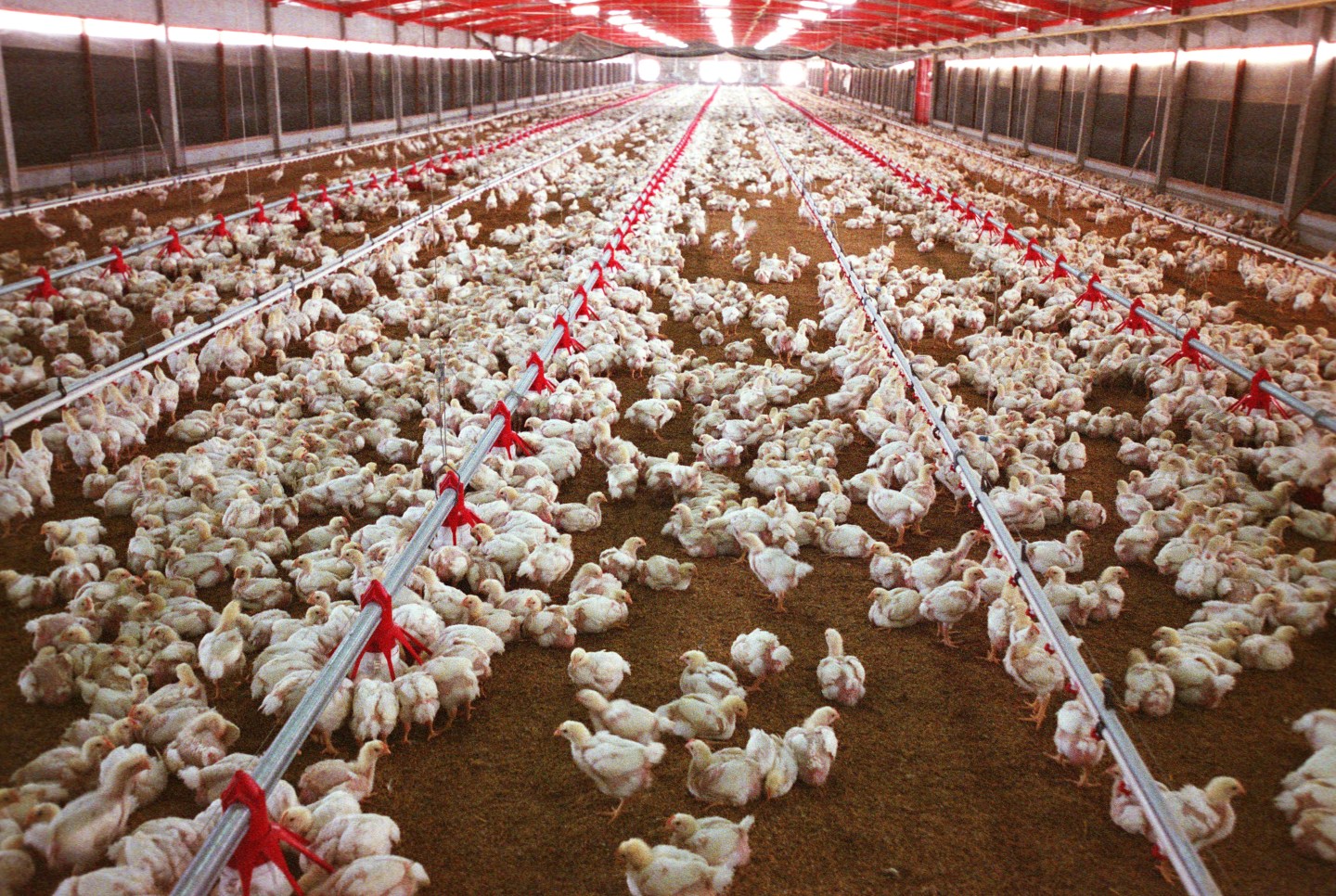
Chickens in various stages of breeding at a large broiler
CHONBURI PROVINCE, THAILAND - 2004/12/01: Chickens in various stages of breeding at a large broiler farm of the Chaveevan group, one of the largest integrated chicken farms in Thailand.. (Photo by Thierry Falise/LightRocket via Getty Images)Thierry Falise LightRocket via Getty Images

You may not have realized it, but you’ve been eating giant chickens.

The average broiler—meaning a chicken raised for meat rather than eggs—weighs about two and half times more today when it goes to market than it did in 1925. This is by no means a fluke. The poultry industry for years has been breeding its birds to get bigger faster, all while consuming less feed.

This narrative of efficiency fit very neatly into how consumers made their food choices over much of the last century when cost and abundance came above all else. That’s all changed, however, as a small but growing group of consumers has started to move animal welfare up on its list of food priorities.

The increased focus on welfare issues has made giant chickens—which the Humane Society of the U.S. says can suffer from leg disorders, weakened immune systems, and cardiovascular problems because of their size—a hot button issue. Companies like Whole Foods and major food service operators have responded in kind by committing to move to slower growing birds.

But now the National Chicken Council is pushing back, and it’s using another issue near and dear to the heart of the enlightened consumer in its defense: the environment.

A study released this week conducted by Eli Lilly’s Elanco Animal Health division at the request of the National Chicken Council found that if one-third of U.S. broilers switched to slower growing breeds, some 1.5 billion more chickens would be needed annually to produce the same level of meat. That would mean 33.5 billion pounds more feed, 7.6 million acres/year more land, 28.5 billion pounds of manure, and 5.1 billion additional gallons of water. The study estimated that this would come at an additional cost of $9 billion.

The move would have a “severe impact on reversing the progress” the industry has made in terms of improving the environmental footprint of chicken production, the group’s vice president of communications Tom Super told Fortune.

There are a few problems with the study that need to be flagged, including its backing by the poultry industry. It has not undergone academic peer review; the National Chicken Council did not release the study in full but rather an eight-page PowerPoint summarizing the data. I talked to the Humane Society of the U.S., which also called into question some of the assumptions the study made about mortality rates and density rates. The press release that came out with the study also contends that the “national broiler flock is as healthy as it has ever been.” However, mortality rates were actually at their lowest in 2012 and 2013. (“Mortality is only one indicator of overall health,” Super said in a follow up email.)

Josh Balk, vice president of farm animal protection at the Humane Society of the U.S., told Fortune that the meat production industry has long used the environmental impact argument to shield itself from allegations of animal welfare abuses—a strategy that he says “seems pretty disingenuous.”

“The industry is right—when you genetically program animals to the point where they can’t move, you use less resources,” he says.

But the fact that our animal welfare choices have consequences on the environment is real and unavoidable. And as I’ve found repeatedly in my reporting, these issues don’t always line up in the ways that we’d like. This came up for me most recently when reporting on McDonald’s decision to move to cage-free eggs.

Is it more humane for a bird to live in a cage or to experience liberty and die prematurely? And what is most humane is not always what is most productive—an especially relevant question as agriculture tries to feed a few more billion people by the middle of the century.

Of course, McDonald’s built its empire on a system of relentless efficiency. But “in the pursuit of efficiency we introduced a lot of animal welfare problems,” says David Fraser, a professor of animal welfare at the University of British Columbia. Today some of those practices are “looked at with a kind of horror.” Consumers may not quite articulate it, but they seem to yearn for a return to animal husbandry rather than animal science.

We as consumers always want it all: to taste good and be healthy, to be high quality and inexpensive, to be good for the environment and the animal. A lot of the time these things can be diametrically opposed, and grappling with that is not necessarily a bad thing. Doing so forces us to stop and face how incredibly complex and fragile our food systems are.


About the Author
By Beth Kowitt
LinkedIn iconTwitter icon
See full bioRight Arrow Button Icon

Latest in Retail

Finance
Lorem ipsum dolor sit amet, consectetur adipiscing elit, sed do eiusmod tempor incididunt ut labore et dolore magna aliqua. Ut enim ad minim veniam
By Fortune Editors
October 20, 2025
Finance
Lorem ipsum dolor sit amet, consectetur adipiscing elit, sed do eiusmod tempor incididunt ut labore et dolore magna aliqua. Ut enim ad minim veniam
By Fortune Editors
October 20, 2025
Finance
Lorem ipsum dolor sit amet, consectetur adipiscing elit, sed do eiusmod tempor incididunt ut labore et dolore magna aliqua. Ut enim ad minim veniam
By Fortune Editors
October 20, 2025
Finance
Lorem ipsum dolor sit amet, consectetur adipiscing elit, sed do eiusmod tempor incididunt ut labore et dolore magna aliqua. Ut enim ad minim veniam
By Fortune Editors
October 20, 2025
Finance
Lorem ipsum dolor sit amet, consectetur adipiscing elit, sed do eiusmod tempor incididunt ut labore et dolore magna aliqua. Ut enim ad minim veniam
By Fortune Editors
October 20, 2025
Finance
Lorem ipsum dolor sit amet, consectetur adipiscing elit, sed do eiusmod tempor incididunt ut labore et dolore magna aliqua. Ut enim ad minim veniam
By Fortune Editors
October 20, 2025

Most Popular

Finance
Lorem ipsum dolor sit amet, consectetur adipiscing elit, sed do eiusmod tempor incididunt ut labore et dolore magna aliqua. Ut enim ad minim veniam
By Fortune Editors
October 20, 2025
Finance
Lorem ipsum dolor sit amet, consectetur adipiscing elit, sed do eiusmod tempor incididunt ut labore et dolore magna aliqua. Ut enim ad minim veniam
By Fortune Editors
October 20, 2025
Finance
Lorem ipsum dolor sit amet, consectetur adipiscing elit, sed do eiusmod tempor incididunt ut labore et dolore magna aliqua. Ut enim ad minim veniam
By Fortune Editors
October 20, 2025
Finance
Lorem ipsum dolor sit amet, consectetur adipiscing elit, sed do eiusmod tempor incididunt ut labore et dolore magna aliqua. Ut enim ad minim veniam
By Fortune Editors
October 20, 2025
Finance
Lorem ipsum dolor sit amet, consectetur adipiscing elit, sed do eiusmod tempor incididunt ut labore et dolore magna aliqua. Ut enim ad minim veniam
By Fortune Editors
October 20, 2025
Finance
Lorem ipsum dolor sit amet, consectetur adipiscing elit, sed do eiusmod tempor incididunt ut labore et dolore magna aliqua. Ut enim ad minim veniam
By Fortune Editors
October 20, 2025
Fortune Secondary Logo
Rankings
  • 100 Best Companies
  • Fortune 500
  • Global 500
  • Fortune 500 Europe
  • Most Powerful Women
  • Future 50
  • World’s Most Admired Companies
  • See All Rankings
Sections
  • Finance
  • Fortune Crypto
  • Features
  • Leadership
  • Health
  • Commentary
  • Success
  • Retail
  • Mpw
  • Tech
  • Lifestyle
  • CEO Initiative
  • Asia
  • Politics
  • Conferences
  • Europe
  • Newsletters
  • Personal Finance
  • Environment
  • Magazine
  • Education
Customer Support
  • Frequently Asked Questions
  • Customer Service Portal
  • Privacy Policy
  • Terms Of Use
  • Single Issues For Purchase
  • International Print
Commercial Services
  • Advertising
  • Fortune Brand Studio
  • Fortune Analytics
  • Fortune Conferences
  • Business Development
  • Group Subscriptions
About Us
  • About Us
  • Editorial Calendar
  • Press Center
  • Work At Fortune
  • Diversity And Inclusion
  • Terms And Conditions
  • Site Map
Fortune Secondary Logo
  • About Us
  • Editorial Calendar
  • Press Center
  • Work At Fortune
  • Diversity And Inclusion
  • Terms And Conditions
  • Site Map
  • Facebook icon
  • Twitter icon
  • LinkedIn icon
  • Instagram icon
  • Pinterest icon

Latest in Retail

target
RetailRetail
Target sales, profits decline for another quarter, but shares rise on solid outlook
By Anne D'Innocenzio and The Associated PressMarch 3, 2026
17 hours ago
HealthFood and drink
Chains like Sweetgreen and Chipotle are finally realizing they need to look beyond the ‘slop bowl’
By Phil WahbaFebruary 27, 2026
5 days ago
burger king
AIOpenAI
Burger King tests OpenAI-powered headsets that will track the friendliness of drive-through workers
By Dee-Ann Durbin and The Associated PressFebruary 27, 2026
5 days ago
Two restaurant workers wearing black stand in front of a silver "Flippy" fry station.
AIAutomation
Meet your new robot fry cooks: Inside the $28 billion race to disrupt White Castle and Jack in the Box
By Sasha RogelbergFebruary 26, 2026
6 days ago
Customers in the electronics section at Walmart on Black Friday in Columbus, Ohio, US, on Friday, Nov. 28, 2025. Americans are planning to spend more this holiday season than last year, according to credit reporting firm TransUnion. Photographer: Brian Kaiser/Bloomberg via Getty Images
C-SuiteLeadership
McKinsey studied 61 growth companies that outperformed their peers through COVID, inflation, and labor shocks. Here’s what they all had in common
By Geoff ColvinFebruary 26, 2026
6 days ago
The Home Depot storefront
InvestingHome Depot
Home Depot CEO says with the housing market stalemate, ‘our customers are telling us that they’re not investing’
By Jacqueline MunisFebruary 25, 2026
7 days ago

Most Popular

placeholder alt text
Economy
Interest on the $38.8 trillion national debt has tripled since 2020, and it already costs taxpayers more than defense and Medicaid
By Nick LichtenbergMarch 2, 2026
1 day ago
placeholder alt text
Middle East
Iran’s Islamic Revolutionary Guard controls a sprawling business empire that dominates the economy
By Jason MaMarch 2, 2026
2 days ago
placeholder alt text
Personal Finance
Current price of silver as of Tuesday, March 3, 2026
By Joseph HostetlerMarch 3, 2026
18 hours ago
placeholder alt text
Personal Finance
Current price of gold as of March 2, 2026
By Danny BakstMarch 2, 2026
2 days ago
placeholder alt text
Middle East
U.S. military gives Iran a taste of its own medicine with cheap copycat Shahed drones, while concern shifts to munitions supply in extended conflict
By Jason MaMarch 1, 2026
2 days ago
placeholder alt text
AI
American schools weren’t broken until Silicon Valley used a lie to convince them they were—now reading and math scores are plummeting
By Sasha RogelbergMarch 1, 2026
2 days ago

© 2026 Fortune Media IP Limited. All Rights Reserved. Use of this site constitutes acceptance of our Terms of Use and Privacy Policy | CA Notice at Collection and Privacy Notice | Do Not Sell/Share My Personal Information
FORTUNE is a trademark of Fortune Media IP Limited, registered in the U.S. and other countries. FORTUNE may receive compensation for some links to products and services on this website. Offers may be subject to change without notice.