• Home
  • News
  • Fortune 500
  • Tech
  • Finance
  • Leadership
  • Lifestyle
  • Rankings
  • Multimedia
TechThe Mobile Executive

Here’s How Intel Is Finally Getting Back on Track With Moore’s Law

By
Aaron Pressman
Aaron Pressman
Down Arrow Button Icon
By
Aaron Pressman
Aaron Pressman
Down Arrow Button Icon
January 5, 2017, 12:34 PM ET
Inside The 2017 Consumer Electronics Show
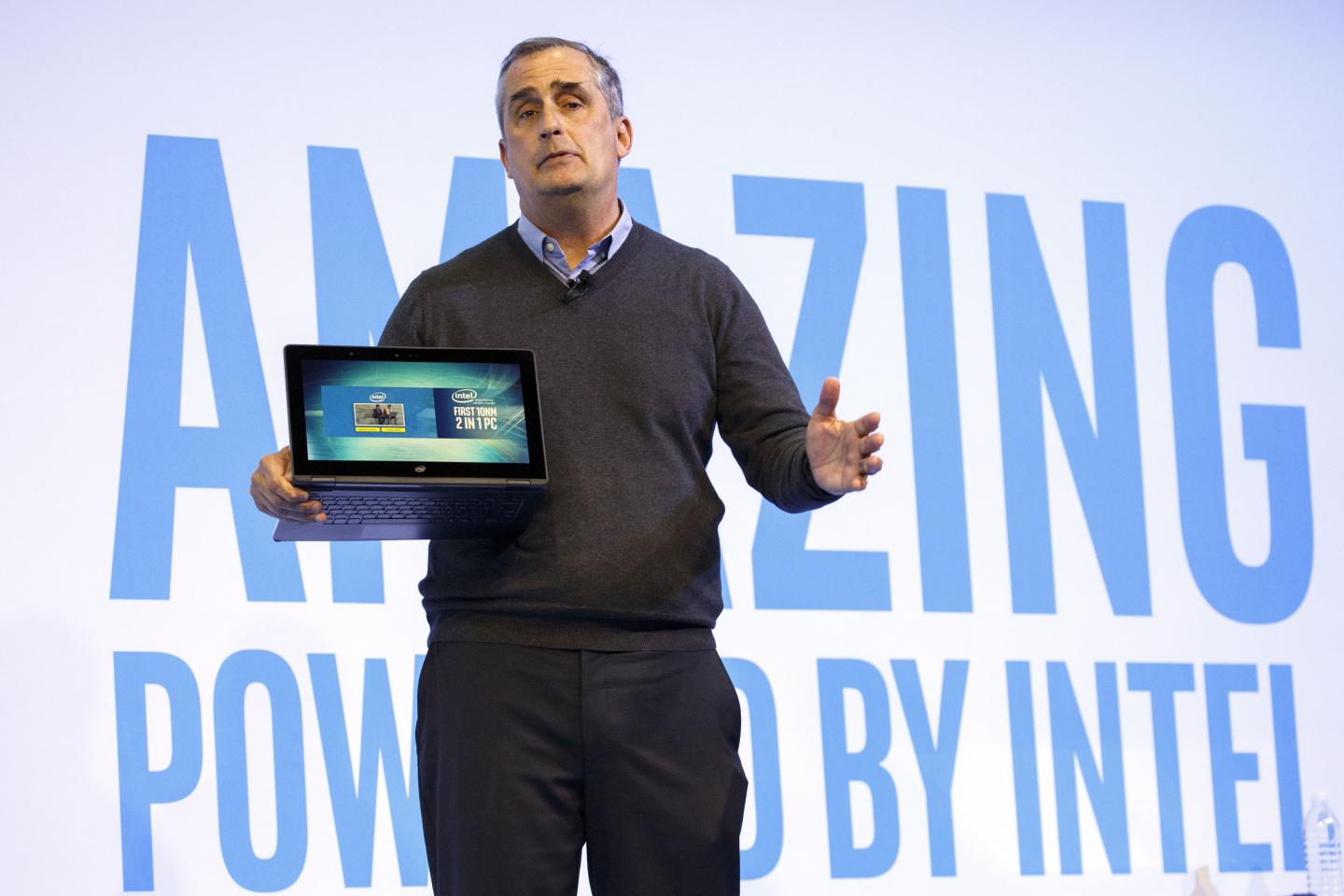
Brian Krzanich, chief executive officer of Intel Corp., speaks during the company's press event at the 2017 Consumer Electronics Show (CES) in Las Vegas, Nevada, U.S., on Wednesday, Jan. 4, 2017. Intel, trying to convert its dominance of computers into a stake in the growing market for chips used in cars, is offering automakers new products aimed at making its technology crucial to the effort to develop self-driving vehicles. Photographer: Patrick T. Fallon/Bloomberg via Getty Images Photo credit: Bloomberg via Getty Images

Intel CEO Brian Krzanich mostly came to Las Vegas to show off a bunch of new virtual and augmented reality apps at CES. But he couldn’t help starting off with a dig at Intel’s–and the semiconductor industry’s–biggest doubters.

Standing in front of hundreds of reporters and analysts, Krzanich brought out an Intel-branded, thin laptop computer. There was nothing special about the laptop’s design. It was what was on the inside that mattered: Intel’s long-delayed Cannonlake chipset that is etched at a scale of just 10 nanometers, down from 14 nanometers used for currently available chips.

It was the first public display of a device running Cannonlake chips and Krzanich was every inch the proud papa.

“I could show a bunch of foils. I could show a bunch of benchmarks and other kinds of devices,” the CEO explained, as the laptop briefly played a video of an Intel TV commercial before being whisked off stage. “But I thought best to just bring (a) 10 nanometer Canonlake product on stage and let you see it live.”

Get Data Sheet, Fortune’s technology newsletter.

Confirming rumors at the end of last year, Krzanich said Intel plans to ship Cannonlake chips by the end of 2017. Investors hope the new chips arrive sooner rather than later. Intel’s share price has gained under 8% over the past year, trailing the 12% gain in the S&P 500 Index. Smaller competitor Nvidia’s stock tripled over the past year while shares in Advanced Micro Devices quadrupled.

Moore’s Law, coined by Intel co-founder Gordon Moore, says that faster chips can be developed at the same cost as older chips by shrinking the size of circuitry every two years or less. Chips manufactured at smaller scale pack more individual transistors into the same space as larger scale chips, which can increase performance and energy efficiency while reducing costs.

Until a few years ago, Intel was able to reduce the scale of its chip designs every two years. But that cycle has been lengthening. Between the introduction of 65 nm and 45 nm chips, about 23 months passed. To get from 45 nm to 32 nm took about 27 months, 28 months to go down from there to 22 nm and 30 months to shrink to the current 14 nm process. And that’s where Intel has been stuck since September 2014.

For more on Intel’s strategy, watch:

The physics of squeezing more transistors in the same space have gotten more challenging, requiring more and more expensive equipment and causing more delays. That’s not the same as Moore’s Law ending, Krzanich pointed out. And the need for expensive equipment favors Intel and other large players that can fund the huge new factories.

“I’ve heard the death of Moore’s law more times than anything else in my career,” Krzanich said. “And I’m here today to really show you and tell you that Moore’s Law is alive and well and flourishing.”

The very latest chips Intel offered this week—part of the high end of its Kaby Lake line—remain stuck at 14 nm and barely outperformed comparable processors in the prior Skylake line.

But help is on the horizon—even if Krzanich wasn’t giving away any benchmark results yet. “We’re really excited about the performance” was all he revealed.

About the Author
By Aaron Pressman
See full bioRight Arrow Button Icon

Latest in Tech

Big TechSpotify
Spotify users lamented Wrapped in 2024. This year, the company brought back an old favorite and made it less about AI
By Dave Lozo and Morning BrewDecember 4, 2025
6 hours ago
InnovationVenture Capital
This Khosla Ventures–backed startup is using AI to personalize cancer care
By Allie GarfinkleDecember 4, 2025
10 hours ago
AIEye on AI
Companies are increasingly falling victim to AI impersonation scams. This startup just raised $28M to stop deepfakes in real time
By Sharon GoldmanDecember 4, 2025
10 hours ago
Jensen Huang
SuccessBillionaires
Nvidia CEO Jensen Huang admits he works 7 days a week, including holidays, in a constant ‘state of anxiety’ out of fear of going bankrupt
By Jessica CoacciDecember 4, 2025
10 hours ago
Ted Pick
BankingData centers
Morgan Stanley considers offloading some of its data-center exposure
By Esteban Duarte, Paula Seligson, Davide Scigliuzzo and BloombergDecember 4, 2025
10 hours ago
Zuckerberg
EnergyMeta
Meta’s Zuckerberg plans deep cuts for metaverse efforts
By Kurt Wagner and BloombergDecember 4, 2025
11 hours ago

Most Popular

placeholder alt text
Economy
Two months into the new fiscal year and the U.S. government is already spending more than $10 billion a week servicing national debt
By Eleanor PringleDecember 4, 2025
15 hours ago
placeholder alt text
Success
‘Godfather of AI’ says Bill Gates and Elon Musk are right about the future of work—but he predicts mass unemployment is on its way
By Preston ForeDecember 4, 2025
11 hours ago
placeholder alt text
North America
Jeff Bezos and Lauren Sánchez Bezos commit $102.5 million to organizations combating homelessness across the U.S.: ‘This is just the beginning’
By Sydney LakeDecember 2, 2025
2 days ago
placeholder alt text
Success
Nearly 4 million new manufacturing jobs are coming to America as boomers retire—but it's the one trade job Gen Z doesn't want
By Emma BurleighDecember 4, 2025
11 hours ago
placeholder alt text
Health
Bill Gates decries ‘significant reversal in child deaths’ as nearly 5 million kids will die before they turn 5 this year
By Nick LichtenbergDecember 4, 2025
22 hours ago
placeholder alt text
Success
Nvidia CEO Jensen Huang admits he works 7 days a week, including holidays, in a constant 'state of anxiety' out of fear of going bankrupt
By Jessica CoacciDecember 4, 2025
10 hours ago
Rankings
  • 100 Best Companies
  • Fortune 500
  • Global 500
  • Fortune 500 Europe
  • Most Powerful Women
  • Future 50
  • World’s Most Admired Companies
  • See All Rankings
Sections
  • Finance
  • Leadership
  • Success
  • Tech
  • Asia
  • Europe
  • Environment
  • Fortune Crypto
  • Health
  • Retail
  • Lifestyle
  • Politics
  • Newsletters
  • Magazine
  • Features
  • Commentary
  • Mpw
  • CEO Initiative
  • Conferences
  • Personal Finance
  • Education
Customer Support
  • Frequently Asked Questions
  • Customer Service Portal
  • Privacy Policy
  • Terms Of Use
  • Single Issues For Purchase
  • International Print
Commercial Services
  • Advertising
  • Fortune Brand Studio
  • Fortune Analytics
  • Fortune Conferences
  • Business Development
About Us
  • About Us
  • Editorial Calendar
  • Press Center
  • Work At Fortune
  • Diversity And Inclusion
  • Terms And Conditions
  • Site Map

© 2025 Fortune Media IP Limited. All Rights Reserved. Use of this site constitutes acceptance of our Terms of Use and Privacy Policy | CA Notice at Collection and Privacy Notice | Do Not Sell/Share My Personal Information
FORTUNE is a trademark of Fortune Media IP Limited, registered in the U.S. and other countries. FORTUNE may receive compensation for some links to products and services on this website. Offers may be subject to change without notice.