• Home
  • Latest
  • Fortune 500
  • Finance
  • Tech
  • Leadership
  • Lifestyle
  • Rankings
  • Multimedia
Commentary

Why Conservatives Should Fear a Trump Federal Reserve

By
Peter Conti-Brown
Peter Conti-Brown
and
Bethany Cianciolo
Bethany Cianciolo
Down Arrow Button Icon
By
Peter Conti-Brown
Peter Conti-Brown
and
Bethany Cianciolo
Bethany Cianciolo
Down Arrow Button Icon
October 6, 2016, 1:13 PM ET
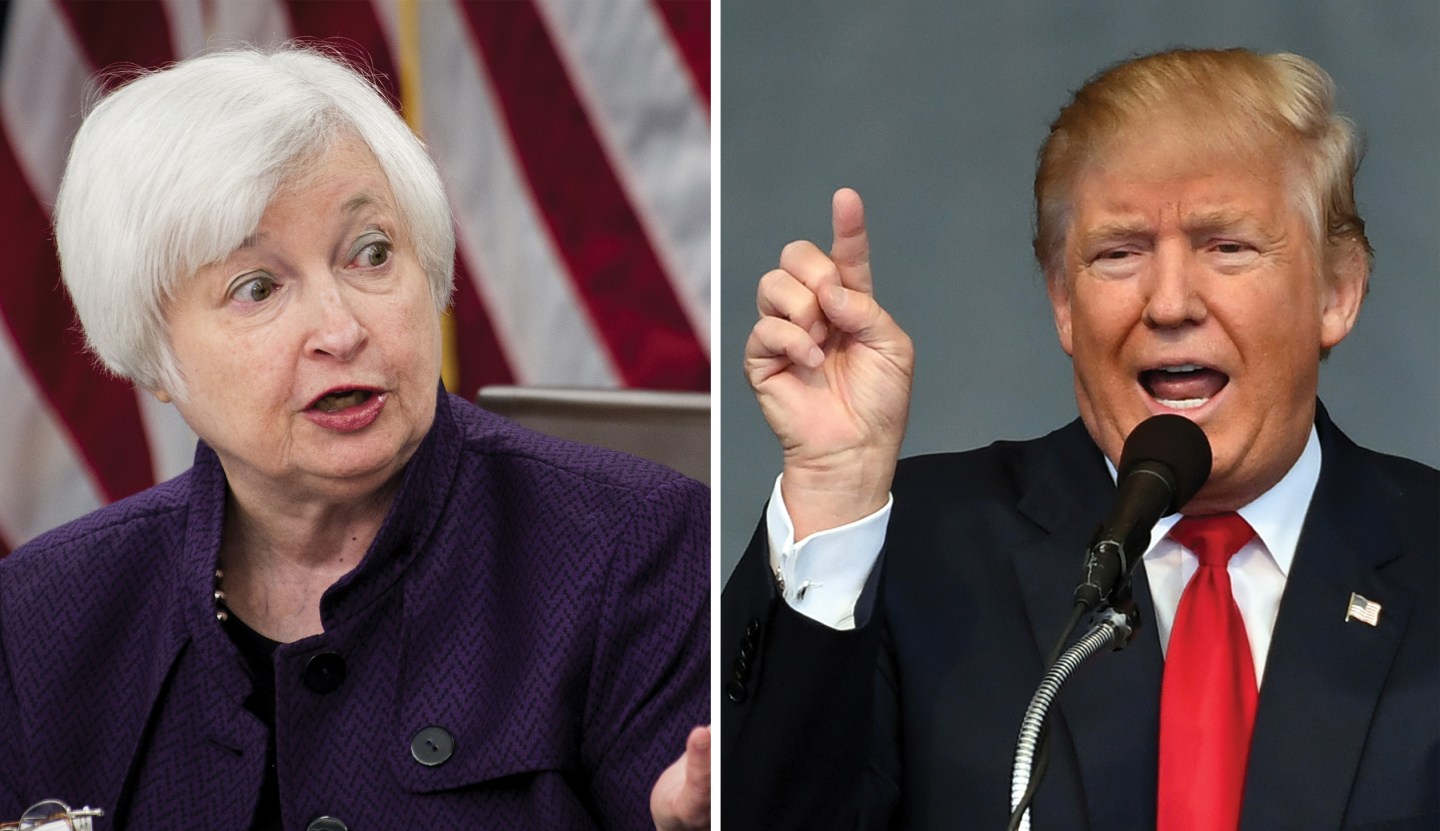
Photos by Pete Marovich/Bloomberg & Ethan Miller—Getty Images

Something happened during the first presidential debate that is new in the modern era. Donald Trump insisted, citing no evidence, that the Federal Reserve is one of the most partisan institutions in Washington, “more political than Secretary Clinton.” Some applauded this assault on the Fed, whose monetary policies after the financial crisis have kept interest rates at or near zero. These critics join Trump in viewing the Fed as an assault on the U.S. dollar, inviting an inflationary tsunami that is just around the corner. But for those voters who dread inflation, it is Trump who should keep them up at night, not Fed Chair Janet Yellen.

The problem is, as former Fed chairman Paul Volcker long ago noted, that when it comes to controlling inflation, the Fed quickly becomes the “only game in town.” The U.S. promotes the value of an independent central bank for precisely this reason: Independence gives the Fed some space from the day-to-day of the partisan political process so that it can pursue rigorous, if sometimes controversial, decisions.

Some like to think of Fed independence in excessively legalistic terms—that because the Federal Reserve Act takes the Fed off of the appropriations process, for example, it thereby has all of the independence it should ever need.

This legalistic conception of Fed independence is pure fantasy. Any president has the resources and power to significantly influence Fed decision-making, for better and worse. Democratic accountability demands some of this political control, most noticeably through the political appointment of the Fed’s senior leadership. But presidents can use and abuse the Fed in other ways, too. Richard Nixon’s dominance of his Fed chair, Arthur Burns, is a perfect example. Anyone listening to the Nixon tapes or reading Burns’ diary sees just how closely the two worked together in the political interests of Nixon.

To say that we should value the Fed’s separation from partisan politics isn’t to say that the Fed should become a power unto itself. A president need not bow at the altar of Fed supremacy to protect the tradition of an accountable Fed, independent of electoral concerns. The Fed remains a political institution embedded within a political system. It will face uncertainty in ways that will cause even the experts to split. When they do, it’s appropriate, even patriotic, for politicians—and the public—to question the substance of Fed decision-making.

This patriotic critique is not what Trump is about. His critique isn’t about interest rates or unemployment or asset bubbles. It isn’t really about the economy at all. It’s about power. And once Trump has it, no one should be surprised that he will guard it jealously and continue to undermine those who would share it. We have seen this story before. By accusing the Fed of playing partisan politics, Trump is wagging the dog: the economy’s performance—whether in regards to inflation, consumer confidence, unemployment, middle-income growth, or manufacturing—isn’t consistent with Trump’s preferred narrative that the country is in the grips of an economic devastation “[he] alone can fix.” His is a solution looking for a problem, and so he seeks to change the problem: a public institution responsible for the inconvenient narrative that must be delegitimized.

Trump has used this strategy throughout his campaign. He did it with the federal judiciary, attacking a judge as a biased “Mexican” when the judge ruled against him (the judge is from Indiana). He did it with the U.S. presidency, breathing life into the cartoonish attacks on President Obama’s country of birth when he disagreed with the president’s policy decisions. He did it with governmental statistics, insisting they can’t be trusted when they don’t tell the story consistent with his narrative. And he did it with the military, the media, and even the presidential election process itself. If these institutions can’t produce results that feed Trump’s narrative, then the public trust on which they rely must be destroyed.

Everything about Trump’s style of personality-driven power telegraphs how differently he would approach the question of monetary stability. Given the persistently low levels of inflation, it’s hard to imagine a hyperinflationary future just around the corner. But make no mistake: Come the midterms of 2018, or reelection in 2020, the institutional bulwark against that inflation that the Fed represents will be reduced to rubble.

In this sense, Trump is nothing like his predecessors of the past 40 years—on both sides of the aisle. Jimmy Carter appointed Volcker, who was anti-inflation, at a most inopportune time for Carter’s reelection prospects. Ronald Reagan, Carter’s biggest critic, repeatedly sought to preserve the Fed’s institutional autonomy even though it cost him politically (just see the consequences of the Fed’s monetary policies for President Reagan’s first midterm election). George H.W. Bush, Bill Clinton, George W. Bush, and Obama, even when they disagreed with the Fed—and each one did at various points—they recognized the importance of keeping the Fed an island of nonpartisan expertise.

Trump is the single-biggest challenge to that tradition in recent memory. We cannot claim this wolf comes in sheep’s clothing. To invoke Justice Antonin Scalia‘s ominous warning, this wolf comes as a wolf. The independence of the central bank to set a monetary course separate from the day-to-day of electoral politics is as fragile as it is essential. Any president set on consolidating power away from the Fed and toward the presidency has significant resources to accomplish that goal. What Trump would unleash is bigger than Nixon. At least Nixon’s efforts were behind the scenes, leaving an institutional framework in place that could recover after his departure. Trump’s political assault on the Fed is transparent. If he succeeds, it could be years before the Fed recovers, if it recovers at all.

Peter Conti-Brown, a legal scholar and a financial historian, is an assistant professor at The Wharton School of the University of Pennsylvania. Conti-Brown is the author of The Power and Independence of the Federal Reserve and is currently writing a comprehensive history of the Fed, forthcoming from Harvard University Press.

About the Authors
By Peter Conti-Brown
See full bioRight Arrow Button Icon
By Bethany Cianciolo
See full bioRight Arrow Button Icon

Latest in Commentary

Finance
Lorem ipsum dolor sit amet, consectetur adipiscing elit, sed do eiusmod tempor incididunt ut labore et dolore magna aliqua. Ut enim ad minim veniam
By Fortune Editors
October 20, 2025
Finance
Lorem ipsum dolor sit amet, consectetur adipiscing elit, sed do eiusmod tempor incididunt ut labore et dolore magna aliqua. Ut enim ad minim veniam
By Fortune Editors
October 20, 2025
Finance
Lorem ipsum dolor sit amet, consectetur adipiscing elit, sed do eiusmod tempor incididunt ut labore et dolore magna aliqua. Ut enim ad minim veniam
By Fortune Editors
October 20, 2025
Finance
Lorem ipsum dolor sit amet, consectetur adipiscing elit, sed do eiusmod tempor incididunt ut labore et dolore magna aliqua. Ut enim ad minim veniam
By Fortune Editors
October 20, 2025
Finance
Lorem ipsum dolor sit amet, consectetur adipiscing elit, sed do eiusmod tempor incididunt ut labore et dolore magna aliqua. Ut enim ad minim veniam
By Fortune Editors
October 20, 2025
Finance
Lorem ipsum dolor sit amet, consectetur adipiscing elit, sed do eiusmod tempor incididunt ut labore et dolore magna aliqua. Ut enim ad minim veniam
By Fortune Editors
October 20, 2025

Most Popular

Finance
Lorem ipsum dolor sit amet, consectetur adipiscing elit, sed do eiusmod tempor incididunt ut labore et dolore magna aliqua. Ut enim ad minim veniam
By Fortune Editors
October 20, 2025
Finance
Lorem ipsum dolor sit amet, consectetur adipiscing elit, sed do eiusmod tempor incididunt ut labore et dolore magna aliqua. Ut enim ad minim veniam
By Fortune Editors
October 20, 2025
Finance
Lorem ipsum dolor sit amet, consectetur adipiscing elit, sed do eiusmod tempor incididunt ut labore et dolore magna aliqua. Ut enim ad minim veniam
By Fortune Editors
October 20, 2025
Finance
Lorem ipsum dolor sit amet, consectetur adipiscing elit, sed do eiusmod tempor incididunt ut labore et dolore magna aliqua. Ut enim ad minim veniam
By Fortune Editors
October 20, 2025
Finance
Lorem ipsum dolor sit amet, consectetur adipiscing elit, sed do eiusmod tempor incididunt ut labore et dolore magna aliqua. Ut enim ad minim veniam
By Fortune Editors
October 20, 2025
Finance
Lorem ipsum dolor sit amet, consectetur adipiscing elit, sed do eiusmod tempor incididunt ut labore et dolore magna aliqua. Ut enim ad minim veniam
By Fortune Editors
October 20, 2025
Rankings
  • 100 Best Companies
  • Fortune 500
  • Global 500
  • Fortune 500 Europe
  • Most Powerful Women
  • Future 50
  • World’s Most Admired Companies
  • See All Rankings
Sections
  • Finance
  • Leadership
  • Success
  • Tech
  • Asia
  • Europe
  • Environment
  • Fortune Crypto
  • Health
  • Retail
  • Lifestyle
  • Politics
  • Newsletters
  • Magazine
  • Features
  • Commentary
  • Mpw
  • CEO Initiative
  • Conferences
  • Personal Finance
  • Education
Customer Support
  • Frequently Asked Questions
  • Customer Service Portal
  • Privacy Policy
  • Terms Of Use
  • Single Issues For Purchase
  • International Print
Commercial Services
  • Advertising
  • Fortune Brand Studio
  • Fortune Analytics
  • Fortune Conferences
  • Business Development
About Us
  • About Us
  • Editorial Calendar
  • Press Center
  • Work At Fortune
  • Diversity And Inclusion
  • Terms And Conditions
  • Site Map
  • Facebook icon
  • Twitter icon
  • LinkedIn icon
  • Instagram icon
  • Pinterest icon

Latest in Commentary

TrumpRx
CommentaryPharmaceutical Industry
TrumpRx is here and it helps, though a bit less than advertised
By Jeffrey Sonnenfeld, Stephen Henriques, Ferron Chen, Asuka Koda and Vanessa McLennanFebruary 11, 2026
4 hours ago
saunders
CommentaryLeadership
Bausch + Lomb CEO: Standing still is the new falling behind
By Brent SaundersFebruary 11, 2026
11 hours ago
shumer
CommentaryEntrepreneurship
Something big is happening in AI — and most people will be blindsided
By Matt ShumerFebruary 11, 2026
11 hours ago
profusek
CommentaryCorporate Governance
It isn’t partisan politics to admit that stakeholder capitalism went too far, too fast 
By Robert ProfusekFebruary 11, 2026
12 hours ago
CommentaryE-commerce
Agentic commerce will reward the fastest learners, not the biggest retailers
By Simon JamesFebruary 10, 2026
1 day ago
abhas
CommentaryCloud
I’m Cloudera’s chief strategy officer and here’s why your $1 billion AI budget just became obsolete
By Abhas RickyFebruary 10, 2026
1 day ago

Most Popular

placeholder alt text
Economy
America borrowed $43.5 billion a week in the first four months of the fiscal year, with debt interest on track to be over $1 trillion for 2026
By Eleanor PringleFebruary 10, 2026
2 days ago
placeholder alt text
Economy
It turns out that Joe Biden really did crush Americans' dreams for the future. Just look at how the vibe changed 5 years ago
By Jake AngeloFebruary 10, 2026
1 day ago
placeholder alt text
C-Suite
Meet Jody Allen, the billionaire owner of the Seattle Seahawks, who plans to sell the team and donate the proceeds to charity
By Jake AngeloFebruary 9, 2026
2 days ago
placeholder alt text
Commentary
Something big is happening in AI — and most people will be blindsided
By Matt ShumerFebruary 11, 2026
11 hours ago
placeholder alt text
AI
As billionaires bail, Mark Zuckerberg doubles down on California with $50 million donation
By Sydney LakeFebruary 9, 2026
2 days ago
placeholder alt text
Economy
China might be beginning to back away from U.S. debt as investors get nervous about overexposure to American assets
By Eleanor PringleFebruary 9, 2026
3 days ago

© 2026 Fortune Media IP Limited. All Rights Reserved. Use of this site constitutes acceptance of our Terms of Use and Privacy Policy | CA Notice at Collection and Privacy Notice | Do Not Sell/Share My Personal Information
FORTUNE is a trademark of Fortune Media IP Limited, registered in the U.S. and other countries. FORTUNE may receive compensation for some links to products and services on this website. Offers may be subject to change without notice.