One night a month, retired auto workers shuffle into a former elementary school classroom here to discuss their legal fight against the company that canceled their health care benefits seven years ago.
But the conversation often turns quickly to presidential politics.
“It can get pretty heated,” says Gerald Poor, the group’s 77-year-old president, of their political discussions. “I call it to order if it gets out of hand.”
Their anger is understandable. The group is a remnant of a once-powerful United Auto Workers union local, which at its peak in the 1960s represented over 5,000 workers who made transmissions in Muncie for BorgWarner (BWA), the global auto parts maker. An American flag drapes the wall at one end of the room, portraits of former labor bosses line the other, salvaged from a union hall that had its own baseball field.
For this group of mostly white, working-class men, the last two decades have brought much loss. In this election—with the victory of the populist Donald Trump as the Republican Party nominee and the strong run by the populist Bernie Sanders for the Democratic Party crown—many say they feel they’re finally being heard again.
Working-class white men were once a force to be reckoned with in American politics. Many here speak wistfully of how John F. Kennedy stopped at BorgWarner to talk to workers when he campaigned in 1960. For these men, this year’s election is a rare taste of the clout they once took for granted.
In the primary, Trump received the most votes of any candidate in either party in Delaware County, which encompasses Muncie. Just over 52% of Republican voters went for Trump. Democrats picked Sanders over Hillary Clinton by an even wider margin.
“Candidates in the past made a lot of promises to the working class in this country and failed to follow through with it,” says 66-year-old Bruce Reynolds, who followed his father and grandfather into a career at BorgWarner.
Gazing through the rusted chain link fence that encircles the sprawling, abandoned factory, where he notes with precision that he worked for “32 and a half years,” he says he’s still skeptical of both side’s promises.
The White Slide
Neither Trump nor Clinton was his first choice. Reynolds and his wife voted for Sanders in the primary, he says. Among other things, they couldn’t support Clinton: She’s the wife of former President Bill Clinton, who signed the North American Free Trade Agreement, which many here blame for Muncie’s economic decline. They were uneasy with the often fiery rhetoric of Trump, the other side’s top candidate.
Yet both plan to vote for Trump in November, and Reynolds says they’ve grown comfortable with the choice.
“I know, it sounds like we’re confused,” he says. But they’re not.
Like many Trump supporters, he glides over the unappealing aspects of the candidate’s message to lock onto those that he likes. For Reynolds, it’s the hope of bringing back jobs for his children, some of whom still struggle to find decent work.
Trump’s gloomy world view is often dismissed as hyperbole, such as when he described crime and collapsed economies in America’s cities at the Republican National Convention. But for someone in Muncie, that’s not far off reality.
An analysis by Reuters found Delaware County is an extreme example of the declining fortunes of America’s white working-class men.
In 2000, white men with less than a college degree accounted for about three-quarters of all white men living in the county. By 2014, their proportion had dropped by about 5 percentage points, according to the U.S. Census Bureau. But while this group’s share of the population held relatively steady, the earnings of white men with full-time jobs had fallen dramatically.
In 2000, 47% of white men working full-time were in the bottom third of earners, with incomes of $50,000 or less, based on 2015 dollars. By 2014, 60% of them were in the bottom third.
Meanwhile, the percentage of white men in full-time jobs making between $50,000 and $100,000 dropped from 43% to 32%. And the percentage in the ranks of earners above $100,000 slipped from 11% to 8%.
In essence, white men in Muncie have slid down from every rung of the economic ladder. They have clustered at the bottom, poorer and more isolated than ever before, even as the overall U.S. economy has grown and globalized.
Muncie as “Middletown”
The same trend is visible in faded industrial pockets from New Jersey and upstate New York to Alabama and Kentucky.
According to the data, in about 1,800 counties across the U.S.—nearly 60% of those where data is available—the share of white men in the lowest group of earners has grown over this period. The trend is particularly pronounced in the Rust Belt states of Michigan, Ohio, and Indiana.
Jonathan Haidt, a social psychologist at New York University’s Stern School of Business, studies how people adopt their political beliefs. “Trump is the first candidate to speak to-and speak for-working-class white men in a long time,” Haidt says. That separates him from the last two Republican nominees. Mitt Romney, who lost in 2012, didn’t do that, “and John McCain didn’t particularly reach out to that constituency” in 2008.
As for Trump’s extreme positions and outright falsehoods, Haidt notes, “If your hero says things that are untrue, you’ll cut him slack.”
Muncie was once the epitome of America’s muscular manufacturing economy. After natural gas was discovered here late in the 19th century, the city attracted dozens of energy-intensive glass manufacturers, most notably Ball (BLL), which built sprawling factories that churned out millions of mason jars.
The auto industry followed, and Muncie became a hub for transmission making. The term “Muncie transmission” is still used by hot rod enthusiasts when talking about gearboxes produced here by General Motors (GM) in the 1960s. One particularly powerful version is the “rock crusher,” used in Corvettes and other muscle cars.
BorgWarner, based in Auburn Hills, Mich., has even deeper roots in Muncie than GM. Warner Gear was founded here in 1901 and merged with other businesses to create what became BorgWarner in the late 1920s. Many former workers here still call it Warner Gear.
In the 1920s, a husband-and-wife team of sociologists picked the city to study the values in a typical American community. They called it “Middletown,” to conceal the identity of a place they felt was emblematic of the country as a whole. Muncie residents soon figured out it was all about them.
The Center for Middletown Studies-at Ball State University-has continued the work, compiling oral histories and, in recent years, focused on the devastation of deindustrialization. James Connolly, a history professor who runs the center, says that more than anything else, Muncie’s working-class white men feel a loss of power. When the big factories were humming, the unions were an unstoppable force-not just for getting good paychecks and lush benefits, but a voice in almost everything else.
Union Power
To illustrate this power, he cites a locally famous episode from the 1960s, when waitresses at a big downtown hotel went on strike for higher wages.
“A group of police got rough and tried to break up the pickets,” says Connolly. A local union leader-who had nothing to do with the waitresses, other than knowing about them through community connections-called the then-mayor, who was visiting Washington, and “ordered him home” to intervene. The mayor returned and the police backed off.
“The strikers weren’t union members-but there was a system of connections that gave them a sense of control,” says Connolly. With the decline of the unions, working-class people “feel like they’ve been robbed of that voice.”
And yet unions, which were unable to prevent the factory closures that ravaged the city, are often viewed just as suspiciously here as most national politicians are. That tension is visible at the old school where the BorgWarner retirees meet.
The Muncie Delaware County Senior Center was created to give retirees from the big factories—particularly men—a place to go for companionship and activities. One recent day, the room the BorgWarner retirees use was filled with seniors learning line dancing.
“Some people don’t like the photos” of the union leaders, says Jim Shields, a janitor, motioning toward the 10 portraits that adorn the front of the room. They feel the images carry an implicitly political, pro-union message. So, there was a fuss the last time the building was used as a polling station, he said. “We had complaints.” Now, when the BorgWarner retiree group isn’t meeting, Shields carefully drapes a long bolt of fabric over the pictures to conceal them.
Michael Hicks, a Ball State economist who studies manufacturing, says a mix of exasperation with unions and the political elite created the perfect opening for Trump. “It’s always easier to blame a larger force for your problems, whether that’s Mexicans or greedy factory owners,” he says. “But these people aren’t stupid. They know the jobs aren’t coming back.” The bigger concern for many of them, he says, is what will happen to their children.
The Reynolds family is a good example. Bruce Reynolds’s oldest son, Bruce Jr, is a Baptist pastor and is supporting Trump, albeit reluctantly. “I don’t think any of them can fix it,” Bruce Jr says of the fallout he sees from economic hardship in his congregation, from growing drug addiction to broken families.
From Factory to Warehouse
Reynolds’s second son, Robert, followed his father into BorgWarner after high school. That job didn’t last. After just four years, he was laid off in 1994 during a wave of downsizing. He and his father say it was a trauma from which he never fully recovered.
“I make $8 an hour less now than I made 21 years ago,” says Robert, who enthusiastically backs Trump. After a series of low-paying jobs, including a stint at Wal-Mart (WMT) and as a manager of a video store, he now works overnight shifts at a warehouse for $18 an hour. He likes the job, he says, although the company recently cut three paid holidays, including the Fourth of July.
Robert concedes that he finds the Republican candidate’s approach to foreign policy worrisome. “You wonder if something will upset him and he’ll declare war,” he says. “That would be awful.” He also doesn’t like how race and immigration has become a theme in the campaign. “This country was built on bring us your tired, your poor—I think we should honor what our forefathers built,” he says.
But he also doesn’t believe Trump’s message is racist. “I think he’s looking at all the illegal activity going on in the U.S. and how it affects the job market,” he says. “He’s just not very tactful” in how he expresses this. Meanwhile, Trump’s promise to restore the economy is the draw.
To be sure, Muncie has retained some of its smaller factories, and other jobs have come in, including a call center that tracks down delinquent student loans and a Caterpillar (CAT) locomotive factory that moved into an old plant. But none of these are unionized, and the wages and benefits aren’t as high as the old places offered.
One frustration for locals is that the statistical measures of the economy don’t seem to reflect what they see around them. Muncie’s jobless rate is 5.7%, less than one percentage point higher than the national rate of 4.9% or Indiana’s 4.6%.
But the impact of deindustrialization-including the exodus of over 10,000 factory jobs since 1970 in a city of only 70,000 people-is visible almost everywhere.
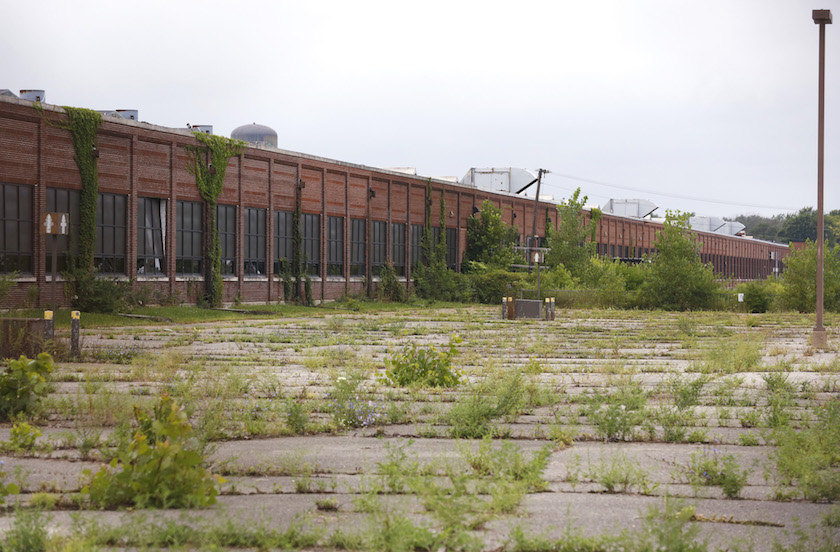
Most of the departing companies tore down their factories, leaving lots strewn with weeds and rubble. BorgWarner left a handful of structures-including a 1.2 million-square-foot sprawl of red brick and steel near the edge of town.
The city, especially the once-thriving white working-class neighborhoods on the south side, is now dotted with over 2,000 abandoned houses. Some can’t be occupied because they were contaminated by chemicals left behind by meth labs.
Photograph from a Happier Time
Meanwhile, the FBI recently opened a probe of the city government, which appears to be focused on possible corruption in its blight clearing program and the sanitation district. The FBI wouldn’t comment on the investigation, and Mayor Dennis Tyler said he can’t talk about it. There have been no indictments in the case, and it’s possible no charges will result.
Mayor Tyler, a Democrat, notes the jobless rate stood just under 10% four years ago, when he took office, so there’s been improvement. But he understands working-class frustration.
“They feel they’ve intentionally been left behind by trade agreements this country imposed on them over the last 25 years,” says Tyler.
Trump’s appeal here isn’t restricted to working-class white men. Another local supporter is Todd Murray, president and CEO of family-owned Mursix, which makes auto parts including tiny switches that go inside door locks and interior lights. His company has grown rapidly in recent years and now employs over 300 people.
Murray says he knows some of Trump’s trade proposals—such as putting hefty tariffs on goods from Mexico and China—could hit his own business. He exports 60% of his output, mostly to Mexico, and operates his own small plant in China. But he insists he’s “not smart enough to know how that would all shake out.” He still strongly favors the Republican standard bearer, who he sees as more pro-business.
But the economy alone doesn’t explain Trump’s appeal. Another family with deep roots at BorgWarner is the Lephart clan. At one point in the 1950s and 1960s, the patriarch and nine of his sons worked there, a fact immortalized in the company magazine by a photo of the group posed on a tall step ladder, each holding a lunch bucket, except for the brother at the top, who holds the family dog.
David Lephart, whose father is one of the nine brothers, avoided the decline entirely through shrewd job-hopping and retraining-but he’s still a Trump supporter. He commutes to a UAW job as a pipefitter at a GM plant in Marion, Ind. He earns about $100,000 a year, with overtime, he says, and has put both of his children through college.
The 58-year-old says one thing that influenced his transition from Democrat to Republican was talking to his children, whom he describes as part of the “business world.” His son is now a stockbroker in Indianapolis.
“For the first half of my life, I thought Democrat was the only way to be,” Lephart says. “There’s this belief that you can’t be Republican and union-but I don’t believe that any more.”