• Home
  • News
  • Fortune 500
  • Tech
  • Finance
  • Leadership
  • Lifestyle
  • Rankings
  • Multimedia
TechBrainstorm Tech

The Key to Tech Industry Diversity Is the White Male CEO

Andrew Nusca
By
Andrew Nusca
Andrew Nusca
Editorial Director, Brainstorm and author of Fortune Tech
Down Arrow Button Icon
Andrew Nusca
By
Andrew Nusca
Andrew Nusca
Editorial Director, Brainstorm and author of Fortune Tech
Down Arrow Button Icon
July 12, 2016, 12:56 PM ET
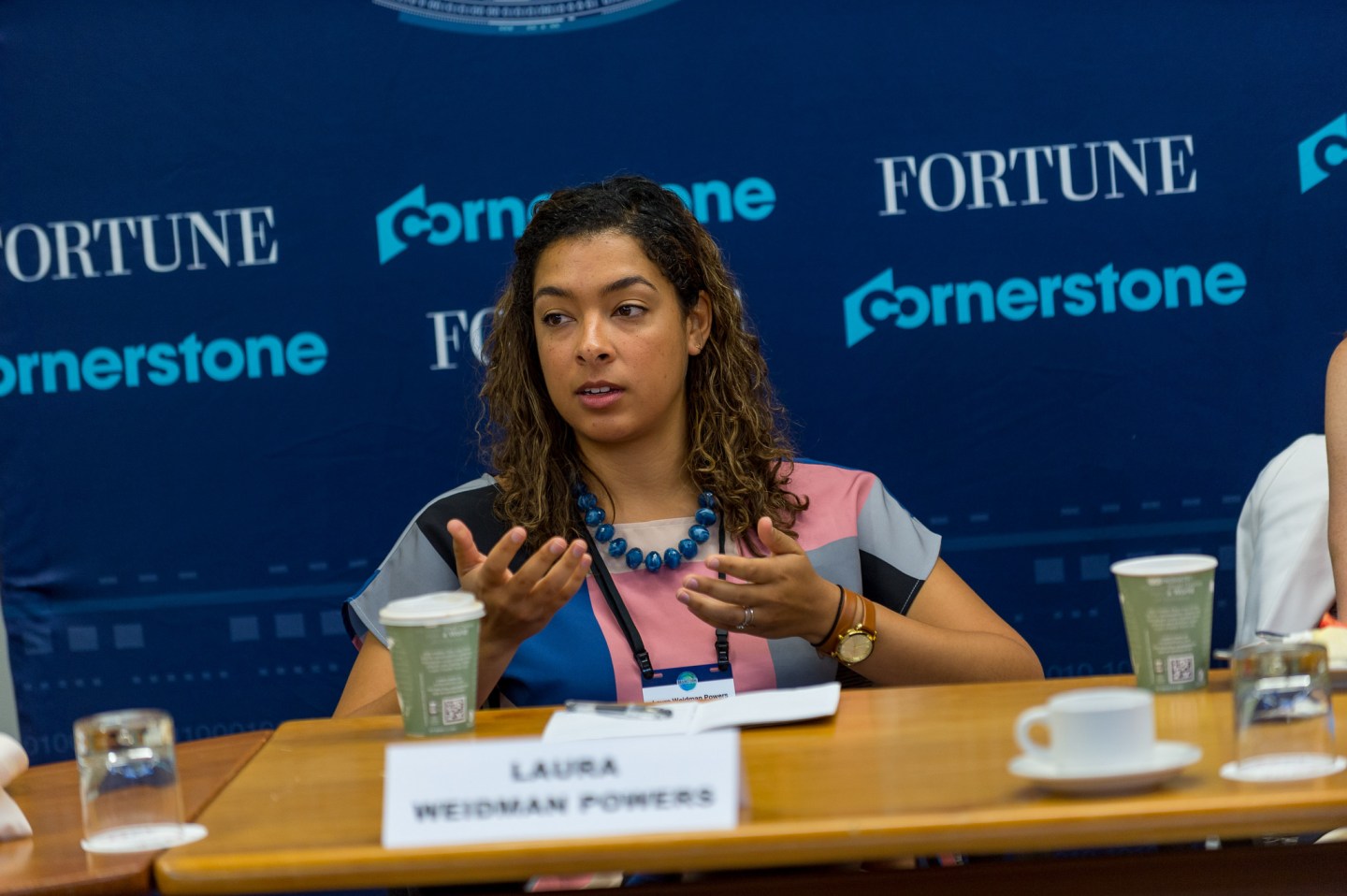
Code2040 CEO Laura Weidman Powers at Fortune Brainstorm Tech 2016
Code2040 CEO Laura Weidman Powers at Fortune Brainstorm Tech 2016Stuart Isett/Fortune Brainstorm Tech

“How many white male CEOs are in this room,” asked former NBA commissioner David Stern from the back of the room, “versus the one for the China roundtable next door?”

Stern, who is white and male, had a point. Here at the annual Fortune Brainstorm Tech conference in Aspen, executives from startups and Fortune 500 firms alike assembled to discuss why corporate diversity remained so elusive. (Down the hall at the Aspen Institute, sessions about venture capital, the Internet of things, and the future of TV were also underway.)

But despite the intellectual firepower in the room—among them were HP chief diversity officer Lesley Slaton Brown, Twitter VP Jeffrey Siminoff, Code2040 CEO Laura Weidman Powers, NEA partner Melissa Taunton, and John Rice, the chief executive of Management Leadership for Tomorrow—a frustrating reality set in. If you really want to achieve diversity in the technology industry, you’re going to need support from those who are overrepresented. In tech, that’s the white male.

“If you have a diversity island pumping things out,” Siminoff said, “it’s not going to make damn bit of good.”

NEA partner Melissa Taunton at Fortune Brainstorm Tech 2016Stuart Isett/Fortune Brainstorm Tech
Stuart Isett/Fortune Brainstorm Tech

The problem? Whether focused on gender, sexuality, or ethnicity, too many diversity sessions preach to the choir. We talk about diversity and “often there are only men in the room,” Taunton said.

“I go to a lot of women conferences and diversity panels, and the people sitting at the table are those dealing with these challenges,” she said. “When white males in the U.S. stand up, that’s when real change will happen.”

Hence Stern’s comment.

The challenges of engaging this group are “hugely complex,” Weidman Powers said. For one, there are many white male CEOs in the technology industry who are already sensitive to these issues. “I have spent a lot of time with white male CEOs who genuinely care but are terrified about what to do,” she said. “Literally they say to me, ‘What should I do?’”

But their efforts can sometimes do more harm than good. After Black Lives Matter activist DeRay McKesson was photographed wearing a Twitter #StayWoke t-shirt as he was being arrested for protesting in Baton Rouge, Salesforce CEO Marc Benioff commented in a Tweet that the image illustrated how technology was a force for good. The sentiment was meant to be positive, but it rang hollow on Twitter, where he was pilloried for the comment. He apologized and deleted it, Weidman Powers said—but to his credit, he engaged with every one of his critics individually and encouraged further discussion.

“He responded in a way that felt very authentic,” she said. (Weidman Powers’ firm Code2040 works with technology companies, including Salesforce, to help them achieve corporate diversity.)

The same thing happened when Microsoft CEO Satya Nadella made an ill-advised comment about women’s pay at the annual Grace Hopper Celebration of Women Computing event in Texas. He clearly made a mistake—but his work to patch things up with Microsoft employees and people affiliated with the Anita Borg Institute, which puts the conference on, was notable, said the institute’s president and CEO Telle Whitney.

“I really came to admire the man,” she said, adding: ““I do feel that speaking the truth makes a difference.”

John Rice, CEO, Management Leadership for Tomorrow at Fortune Brainstorm Tech 2016
Stuart Isett/Fortune Brainstorm Tech

So what’s a white male to do? The panelists had a few suggestions.

Address the disparity through recruiting by reaching “to the perimeters of people who are really strong and really qualified,” Simonoff said. That’s not happening today, he added.

Further clarify your diversity mission and “help people understand what you’re solving for,” Rice said. “In my view, it’s critical mass of diverse talent.”

Create an environment where people can speak with their coworkers as issues flare up (such as the recent sexuality- and race-motivated shootings in Florida, Minnesota, and Louisiana) as well as create spaces where they can contemplate things by themselves, Taunton said. “It’s really important to give people a voice in the company and create an empathetic environment.”

Don’t expect diverse employees to shoulder the burden of the challenge, Slaton Brown said. They’re busy enough dealing with it themselves. “I don’t want to be a spokesperson at HP for Black Lives Matter,” she said. “We have people with different perspectives and views. Those matter.”

And finally: Fix the pipeline. Conventional wisdom is that getting minorities into college is sufficient, Rice said. It’s not. “If you could prepare a broader cadre of senior leaders in institutions, they will create a critical mass and be a catalyst for broader diversity,” he said.

There’s plenty of work left to do, Slaton Brown said.

“If this is our business review,” she said, gesturing at the faces around the room, “we should all be fired.”

About the Author
Andrew Nusca
By Andrew NuscaEditorial Director, Brainstorm and author of Fortune Tech
Instagram iconLinkedIn iconTwitter icon

Andrew Nusca is the editorial director of Brainstorm, Fortune's innovation-obsessed community and event series. He also authors Fortune Tech, Fortune’s flagship tech newsletter.

See full bioRight Arrow Button Icon

Latest in Tech

AIMeta
It’s ‘kind of jarring’: AI labs like Meta, Deepseek, and Xai earned some of the worst grades possible on an existential safety index
By Patrick Kulp and Tech BrewDecember 5, 2025
4 hours ago
Elon Musk
Big TechSpaceX
Musk’s SpaceX discusses record valuation, IPO as soon as 2026
By Edward Ludlow, Loren Grush, Lizette Chapman, Eric Johnson and BloombergDecember 5, 2025
5 hours ago
data center
EnvironmentData centers
The rise of AI reasoning models comes with a big energy tradeoff
By Rachel Metz, Dina Bass and BloombergDecember 5, 2025
5 hours ago
netflix
Arts & EntertainmentAntitrust
Hollywood writers say Warner takeover ‘must be blocked’
By Thomas Buckley and BloombergDecember 5, 2025
5 hours ago
person
CybersecurityDigital
Dictionaries’ words of the year are trying to tell us something about being online in 2025
By Roger J. KreuzDecember 5, 2025
6 hours ago
Greg Peters
Big TechMedia
Top analyst says Netflix’s $72 billion bet on Warner Bros. isn’t about the ‘death of Hollywood’ at all. It’s really about Google
By Nick LichtenbergDecember 5, 2025
7 hours ago

Most Popular

placeholder alt text
Economy
Two months into the new fiscal year and the U.S. government is already spending more than $10 billion a week servicing national debt
By Eleanor PringleDecember 4, 2025
2 days ago
placeholder alt text
Success
‘Godfather of AI’ says Bill Gates and Elon Musk are right about the future of work—but he predicts mass unemployment is on its way
By Preston ForeDecember 4, 2025
1 day ago
placeholder alt text
Success
Nearly 4 million new manufacturing jobs are coming to America as boomers retire—but it's the one trade job Gen Z doesn't want
By Emma BurleighDecember 4, 2025
1 day ago
placeholder alt text
Success
Nvidia CEO Jensen Huang admits he works 7 days a week, including holidays, in a constant 'state of anxiety' out of fear of going bankrupt
By Jessica CoacciDecember 4, 2025
1 day ago
placeholder alt text
Real Estate
‘There is no Mamdani effect’: Manhattan luxury home sales surge after mayoral election, undercutting predictions of doom and escape to Florida
By Sasha RogelbergDecember 4, 2025
1 day ago
placeholder alt text
Economy
Tariffs and the $38 trillion national debt: Kevin Hassett sees ’big reductions’ in deficit while Scott Bessent sees a ‘shrinking ice cube’
By Nick LichtenbergDecember 4, 2025
1 day ago
Rankings
  • 100 Best Companies
  • Fortune 500
  • Global 500
  • Fortune 500 Europe
  • Most Powerful Women
  • Future 50
  • World’s Most Admired Companies
  • See All Rankings
Sections
  • Finance
  • Leadership
  • Success
  • Tech
  • Asia
  • Europe
  • Environment
  • Fortune Crypto
  • Health
  • Retail
  • Lifestyle
  • Politics
  • Newsletters
  • Magazine
  • Features
  • Commentary
  • Mpw
  • CEO Initiative
  • Conferences
  • Personal Finance
  • Education
Customer Support
  • Frequently Asked Questions
  • Customer Service Portal
  • Privacy Policy
  • Terms Of Use
  • Single Issues For Purchase
  • International Print
Commercial Services
  • Advertising
  • Fortune Brand Studio
  • Fortune Analytics
  • Fortune Conferences
  • Business Development
About Us
  • About Us
  • Editorial Calendar
  • Press Center
  • Work At Fortune
  • Diversity And Inclusion
  • Terms And Conditions
  • Site Map

© 2025 Fortune Media IP Limited. All Rights Reserved. Use of this site constitutes acceptance of our Terms of Use and Privacy Policy | CA Notice at Collection and Privacy Notice | Do Not Sell/Share My Personal Information
FORTUNE is a trademark of Fortune Media IP Limited, registered in the U.S. and other countries. FORTUNE may receive compensation for some links to products and services on this website. Offers may be subject to change without notice.