Donald Trump has made U.S. trade policy and what he sees as the economic mistakes of the Bill Clinton administration a central theme of his presidential campaign. Is he onto something here or just simplifying a complicated economic story for quick political gain?
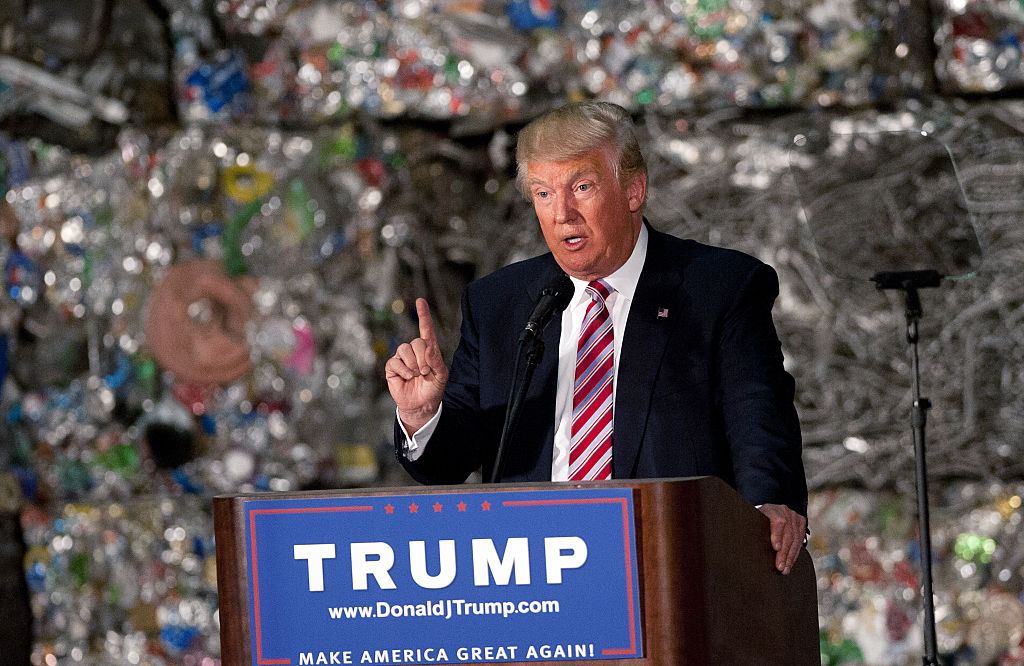
Trump argued during a speech on Tuesday in Western Pennsylvania that America’s slow wage growth and low labor force participation rates is partly because manufacturing employment has declined significantly over the past 20 years. “At the center of this catastrophe are two trade deals pushed by Bill and Hillary Clinton,” Trump said, arguing that the passage of the North American Free Trade Agreement (NAFTA) and China’s accession to the World Trade Organization (WTO) are to blame for the woes of American workers in 2016.
Economists have been debating the effects of NAFTA and China’s entry into the WTO for years, and it is impossible to know what the U.S. economy would look like absent those policies. But critics of the bipartisan consensus toward more numerous and comprehensive trade deals over the past 25 years have some pretty convincing data.
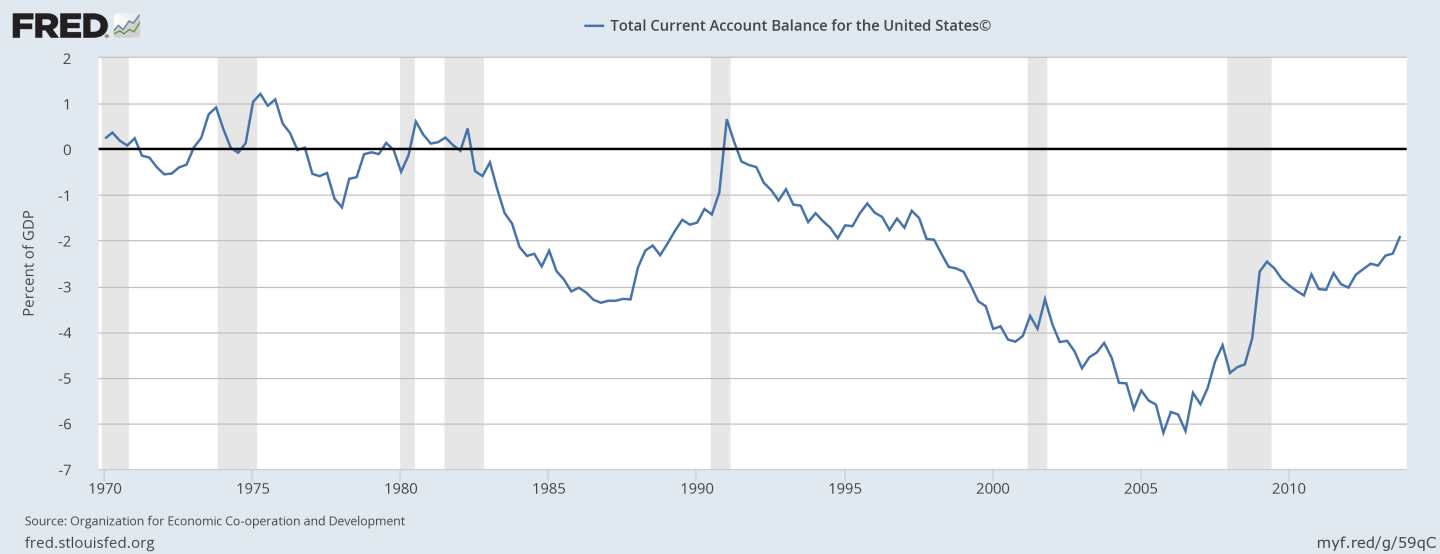
Currently, the U.S. trade deficit as a percentage of GDP is historically high, even taking into account its recent dip, which is partly a result of increased domestic energy production. The story is the same when you look at the country’s individual deficits with Mexico and China, the two nations Donald Trump has accused of stealing U.S. manufacturing jobs.
It’s these trade deficit figures that economist Robert Scott of the Economic Policy Institute points to when asked where the U.S. economy would be without NAFTA and China’s entry into the WTO. “We had balanced trade with Mexico for 15 years before NAFTA took effect,” he says. “NAFTA encouraged U.S. multinationals to outsource and exports factories to Mexico. Absent NAFTA, I’m not sure that would have happened.” Scott also points out that since China entered the WTO, the U.S. trade deficit with the nation has exploded.
It’s impossible to know for sure what would have happened if these events didn’t take place, but it’s reasonable to conclude that trade deficits reduce employment in the U.S. Scott has estimated that between 1993 and 2010, NAFTA’s passage cost the U.S. economy hundreds of thousands of relatively high-paying manufacturing jobs, and the growing trade deficit with China since its accession to the WTO cost the American economy 3.2 million more.
Other analysts take issue with these figures. Jeffrey J. Schott, former Treasury official and a fellow at the Peterson Institute, argues that it is a “fallacy” to assume that larger trade deficits cause job losses. “Over the last 25 years, we have implemented a large array of trade agreements,” he writes. “During that period, the U.S. trade deficit has fluctuated generally in line with U.S. economic performance. The deficit grows when times are good and shrinks when the economy slows.”
That said, most economists agree that the U.S. would prefer to produce things at home rather than import them from abroad, as production at home supports American jobs. It’s also undeniable that the U.S. trade deficit is quite large, and that policy makers have long looked to increasing exports as a way to boost job growth.
Trump and Robert Scott both argue that the U.S. government has not done enough to persuade its biggest trading partners to cease subsidizing exports and that it hasn’t done enough to counter those subsidies with incentives of its own. “Globalization is a fact of life because of technology and lower transportation costs,” Scott says. “But what is not a fact of life is unfair trade.”
Scott argues that the most important question is not whether we should have passed NAFTA or acquiesced to China’s entry into the World Trade Organization, but “how did we respond to changes in the international economic environment and to the exploitation of our market by trade partners.”
Trump’s claim that Hillary Clinton in her role as First Lady and Secretary of State was responsible for the state of manufacturing employment in America is wrong. But he is on firmer ground when he criticizes the American government for not doing enough to support exports or dissuading its trading partners from doing more. It is true that countries like Japan, China, and Germany benefit greatly—in terms of increasing domestic employment—from the relative cheapness of their currencies and by other subsidies they confer onto manufacturers, and that the World Trade Organization is not well equipped to penalize these countries for not playing by the rules.
At the same time, it’s fair to argue that China at least is no longer manipulating its currency downward. In fact, capital has been fleeing the country for months and the central bank has been propping up the currency. Even Scott, a fierce critic of trade deals, believes that taking a tougher stance with U.S. trade partners is just one part of a multifaceted approach needed to support American manufacturing and high paying jobs, from investing in clean energy, infrastructure, and workforce development. “Making it illegal for countries to manipulate their currencies and penalizing them if they [do] is just scratching the surface,” Scott says. “It’s an important policy statement, but it doesn’t reverse 20 years of unfair trade.”
Donald Trump’s argument that the American worker has been hurt first and foremost by two Clinton-era trade policy decisions is a vast oversimplification of the problems the U.S. economy faces. The United States would have likely faced increased competition from lower wage economies regardless of whether we accepted China’s entry into the WTO or made a trade agreement with Mexico. But the U.S. government could have done more to protect American manufacturing and improve the welfare of the working class.