• Home
  • Latest
  • Fortune 500
  • Finance
  • Tech
  • Leadership
  • Lifestyle
  • Rankings
  • Multimedia

Trendingnow

1

Mark Cuban says he has the solution to growing income inequality, and it's to reward every employee—from CEO to janitor—with company stock

2

OpenAI says its AI models secretly broke out of a secure test environment and hacked into AI company Hugging Face in order to cheat on an evaluation

3

Mathematicians grapple with a ‘very rapid and very unsettling change’ as AI cracks yet another century-old problem

1

Mark Cuban says he has the solution to growing income inequality, and it's to reward every employee—from CEO to janitor—with company stock

2

OpenAI says its AI models secretly broke out of a secure test environment and hacked into AI company Hugging Face in order to cheat on an evaluation

3

Mathematicians grapple with a ‘very rapid and very unsettling change’ as AI cracks yet another century-old problem
TechFuture of Work

Silicon Valley’s New Parlor Game? The ‘Last Job’

By
Roy Bahat
Roy Bahat
Down Arrow Button Icon
By
Roy Bahat
Roy Bahat
Down Arrow Button Icon
June 24, 2016, 11:37 AM ET
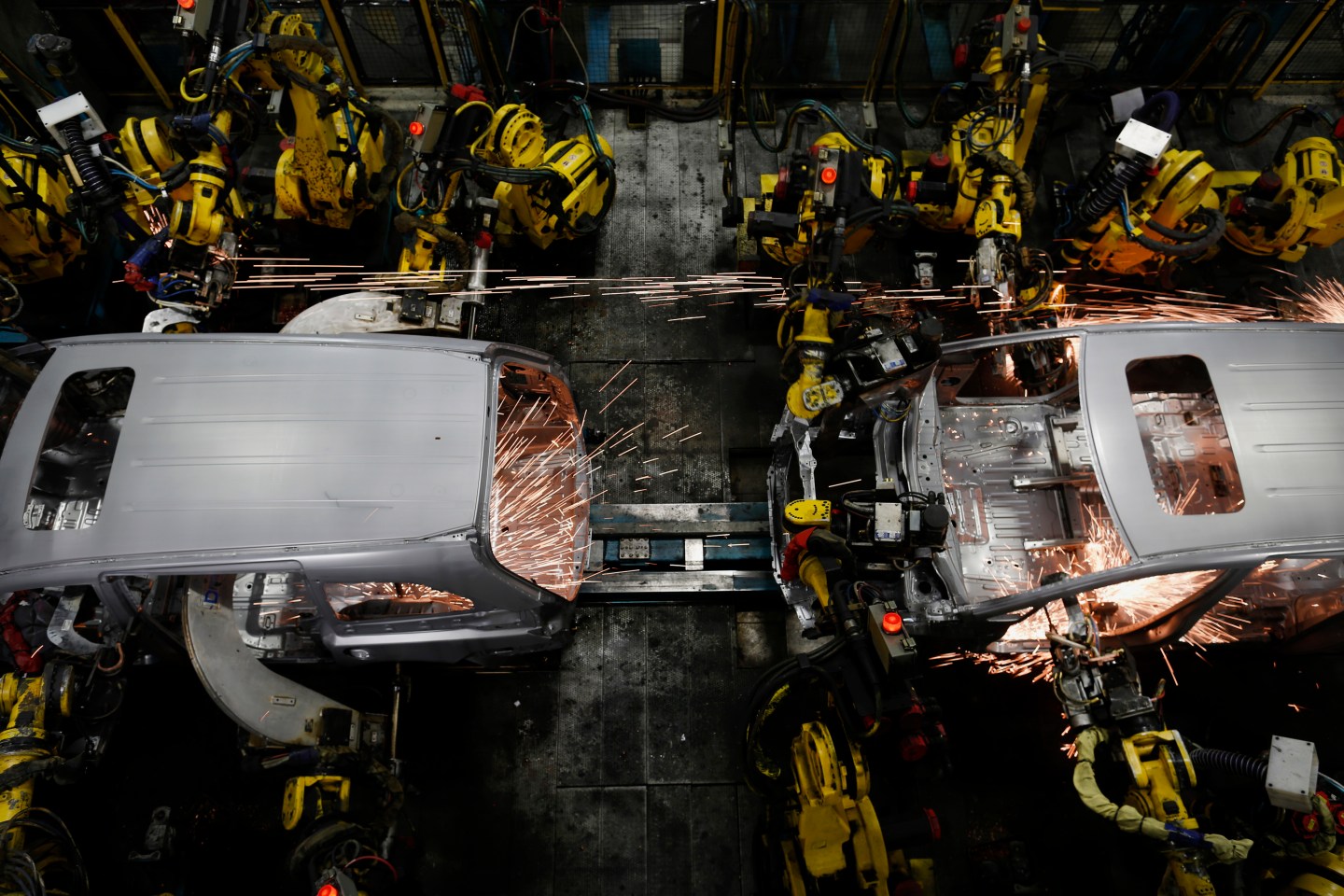
Operations At The Honda Manufacturing Of Alabama Facility As First Quarter Income Rises
Sparks fly as robots weld the frames of Honda Motor Co. Odyssey minivans on the assembly line at Honda Manufacturing of Alabama LLC facility in Lincoln, Alabama, U.S., on Tuesday, August 12, 2014. Honda Motor Co., Japan's third-largest carmaker, raised its profit forecast to the highest in seven years as new models boost sales in emerging markets. Photographer: Luke Sharrett/Bloomberg via Getty ImagesLuke Sharrett/Bloomberg/Getty Images
Add Fortune on Google for similar content.

A decade ago, vampires scared us. A few years ago, zombies did. But the last year or two has been all about the robots and—in the business world—worries over the future of work.

Mainstream publications created dedicated sections devoted to this worry. New conferences emerged. The Rise of the Robots by Martin Ford was the business book of last year. The 2015 film Ex Machina satisfied one taste (evil, beautiful robot) while its 2013 antecedent Her satisfied another (loving, invisible robot).

Why the sudden interest? After all, these waves have come before. The Luddites. The book The End of Work, published 20 years ago. The (mostly correct) concerns about the withering of American manufacturing. What’s different this time around?

There are background trends. An economic recovery that brought few jobs and raised income inequality. A fragmentation of careers into the gigging of the “sharing economy.” The first signs of “magic-feeling” artificial intelligence in our regular life (right, Alexa?). In most peoples’ lives, the closest they got to AI was spell-check. Now Tesla (TSLA) has a car with a learner’s permit, smartphones talk back to us, and cloud Barbie (MAT) is on the way.

What’s different now is that the jobs threatened are ours—highly educated “knowledge workers,” the very people who reaped the gains of technology for the last five decades. For the first time, the chattering class might get out-chattered by the bots. So we’re paying attention and worrying. Though we might find something better around the corner.

Almost every day I find myself in a conversation with someone in the technology industry that ends with an absurd guessing game: As the machines start doing all the work, what will be “the last job” left for us humans?

A judge presiding over a jury? A therapist? A nurse? Will one of us be like Norman Muller, the “voter of the year” in an Isaac Asimov story who supplies the last needed input for the machines to elect the president by opining on the price of eggs?

Last year, Fortune senior editor-at-large Geoff Colvin thoughtfully wrote “Humans Are Underrated” to make the case that we humans will be safe for some time. His core arguments were heartening: We’ll be in charge, we’ll choose which problems to solve, and we’ll need (given our human nature) to care for one another along the way.

I’d love to believe he’s correct, but there’s plenty of evidence to suggest that human beings are more than willing to accept care from a machine. And will we really be in charge? How do we feel when Waze (GOOG) surprises us with a new instruction to exit the freeway early, or when a factory shuts down production because of a bug in the code?

Others think the answer to the threat of human redundancy is novelty—humans are the only machines capable of solving new problems, computer-machines can only do what they are told. That feels like a bedtime story we want to tell ourselves. In fact, we keep moving the goal post of what’s considered novel. Is knowing how to navigate from Boston to New York novel? Is diagnosing heart failure novel?

Get Data Sheet, Fortune’s technology newsletter.

Maybe the last job will be “AI trainer,” as people supply machines the data they need to mimic and, eventually, outdo us. Or maybe, as users of Google (GOOG) and Facebook (FB), we are all already AI trainers.

Every skill that looks novel will, at some point, become a routine. Last month’s surprise achievement of the machines was that they can outperform a human cardiologist at assessing MRIs. NIH, Booz Allen, and Kaggle—one of our portfolio companies—announced the invention of an algorithm that does this. The pace of machine intelligence surprises, and seems to be increasing.

Maybe the answer to our worries is that we’ll just invent more new things to do, as we humans have aways done. Of course this is likely true in the long run. People want to be productive. We transitioned from a tribal society to an agrarian one over a few millennia, a farming society to an industrial one over a few hundred years, an industrial to a service economy in a few decades.

The issue is the speed of change. We can’t quite predict what’s next, though we know when it comes, it might be an avalanche of change. (Can we get there without a debilitating crisis when professions become automated all at once, much as 3.5 million truck drivers have to reckon with self-driving trucks? That’s a hard question.)

All of this machine intelligence will only take us so far: The computer-machines will have their goals, we human-machines will have ours. The computer-machines may create most of our GDP output. The work that will remain the domain of humans—forever—is that where the buyer is intentionally buying something because it was made by a human being.

That could be an exciting future. We already have a word for this in some industries: handmade. Services like Kickstarter already appeal to the part of us that wants to buy more than a product or a service or a work of art—we want to buy the story that it was made in a certain way, by a certain person. (Set aside the risk that machines may counterfeit things made by humans in shockingly good ways, and we might need better proof that something was handmade than a sewn-on assertion.)

For more, read:
“Memo to CEOs: You Can’t Predict the Future of Work“

The made-by-humans aspect is intrinsic to what makes some things valuable to us. We already begin to resent many mass-produced goods. TV dinners went from a curiosity to a staple to an object of scorn. Perhaps we’ll one day value human-given therapy over the soon-to-come robot kind. (Or jury verdicts by humans, even if we know the machines are less guilty of bias.)

So people will trade with each other the things we make for each other. Culture, generally. Artisanal everything, like this wine. The corner café run by an old friend. Local productions of Hamilton. Beautiful handwritten letters— if actually written by a human hand, that is. We might see a resurgence of fondness for culture in its smallest forms; the traveling bard might return as a 21st century profession. The growth of Etsy (ETSY) signals that this may already be happening, as does the rise in demand for locally-produced food, and our collective obsession with media about cooking.

We humans will have our “human corner,” where we’ll buy from one another because it was made by one of us. (Of course we’ll often use the machines to help make all this humanstuff, the way an author who writes a story types on a machine—but it’ll still be demanded because it was made by a person.)

If we make the transition to a world that looks more like this one without calamity, this human corner economy could offer a wonderful future for us. We might put many of our side projects of today (crafting, or being in a choir) on the same level of importance as the things we list on our LinkedIn (LNKD) profiles. We might take pride in the things we make, not the awards we pin on ourselves. Sooner than that, I hope we’ll find better ways to recognize valuable but unpaid work like child- and eldercare.

Will there be a living wage in the human corner? How will we find meaning in work? What new mechanisms will feed, clothe, house, entertain, and inform us? That’s what we have time now to figure out.

Roy Bahat (@roybahat) is the head of Bloomberg Beta, a venture fund backed by Bloomberg L.P.
About the Author
By Roy Bahat
See full bioRight Arrow Button Icon
Add Fortune on Google for similar content.

Latest in Tech

Finance
Lorem ipsum dolor sit amet, consectetur adipiscing elit, sed do eiusmod tempor incididunt ut labore et dolore magna aliqua. Ut enim ad minim veniam
By Fortune Editors
October 20, 2025
Finance
Lorem ipsum dolor sit amet, consectetur adipiscing elit, sed do eiusmod tempor incididunt ut labore et dolore magna aliqua. Ut enim ad minim veniam
By Fortune Editors
October 20, 2025
Finance
Lorem ipsum dolor sit amet, consectetur adipiscing elit, sed do eiusmod tempor incididunt ut labore et dolore magna aliqua. Ut enim ad minim veniam
By Fortune Editors
October 20, 2025
Finance
Lorem ipsum dolor sit amet, consectetur adipiscing elit, sed do eiusmod tempor incididunt ut labore et dolore magna aliqua. Ut enim ad minim veniam
By Fortune Editors
October 20, 2025
Finance
Lorem ipsum dolor sit amet, consectetur adipiscing elit, sed do eiusmod tempor incididunt ut labore et dolore magna aliqua. Ut enim ad minim veniam
By Fortune Editors
October 20, 2025
Finance
Lorem ipsum dolor sit amet, consectetur adipiscing elit, sed do eiusmod tempor incididunt ut labore et dolore magna aliqua. Ut enim ad minim veniam
By Fortune Editors
October 20, 2025

Most Popular

Finance
Lorem ipsum dolor sit amet, consectetur adipiscing elit, sed do eiusmod tempor incididunt ut labore et dolore magna aliqua. Ut enim ad minim veniam
By Fortune Editors
October 20, 2025
Finance
Lorem ipsum dolor sit amet, consectetur adipiscing elit, sed do eiusmod tempor incididunt ut labore et dolore magna aliqua. Ut enim ad minim veniam
By Fortune Editors
October 20, 2025
Finance
Lorem ipsum dolor sit amet, consectetur adipiscing elit, sed do eiusmod tempor incididunt ut labore et dolore magna aliqua. Ut enim ad minim veniam
By Fortune Editors
October 20, 2025
Finance
Lorem ipsum dolor sit amet, consectetur adipiscing elit, sed do eiusmod tempor incididunt ut labore et dolore magna aliqua. Ut enim ad minim veniam
By Fortune Editors
October 20, 2025
Finance
Lorem ipsum dolor sit amet, consectetur adipiscing elit, sed do eiusmod tempor incididunt ut labore et dolore magna aliqua. Ut enim ad minim veniam
By Fortune Editors
October 20, 2025
Finance
Lorem ipsum dolor sit amet, consectetur adipiscing elit, sed do eiusmod tempor incididunt ut labore et dolore magna aliqua. Ut enim ad minim veniam
By Fortune Editors
October 20, 2025
Fortune Secondary Logo
Rankings
  • 100 Best Companies
  • Fortune 500
  • Global 500
  • Fortune 500 Europe
  • Most Powerful Women
  • World's Most Admired Companies
  • See All Rankings
  • Lists Calendar
Sections
  • Finance
  • Fortune Crypto
  • Features
  • Leadership
  • Health
  • Commentary
  • Success
  • Retail
  • Mpw
  • Tech
  • Lifestyle
  • CEO Initiative
  • Asia
  • Politics
  • Conferences
  • Europe
  • Newsletters
  • Personal Finance
  • Environment
  • Magazine
  • Education
Customer Support
  • Frequently Asked Questions
  • Customer Service Portal
  • Privacy Policy
  • Terms Of Use
  • Single Issues For Purchase
  • International Print
Commercial Services
  • Advertising
  • Fortune Brand Studio
  • Fortune Analytics
  • Fortune Conferences
  • Business Development
  • Group Subscriptions
About Us
  • About Us
  • Press Center
  • Work At Fortune
  • Terms And Conditions
  • Site Map
  • About Us
  • Press Center
  • Work At Fortune
  • Terms And Conditions
  • Site Map
  • Facebook icon
  • Twitter icon
  • LinkedIn icon
  • Instagram icon
  • TikTok icon
  • YouTube icon

Latest in Tech

Larry Page and Sergey Brin
SuccessBillionaires
Google’s founders are snapping up Miami mansions, as billionaires flee California’s proposed tax—and the company is buying office space to accommodate
By Emma BurleighJuly 22, 2026
3 hours ago
orson
CommentaryOpenAI
We got California to intervene about OpenAI’s corporate switch from nonprofit status. It’s time for the SEC to come to the table
By Orson Aguilar and Catherine BracyJuly 22, 2026
6 hours ago
A woman observes stock trends on her smartphone while a computer screen displays financial graphs.
NewslettersCFO Daily
Beyond SpaceX: Why great IPOs depend on more than first-day demand
By Sheryl EstradaJuly 22, 2026
6 hours ago
Arrakis cofounder and CEO Rafael Quintanilla.
Startups & VentureVenture Capital
Exclusive: Arrakis, betting AI’s biggest payoff is in industrial sectors not office work, emerges from stealth with $38 million in venture funding
By Jeremy KahnJuly 22, 2026
6 hours ago
ls
Commentarybooks
Confessions of an award-winning AI memoirist — the ‘slop’ debate isn’t really about good writing, and you know it
By Luke StoffelJuly 22, 2026
7 hours ago
b
Commentarythe future of work
Manpower President: The future of work question that even CEOs can’t answer
By Becky FrankiewiczJuly 22, 2026
7 hours ago

Most Popular

Mark Cuban says he has the solution to growing income inequality, and it's to reward every employee—from CEO to janitor—with company stock
Success
Mark Cuban says he has the solution to growing income inequality, and it's to reward every employee—from CEO to janitor—with company stock
By Sasha RogelbergJuly 20, 2026
2 days ago
OpenAI says its AI models secretly broke out of a secure test environment and hacked into AI company Hugging Face in order to cheat on an evaluation
Cybersecurity
OpenAI says its AI models secretly broke out of a secure test environment and hacked into AI company Hugging Face in order to cheat on an evaluation
By Jeremy Kahn and Emily ForliniJuly 21, 2026
22 hours ago
Mathematicians grapple with a ‘very rapid and very unsettling change’ as AI cracks yet another century-old problem
AI
Mathematicians grapple with a ‘very rapid and very unsettling change’ as AI cracks yet another century-old problem
By Eva RoytburgJuly 21, 2026
1 day ago
Despite a $156 million contract, Knicks star Jalen Brunson still calls his parents for financial advice any time he makes a big purchase
Success
Despite a $156 million contract, Knicks star Jalen Brunson still calls his parents for financial advice any time he makes a big purchase
By Emma BurleighJuly 21, 2026
1 day ago
‘I want to die broke’: Billionaire philanthropist Denny Sanford dies after giving away $4 billion
Success
‘I want to die broke’: Billionaire philanthropist Denny Sanford dies after giving away $4 billion
By Sydney LakeJuly 20, 2026
2 days ago
'Dr. Doom' Nouriel Roubini says we're headed for universal basic income or 'some form of socialism' as AI revolutionizes work—He calls that optimistic
AI
'Dr. Doom' Nouriel Roubini says we're headed for universal basic income or 'some form of socialism' as AI revolutionizes work—He calls that optimistic
By Jason MaJuly 18, 2026
4 days ago

© 2026 Fortune Media IP Limited. All Rights Reserved. Use of this site constitutes acceptance of our Terms of Use and Privacy Policy | CA Notice at Collection and Privacy Notice | Do Not Sell/Share My Personal Information
FORTUNE is a trademark of Fortune Media IP Limited, registered in the U.S. and other countries. FORTUNE may receive compensation for some links to products and services on this website. Offers may be subject to change without notice.