• Home
  • Latest
  • Fortune 500
  • Finance
  • Tech
  • Leadership
  • Lifestyle
  • Rankings
  • Multimedia
Leadership

Why Can’t We Be Friends? Saving Workplace Relationships

By
Kristin J. Behfar
Kristin J. Behfar
and
Darden School of Business—Ideas to Action
Down Arrow Button Icon
By
Kristin J. Behfar
Kristin J. Behfar
and
Darden School of Business—Ideas to Action
Down Arrow Button Icon
June 1, 2016, 4:07 PM ET
Laughing architects at conference table in office
Group of laughing architects discussing project plans at conference table in officePhotograph by Thomas Barwick — Getty Images

This piece originally appeared on Darden School of Business—Ideas to Action.

Conflicts among co-workers are ubiquitous in business. Sometimes they generate positive momentum, but they can often disrupt and stand in the way of workplace efficiency.

In an effort to find solutions, researchers have primarily examined the content of conflict. They’ve studied what we’re fighting about.

While this approach has done a great deal to help us understand how conflict influences cooperation and results, it doesn’t help us to consistently identify positive impacts of conflict or explain the role emotions play in how conflicts unfold.

Our work puts forth a new theory for understanding the impact of conflict by focusing on how conflict is expressed.

To us, managing conflict isn’t just concerned with what we fight about. It’s also about how we fight — and more specifically, how we speak and confront one another during disagreements.

My colleagues and I present evidence from field surveys that demonstrate how understanding conflict expression is better than examining the content of conflict when seeking to manage and resolve workplace battles.

How We Fight

Expression contains information about the problem (the what), but how the opposition is expressed (i.e., what we say and do) speaks volumes about a person’s intentions and openness to problem solving.

Take this example, which illustrates how two individuals approach understanding other people’s viewpoints.
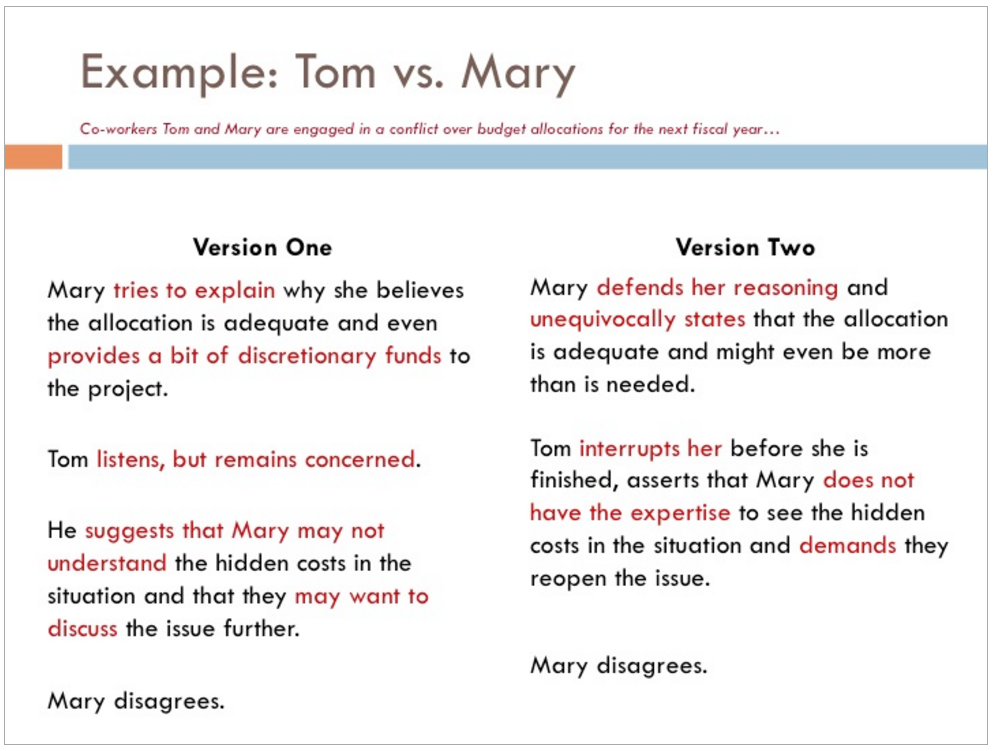
Click to enlarge.

The above example demonstrates two ways in which individuals express the same conflict. The highlighted words exemplify how the processes of discussing the problem differ. In version one, there is still give and take in the conflict, but in version two, there is more defensive posturing and potentially disrespectful behavior. You can imagine that the two conversations would produce different results for Tom and Mary, and how they are able to reach (or not reach) an agreement about the budget allocation.

In our research, we organize these differences in how conflicts are expressed in two ways: directness and oppositional intensity.

Directness

Directness refers to the way in which a person explicitly or implicitly conveys his or her opposition. The more directly conflict is expressed, the more explicit the opposition, leaving little room for doubt about the presence of conflict and interpretation of what the conflict is about. In versions one and two of the example, directness of oppositional expression is high. In both versions, it is clear that Tom disagrees with Mary. Their differences are articulated, explained, and are the focus of the exchange. In less direct expressions, behaviors tend to hint at the problem rather than explicitly state and confront the problem. For example, when an individual agrees to a solution but then blocks or stalls downstream decisions, or uses heavy sarcasm, they disguise the explicit message being conveyed. The two versions of the example above differ in the intensity of Tom and Mary’s opposition.

Oppositional Intensity

Oppositional intensity is the degree of force, strength or energy with which opposition is conveyed. It indicates entrenchment in a position and subversiveness in actions. The high range of oppositional intensity is characterized by threats, fighting, stonewalling and offensive behaviors, such as undermining or dominating. The low range of intensity is indicated by debate and passive aggressive and defensive behaviors, such as protecting and withholding.

Behaviors from version one fall at the low end of the oppositional intensity range (less entrenched arguing). Behaviors from version two lean toward the high range of oppositional intensity (unyielding positions, making demands).

Properties of Conflict Expression

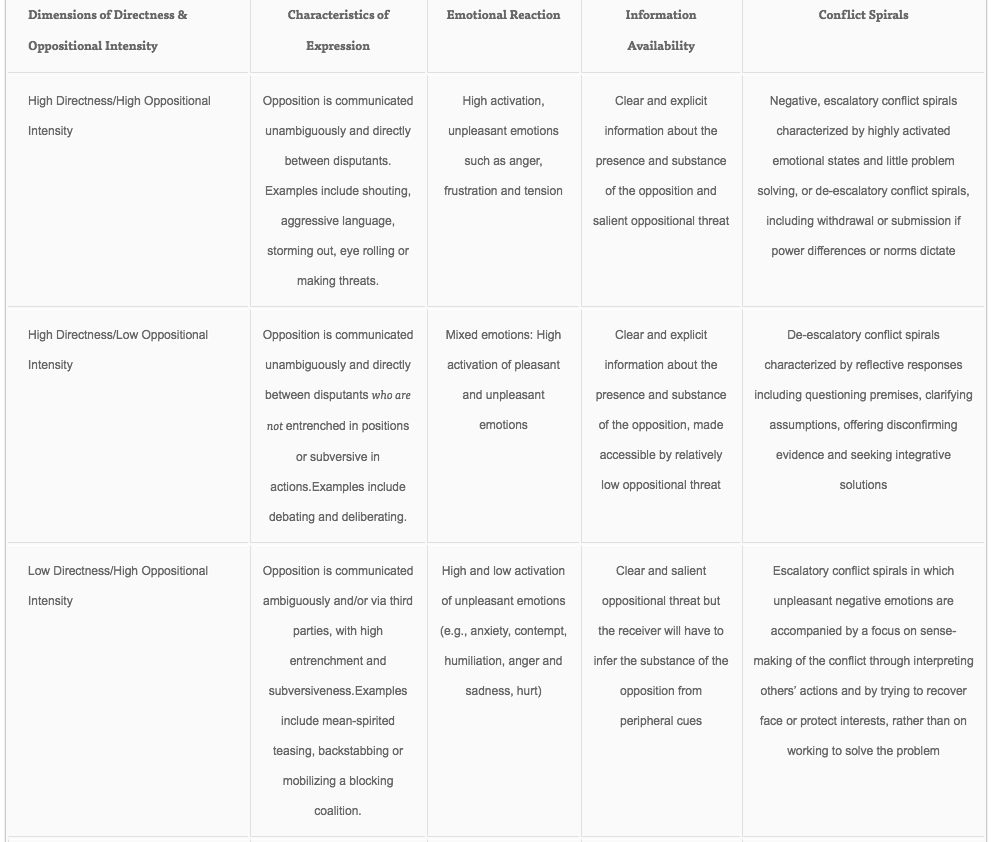
When directness of opposition and oppositional intensity are combined, the results are combinations of verbal and nonverbal communication of opposition between people.
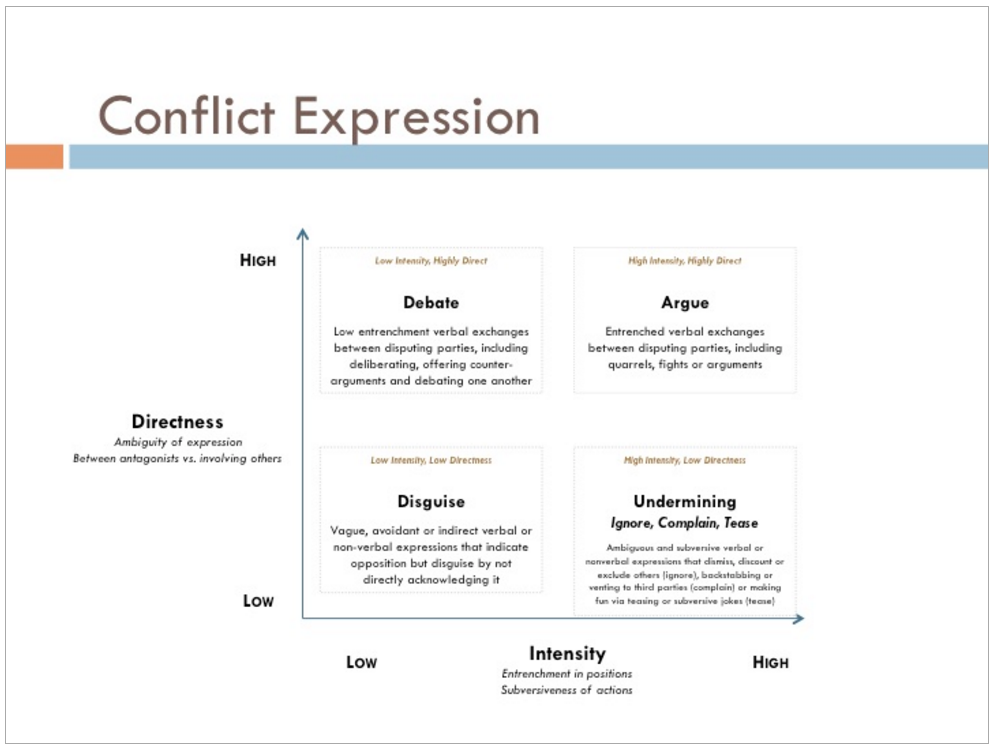
Click to enlarge.

How conflict is expressed will change the nature of the conflict process that unfolds.

Conflict Spirals

Conflict spirals ensue when the receiver of an opposition expression responds in a way consistent with how the conflict was initiated. Spirals can be negative or positive.

Negative Spirals:

  • Suppress information availability
  • Erode trust
  • Produce imbalanced outcomes
  • Generate negative emotions

Positive Spirals:

  • Generate questions and answers
  • Increase efficacy
  • Generate mixed emotions


Click to enlarge.

Different types of work groups and circumstances specifically yield a certain type of conflict spiral and spiral types can result in high or low performance.

What the Findings Mean for You

Our research uncovered that people perceive expressed conflict the same way when the intensity of the expression is high, not low. The findings also show that long-term teams tend to experience a wider range of conflict expressions: Over time there are more ways to be indirect and passive aggressive. In contrast, short-term teams reported more direct conflicts, ranging in intensity. In U.S. samples, the low directness/low intensity conflicts are as detrimental to outcomes as high intensity fights are.

So whether you work one-on-one with colleagues or within teams, it’s better to be clear and explicit about how you feel, while being open to other possibilities. Clearly, avoiding or disguising a confrontation is detrimental. Our research shows that it is preferable to show strong emotions and express your true and honest feelings as long as the expression is not perceived as an unwillingness to compromise or as threatening, and information is being exchanged about the problem. This behavior results in a de-escalatory spiral that can lead to reflection, clarity, understanding and resolution.

About the Authors
By Kristin J. Behfar
See full bioRight Arrow Button Icon
By Darden School of Business—Ideas to Action
See full bioRight Arrow Button Icon

Latest in Leadership

Finance
Lorem ipsum dolor sit amet, consectetur adipiscing elit, sed do eiusmod tempor incididunt ut labore et dolore magna aliqua. Ut enim ad minim veniam
By Fortune Editors
October 20, 2025
Finance
Lorem ipsum dolor sit amet, consectetur adipiscing elit, sed do eiusmod tempor incididunt ut labore et dolore magna aliqua. Ut enim ad minim veniam
By Fortune Editors
October 20, 2025
Finance
Lorem ipsum dolor sit amet, consectetur adipiscing elit, sed do eiusmod tempor incididunt ut labore et dolore magna aliqua. Ut enim ad minim veniam
By Fortune Editors
October 20, 2025
Finance
Lorem ipsum dolor sit amet, consectetur adipiscing elit, sed do eiusmod tempor incididunt ut labore et dolore magna aliqua. Ut enim ad minim veniam
By Fortune Editors
October 20, 2025
Finance
Lorem ipsum dolor sit amet, consectetur adipiscing elit, sed do eiusmod tempor incididunt ut labore et dolore magna aliqua. Ut enim ad minim veniam
By Fortune Editors
October 20, 2025
Finance
Lorem ipsum dolor sit amet, consectetur adipiscing elit, sed do eiusmod tempor incididunt ut labore et dolore magna aliqua. Ut enim ad minim veniam
By Fortune Editors
October 20, 2025

Most Popular

Finance
Lorem ipsum dolor sit amet, consectetur adipiscing elit, sed do eiusmod tempor incididunt ut labore et dolore magna aliqua. Ut enim ad minim veniam
By Fortune Editors
October 20, 2025
Finance
Lorem ipsum dolor sit amet, consectetur adipiscing elit, sed do eiusmod tempor incididunt ut labore et dolore magna aliqua. Ut enim ad minim veniam
By Fortune Editors
October 20, 2025
Finance
Lorem ipsum dolor sit amet, consectetur adipiscing elit, sed do eiusmod tempor incididunt ut labore et dolore magna aliqua. Ut enim ad minim veniam
By Fortune Editors
October 20, 2025
Finance
Lorem ipsum dolor sit amet, consectetur adipiscing elit, sed do eiusmod tempor incididunt ut labore et dolore magna aliqua. Ut enim ad minim veniam
By Fortune Editors
October 20, 2025
Finance
Lorem ipsum dolor sit amet, consectetur adipiscing elit, sed do eiusmod tempor incididunt ut labore et dolore magna aliqua. Ut enim ad minim veniam
By Fortune Editors
October 20, 2025
Finance
Lorem ipsum dolor sit amet, consectetur adipiscing elit, sed do eiusmod tempor incididunt ut labore et dolore magna aliqua. Ut enim ad minim veniam
By Fortune Editors
October 20, 2025
Fortune Secondary Logo
Rankings
  • 100 Best Companies
  • Fortune 500
  • Global 500
  • Fortune 500 Europe
  • Most Powerful Women
  • Future 50
  • World’s Most Admired Companies
  • See All Rankings
Sections
  • Finance
  • Fortune Crypto
  • Features
  • Leadership
  • Health
  • Commentary
  • Success
  • Retail
  • Mpw
  • Tech
  • Lifestyle
  • CEO Initiative
  • Asia
  • Politics
  • Conferences
  • Europe
  • Newsletters
  • Personal Finance
  • Environment
  • Magazine
  • Education
Customer Support
  • Frequently Asked Questions
  • Customer Service Portal
  • Privacy Policy
  • Terms Of Use
  • Single Issues For Purchase
  • International Print
Commercial Services
  • Advertising
  • Fortune Brand Studio
  • Fortune Analytics
  • Fortune Conferences
  • Business Development
About Us
  • About Us
  • Editorial Calendar
  • Press Center
  • Work At Fortune
  • Diversity And Inclusion
  • Terms And Conditions
  • Site Map
Fortune Secondary Logo
  • About Us
  • Editorial Calendar
  • Press Center
  • Work At Fortune
  • Diversity And Inclusion
  • Terms And Conditions
  • Site Map
  • Facebook icon
  • Twitter icon
  • LinkedIn icon
  • Instagram icon
  • Pinterest icon

Latest in Leadership

trump
EconomySocial Security
Trump vows ‘we will always protect Social Security, Medicare, Medicaid,’ but his signature tax cut shortened their lifespans
By Nick LichtenbergFebruary 24, 2026
1 hour ago
Donald Trumpm in a suit and red tie in a swarm of people.
Personal FinanceDonald Trump
Trump announces 401(k) for all: ‘We will match your contribution with up to $1,000 each year’
By Amanda Gerut and Nick LichtenbergFebruary 24, 2026
1 hour ago
Multicolored shipping containers stacked up at a port in China.
AIEye on AI
How one AI company is helping businesses navigate Trump’s new tariff chaos following the Supreme Court ruling
By Jeremy KahnFebruary 24, 2026
9 hours ago
Young woman appears troubled as she looks at her laptop screen
Workplace Culturebenefits
The workplace benefit 95% of workers want but aren’t satisfied with is a pretty basic one: bereavement leave, study shows
By Sydney LakeFebruary 24, 2026
12 hours ago
Joe Tsai
SuccessCareers
Alibaba cofounder tells aspiring entrepreneurs that picking a team you’d spend “24/7 with” should be their first priority—not work-life balance 
By Preston ForeFebruary 24, 2026
13 hours ago
Stressed and sad worker in office
SuccessWealth
Nearly half of companies are turning to poor ‘peanut butter’ raises—following the same pattern of the 2008 recession, an expert says. And it could take years to recover
By Emma BurleighFebruary 24, 2026
13 hours ago

Most Popular

placeholder alt text
Economy
Scott Bessent has ’got a feeling’ that $175 billion raised under the IEEPA is lost to the American people for good
By Eleanor PringleFebruary 23, 2026
2 days ago
placeholder alt text
Economy
In less than a year, Trump erased 12 years of solvency for the trust fund that pays for Medicare Part A
By Nick LichtenbergFebruary 23, 2026
1 day ago
placeholder alt text
Cybersecurity
Discord cuts ties with Peter Thiel–backed verification software after its code was found tied to U.S. surveillance efforts
By Catherina GioinoFebruary 24, 2026
21 hours ago
placeholder alt text
Economy
The record gap between corporate profits and worker pay has an ‘undercurrent of betrayal,’ top economist warns 
By Jason MaFebruary 23, 2026
2 days ago
placeholder alt text
Economy
A two-child household must earn $400,000 a year for childcare to be affordable, study says. 'It’s easy to see why birth rates are falling'
By Jason MaFebruary 22, 2026
2 days ago
placeholder alt text
Success
While Nvidia CEO Jensen Huang enjoys an over $150 billion net worth, his fellow cofounder Curtis Priem sold out in 2006—and missed out on $600 billion
By Preston ForeFebruary 23, 2026
2 days ago

© 2026 Fortune Media IP Limited. All Rights Reserved. Use of this site constitutes acceptance of our Terms of Use and Privacy Policy | CA Notice at Collection and Privacy Notice | Do Not Sell/Share My Personal Information
FORTUNE is a trademark of Fortune Media IP Limited, registered in the U.S. and other countries. FORTUNE may receive compensation for some links to products and services on this website. Offers may be subject to change without notice.