The media industry is struggling to deal with a host of challenges, including a loss of power to distribution platforms like Facebook and the shift to mobile consumption. But one of the most life-threatening problems is the ongoing disruption of the business model that most media companies rely on for survival—namely, advertising.
Not only are advertisers moving away from traditional media outlets to Facebook and other networks, but a growing numbers of users never even see the advertising that media companies are trying to show them because they are using ad-blocking software. That problem is only increasing in intensity, according to a new report.
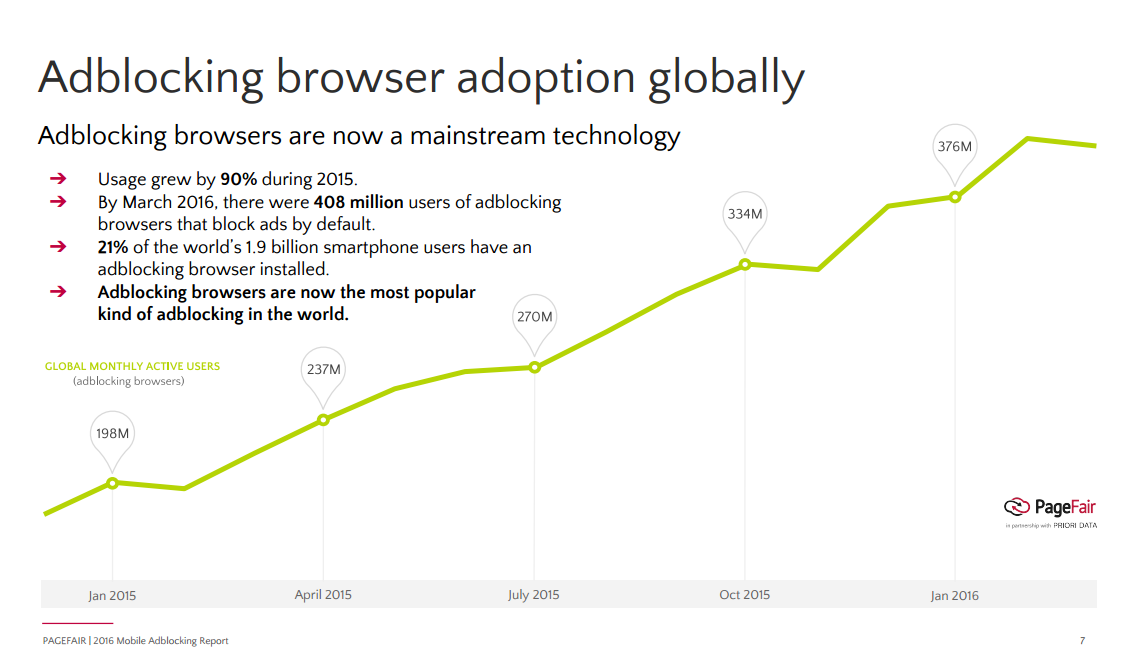
Research from PageFair and Priori Data, which tracked downloads of ad-blocking software from app stores, shows that ad-blocking activity almost doubled in the past year, rising by 90%. More than 415 million people—or about 22% of the world’s smartphone owners—now use ad blockers on their mobile devices, the companies say. Most of those people are using web browsers that block advertising by default.
At the moment, ad blocking appears to be significantly more popular in countries outside of North America and Europe, according to the report. About 36% of users in Asia block mobile advertising, including 159 million people in China, and more than 120 million do so in India. In Europe and North America, however, only 14 million people use ad-blocking software—and only about 2.3 million of those are in the United States.
Is there something about mobile users in North America and Europe that makes them less likely to use ad-blockers? The PageFair report suggests it’s partly because users in Asia pay more for their data and are trying to reduce consumption by any means necessary. Or it could be that North America and Europe are just behind the curve.
Regardless of the answer to that question, North American and European publishers should be careful not to get too complacent about how vulnerable they are to ad-blocking. It’s easy to criticize PageFair’s research because the company sells its services to companies that want to defend themselves against ad-blocking—a report it produced last year was attacked by some for inflating the cost of the phenomenon.
That said, however, there’s no question ad-blocking exists, and it is growing in popularity in many markets. Not only are users downloading software to block ads, but blocking is increasingly becoming a part of the operating system on many devices including the iPhone. Some carriers are even offering ad-blocking as a service—Israeli software provider Shine offers ad-blocking at the cellular network level.
Get Data Sheet, Fortune’s technology newsletter.
Publishers can quibble about the specifics of ad-blocking, and whether PageFair’s numbers are accurate or not. But the fact that it exists at all and appears to be growing should be a wake-up call. In effect, users are telling media companies that their products are broken, and that is never a good thing for an industry in turmoil.
There are two main reasons why most users block ads, especially on mobile. One is that the vast majority of ads slow down websites until they become almost unusable—a problem Facebook offers to solve with its Instant Articles feature, and Google is trying to solve with its Accelerated Mobile Pages project. The second reason is the data tracking that many sites use to keep tabs on who users are.
In Germany, several of the leading news publishers say ad-blocking rates among their readers are as high as 40%—and these are not tech-oriented publications, but mass market newspapers. One of the big reasons people give is the data tracking that media outlets do.
Unfortunately for media companies, that tracking data is often a key part of the deals they have with various ad networks. So the result is that they have terrible advertising that slows down the user experience, and that is combined with surveillance behavior by which many users are irritated. On top of that, mobile advertising rates continue to fall. It’s like a trifecta of disaster if you are a publisher.
Snapchat just raised almost $2 billion in funding. Watch:
What are the advertising and media industries doing about this problem? Media outlets such as the Guardian and New York Times are increasingly trying to convince readers to whitelist their sites through a combination of bullying and cajoling via messages that pop up when the use of ad-blocking software is detected.
Industry groups, meanwhile, are taking a page from the playbook used by the music industry in trying to fight file-sharing—that is to say, they are threatening to sue ad-blocking software companies. Some, including the Newspaper Association of America, are also asking the Federal Trade Commission to intervene because they claim the tactics used by these software providers (such as whitelisting ads from certain companies in return for payment) are unethical.
There have been some attempts by industry groups to promote better advertising methods that are less intrusive. The Interactive Advertising Bureau has an initiative called LEAN, which recommends standards for non-intrusive ads. But it’s not clear how much effect these kinds of marketing efforts are having on actual behavior in the marketplace. In the end, publishers may find out they are too little and too late. In the interim, their complacency will have given Facebook even more power.