One key fact of economic life is that most people who don’t work in capitalist societies don’t make any money. Some social and economic policy wonks have argued, then, that as automation improves our productivity we can afford to pay people a living wage, whether they work or not. This idea is popping up across Europe. Several cities in Holland, beginning with Utrecht, will see what happens when people in a community are simply granted a basic income (about $1,000 per month), effectively breaking the bond that has always existed between income and work. Finland is planning a similar program, and the citizens of Switzerland will vote on a more generous guaranteed basic income (about $2500 per month) next month.
The concept is not a new one (it was discussed, for example, as early as the Nixon administration in the US) but it has picked up support from various quarters as new levels of automation fuel expectations that unprecedented productivity will create more than enough wealth to sustain us all, but it will unfortunately land in only a very few bank accounts – that is, unless government steps in with some extraordinary form of redistribution.
The question, of course, is whether the provision of income with no strings attached will create too much disincentive to work for recipients’ own good and the good of society. Proponents of unconditional income believe the impulse to create value is innate in humans, and if anything is channeled into less socially valuable activities when the point must be to gain payment for one’s work. University of London professor Guy Standing, who coined the term “precariat” to describe a working class increasingly stressed by precarious work arrangements, says that, even more important than a redistribution of wealth, guarantees of basic income would constitute a “redistribution of security.”
Opponents of the idea are much more inclined to think humans are naturally lazy, and if given the opportunity to do nothing for their income, will do exactly that. While such critics are legion, we would put, for example, New York Times columnist David Brooks in this camp. Brooks has written that, as part of a job creation agenda, the government should “reduce its generosity to people who are not working but increase its support for people who are.”
To find out who is right, the Dutch city of Utrecht (in partnership with researchers from the University of Utrecht) has taken the portion of its residents who are already on welfare, and who are currently obliged to fulfill certain requirements to keep receiving it, and divided them into three groups. Some get the income unconditionally, meaning that they are not subject to any rules; indeed, even if they start working at a paying job or otherwise gain income, the monthly disbursements will still be made. The second group is subject to some rules, albeit different ones than the city has today. And the third group, as the experiment’s control group, continues receiving benefits according to current law, which requires them to engage in job-hunting and to lack other sources of income.
The results, as they begin to come in, will be fascinating to see, and we applaud Utrecht (and the other Dutch cities that plan to adopt the program) for its willingness to experiment. But for our part, we feel no strong stake in seeing the unconditional income idea vindicated. There are a couple of reasons for this. Work has value in itself as a way to find meaning in life. As we’ve noted, having a good job is the most desired thing in the world in global polls. Freud said that, “Love and work…work and love, that’s all there is.” Many studies have found that unemployed people are less happy, and that compensating them anyway doesn’t make them as happy as putting them back to work.
How about the idea that unemployed people will resort to creative and recreational activities? Unfortunately, the data don’t bear that out. As Derek Thompson notes in his provocative Atlantic article “A World Without Work,” time studies suggest that people who don’t work tend to sleep more, watch more TV, and browse the Internet. So much for taking up painting.
Even if severing the tie between work and income led to happy people, our perspective is that it is unnecessary to contemplate such drastic redistribution unless you have given up on the possibility of widespread employment in well-paying jobs. If you are convinced, as we are, that human strengths will continue to enable humans to produce economic value, and to be paid for that value, there is no reason to forcibly decouple work from income. Instead, the focus of government action should be on job creation. Without ruling out that some change in the tax structure may be necessary to correct for the “winner take all” effects many predict from further productivity-improving automation, we’re in favor of governments enabling the creation of more meaningful work for their citizens, not requiring less of it.
Why not, for example, fund projects that support more people’s desires to engage in artistic production (as in the WPA Fine Arts Project during the 1930’s US depression)? Most poets, painters, and playwrights today don’t hold steady jobs. Changing that to give them incomes matched to their efforts would seem no more difficult than administering a bureaucracy of handouts – and would yield much surer returns to society. Why not pay people for many of the tasks that are now done on a volunteer basis, for the good of communities? Volunteer service does generally lead to greater happiness. We do believe that the huge gains in productivity will mean we could afford, as a society, to go in either direction. But guaranteed jobs, in our book, still beat guaranteed incomes hands down.
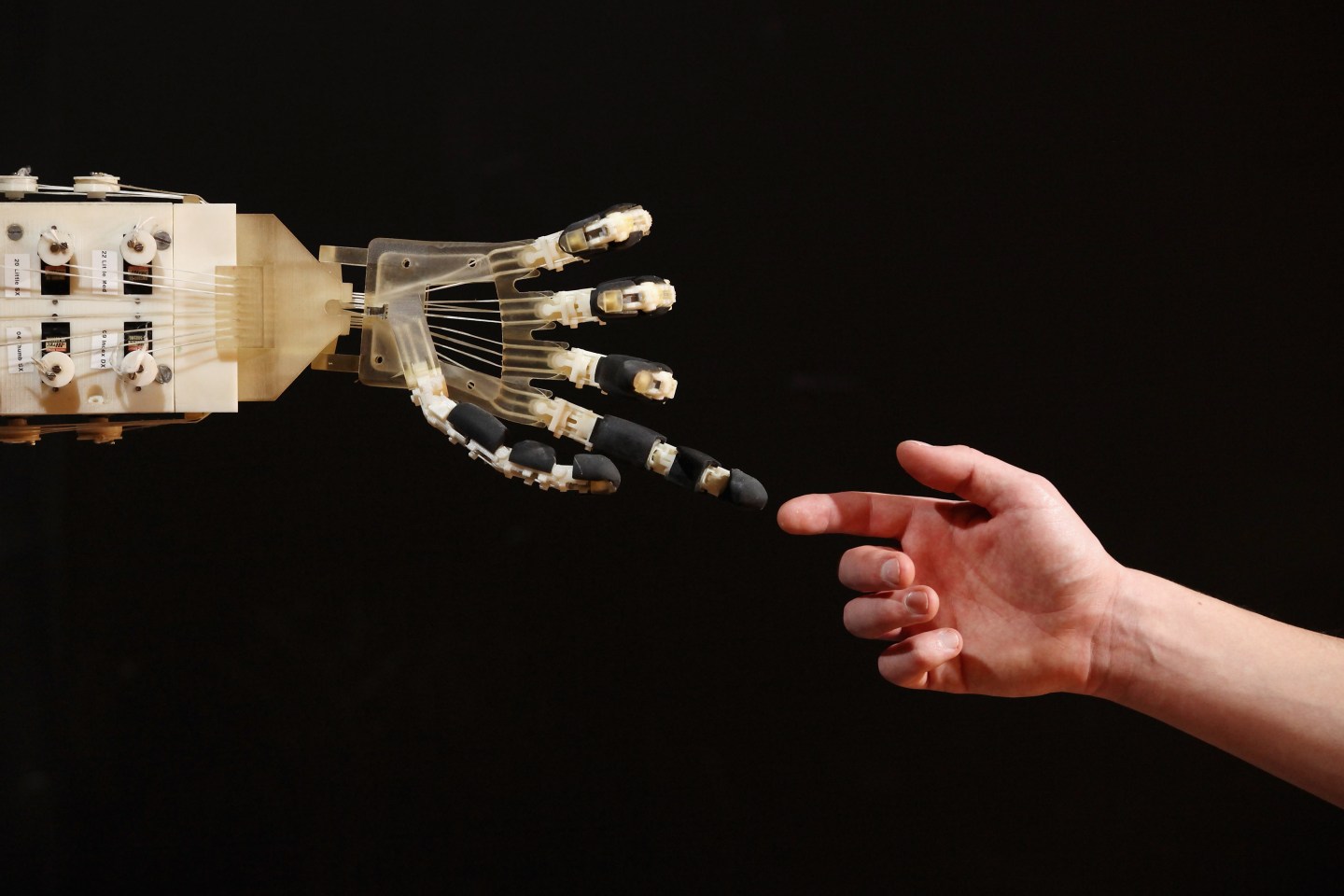
Today, we’re seeing governments and their economic advisors contemplating all these kinds of moves to protect jobs from the onslaught of smart machines. And that is appropriate – all options belong on the table. Our stance, however, would be to encourage them, by their use of any of these tools, to think in terms of human-machine augmentation. They should encourage the creation of jobs that put people in complementary roles with smart machines, and equip them to work in better collaboration with machines in the future. Depression-era programs often improved the employability of workers with government jobs, and this should be true of future programs involving automation or augmentation.
In China’s booming cities today, one often encounters an arresting sight: in front of the construction site of some glistening skyscraper, and amid the crowd of office workers checking smartphones as they bustle along to their business meetings, there is often a worker dressed like a peasant sweeping the street with a straw broom that looks positively medieval. This is make-work, of course, and we summon the image only to mark the absolute antithesis of the job creation we are advocating. Not only is this poor worker performing a task that could be better done by a machine, she is gaining no ability to work in any better capacity by doing it.
In dramatic contrast, look at the set of policies Finland has used to deal with the dislocation of laid-off tech workers after the failure of Nokia. As an article in The New York Times reports, when Nokia started laying off employees in droves, “politicians started providing government grants, entrepreneurship programs and other training to help the thousands of laid-off tech workers start their own companies.” Beyond that, Finland has encouraged other global companies to open offices there to take advantage of this newly available talent pool, and compelled Nokia to do more than it would have otherwise to support its former employees. This help goes far beyond the normal outplacement services. According to the Times, it “includes one-off grants for new business ventures and allowing former employees to use some of the companies’ intellectual property, like unwanted patents, almost free of charge.”
The best strategies, we believe, will equip people with the skills and tools that will enable them to keep creating economic value in an age of extreme automation. Government investment in job creation often gets criticized when it effectively puts policymakers in the position of “picking winners” – but that might not be an issue in this case. As more people become concerned with the “race against the machines,” surely not many will object to a government that picks winners who are human, or at least helps those humans to win.
Tom Davenport and Julia Kirby are authors of Only Humans Need Apply: Winners & Losers in the Age of Smart Machines. Davenport is the president’s distinguished professor in management and information technology at Babson College. Julia Kirby is a senior editor at Harvard University Press and a contributing editor for Harvard Business Review. This an adapted excerpt of their new book.