The financial contributions of star NCAA basketball players to universities are well-documented. According to a recent report from the National College Players Association, the fair market value of a Louisville basketball player in the 2011-2012 season was more than $1.6 million. Syracuse, Duke, and UNC players were all worth nearly $1 million each.
By Lauren Silva Laughlin
By Lauren Silva Laughlin
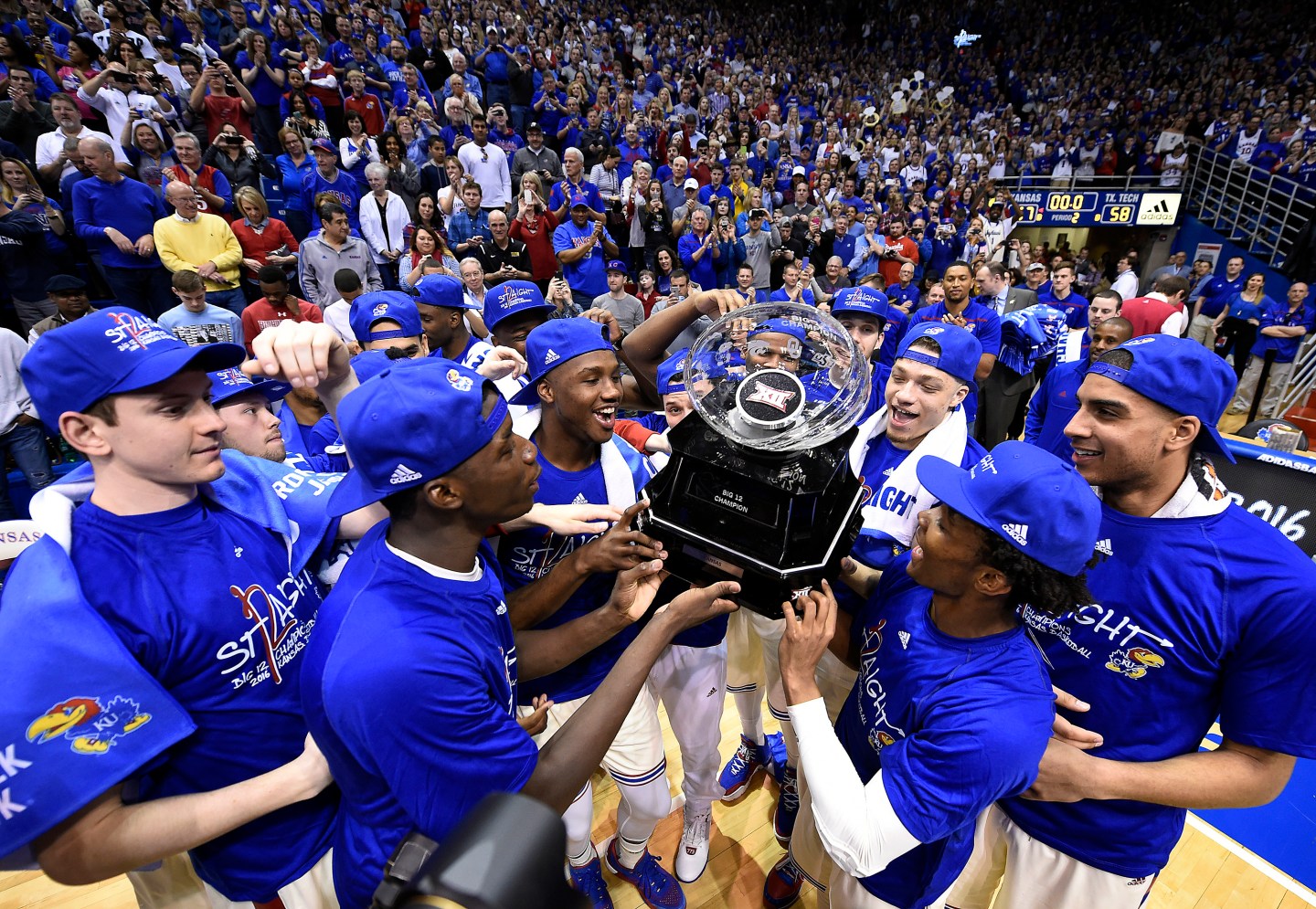
The Kansas Jayhawks celebrate a 12th consecutive Big 12 Conference title with a 67-58 win against Texas Tech on Saturday, Feb. 27, 2016, at Allen Fieldhouse in Lawrence, Kan. (Rich Sugg/Kansas City Star/TNS via Getty Images)Photograph by Rich Sugg —Kansas City Star TNS via Getty Images
About the Author
Latest in





Most Popular




The Fed just ‘Trump-proofed’ itself with a unanimous move to preempt a potential leadership shake-up
By Jason MaDecember 12, 2025
1 day ago

But these lucrative players contribute much more than just to the bottom line. It’s common belief in many athletic circles that, if it weren’t for revenue-generating sports like basketball, others like swimming, lacrosse, and tennis, wouldn’t be funded. Colleges dole out scholarship money fairly between sports to give these “amateur” athletes–the ones who major in something other than their sport, as the NCAA commercial proudly states–an education.
But if this is true, it brings up another inequity. Students from lower socioeconomic standing often fill out rosters on basketball teams. In practice, less-privileged athletes are supporting the scholarships of students who play “country club” sports that favor athletes who come from affluent families. In the debate about fairness in sport, it gives athletes of Olympic sports very little ground to stand on.
Because of legal restrictions, researchers have a hard time pinning down the socioeconomic breakdown of individuals in NCAA athletics. The Family Educational Rights and Privacy Act (FERPA) restricts people from obtaining certain personal financial information at universities. “It makes it difficult to find out and indentify which athletes that may come from privilege and which come from low socioeconomic backgrounds,” says Richard Southall, Director at the College Sport Research Institute at the University of South Carolina.
Nevertheless, there are ways to piece together the socioeconomic disparity between various sports. For example, the NCAA publishes an annual report card that breaks down race in every sport. Though race doesn’t absolutely speak to socioeconomic standing, it can say something about it if you assume the NCAA’s population reflects society over all.
In the 2014-2015 school year, for example, 2.2% of the male athletes who swim at Division 1 schools are black, while more than 80% were white. In lacrosse, 85% of players on the teams, on average, are white. In golf, 71% were white while only 3% were black. Meanwhile, in basketball, only a quarter of the male players are white.
Now consider the average median income per race in the US. African American households, according to the most recent US census data, make around $35,000 a year, about 35% less than the average white household.
When looking at research that shows the socioeconomic breakdown in youth sports, this disparity becomes more drastic. For example, 56% of athletes that play lacrosse come from families that make more than $100,000 a year, according to the Aspen Institute. Only about 4% of the athletes in the sport come from families below the poverty line.
The most affluent category accounts for 43% of the athletes in swimming. About 8% of the athletes who swim are from families that live below the poverty line. In basketball, however, 16% of the athletes who play the sport come from families below the poverty line. Only about a quarter of the young athletes who play the game are from families who make more than $100,000 a year.
Now let’s go back to the example of the Louisville players, for illustrative purposes. If one player is worth $1.6 million to the university, and the cost of tuition at the school is roughly $31,000, a single star basketball player could fund the scholarships of nearly the entire lacrosse team at the average NCAA Division 1 school. Meanwhile only 6% of those lacrosse athletes should be receiving need-based grants, according to financial aid statistics released by the National Center for Education Statistics, if the Aspen Institute household incomes data hold steady through college.
If fairness were a concern, scholarships of sports like swimming and lacrosse should disappear. The trouble with fixing this disparity is two-fold, says Southall. First, disproportionately across athletes, their grant is greater than their market value. So if an athlete plays tennis, for example, “you are going to be quiet because it is a good deal.”
Parents don’t help. “Parents love to talk about their child who is a division 1 scholarship as opposed to be a ‘walk-on,’” he says.
Second, players of the revenue generating sports have a hard time speaking out against their program. “They say to themselves I better stay quiet and the program will take care of me,” Southall says.
But there is another misnomer, according to Ramogi Huma, president of the National College Players Association. “Does it take football and basketball to sustain sports? If so, how does Division 2 and 3 exist? It’s a myth that you need football and basketball to sustain other sports,” he says. Universities like to use this as an excuse to pit athletes against each other. But at universities that have less athletic prominence, “they give hired coaches a full schedule and travel.” In other words, people would probably swim anyway.
Lauren Silva Laughlin is a freelancer for Fortune. She was awarded a full scholarship to the University of North Carolina at Chapel Hill for swimming.